












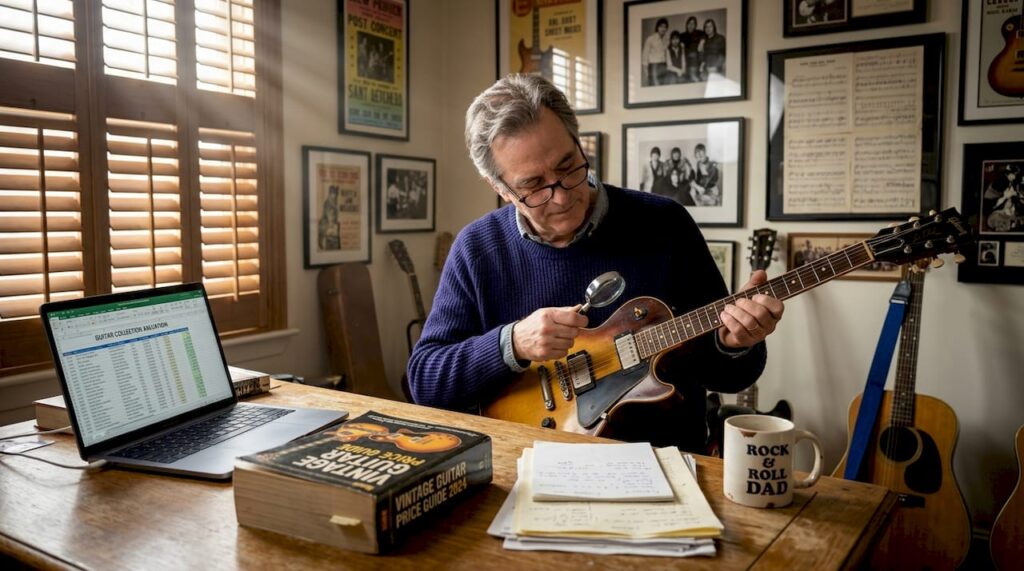

TL;DR:
- Knowing your vintage guitar’s worth in 2026 requires thorough research of authenticity, condition, originality, and market demand. Proper documentation, reliable price guides, and market comparables are essential for an accurate valuation, influenced heavily by model, year, rarity, and provenance. The 2026 market favors electric guitars with strong provenance and originality, but narrative and collector psychology also play crucial roles.
Knowing what your vintage guitar is truly worth in 2026 is not just an academic exercise. Get the number wrong and you risk selling a rare instrument for a fraction of its real value, or overpaying for something that doesn’t deserve the asking price. The collectible guitar market has shifted meaningfully in the past two years, with new pricing dynamics, rising online sales, and a surge of neo-vintage instruments entering the scene. This guide walks you through every stage of the valuation process, so you can approach any assessment with clarity, confidence, and the right tools in hand.
Table of Contents
- What you need before starting your guitar valuation
- Step-by-step: The 2026 guitar valuation workflow
- Key factors influencing guitar values in 2026
- Common mistakes and troubleshooting in guitar valuation
- The real art of guitar valuation in 2026: Beyond the checklist
- Take your next step: Trusted guitar valuation and collecting resources
- Frequently asked questions
Key Takeaways
| Point | Details |
|---|---|
| Originality rules | Maintaining all-original parts is the most critical factor in maximizing your guitar’s collectible value. |
| Provenance premium | Unique history, celebrity ownership, and documentation can raise a guitar’s worth, sometimes even above pristine condition. |
| Market demand shifts | Preferences are cyclical: 2026’s market favors electrics and online sales drive almost half of vintage transactions. |
| Data plus discretion | Use guides and market comps, but holistic judgment and context matter in uncertain or hype-driven markets. |
| Avoid valuation pitfalls | Double-check models, prioritize originality, and beware of relying on outdated price guides or ignoring new trends. |
What you need before starting your guitar valuation
Before diving into the process, you’ll want everything prepared for an efficient and trustworthy valuation. Arriving at a credible number without proper documentation is like navigating without a map. You might end up somewhere, but probably not where you wanted to go.
Documentation and physical materials
Start by gathering everything you know about the instrument. The core factors in any guitar valuation are model, year, originality, condition, rarity, provenance, and market demand. Among these, originality stands paramount; even a single replacement part can reduce value by 10 to 50 percent depending on the piece replaced and the guitar’s overall profile.
Documents and materials to gather:
- Original purchase receipt or bill of sale
- Previous appraisal certificates or insurance valuations
- Service and repair records with dates and technician notes
- Photographs showing the instrument from every angle (headstock, body, interior label, nut, tuners)
- Any correspondence, certificates, or letters confirming ownership history
- Original case, strap, or accessories that accompanied the guitar
Beyond paperwork, you’ll need access to reliable valuation tools. Current price guides like the Vintage Guitar Price Guide (updated annually), online databases such as Reverb.com’s sold listings, and auction records from Christie’s or Bonhams provide real-world pricing context. Cross-referencing at least three sources is considered best practice in 2026.
| Material / Document | Why it matters | Priority |
|---|---|---|
| Serial number records | Confirms year and factory origin | Critical |
| Original parts inventory | Establishes originality percentage | Critical |
| Repair/service logs | Shows modification history | High |
| Provenance letters or photos | Adds historical narrative value | High |
| Original case and accessories | Adds completeness premium | Medium |
| Previous appraisals | Provides valuation history context | Medium |
Pro Tip: Keep a dedicated folder, physical or digital, for each instrument in your collection. Label it with the guitar’s make, model, and approximate year. Store every receipt, repair note, and photograph in chronological order. When valuation time comes, this preparation alone saves hours and helps you project credibility to any buyer, appraiser, or insurer.
For more structured guidance on what appraisers look for, the expert valuation advice section at Vintage Guitar World breaks down professional criteria in detail.
Step-by-step: The 2026 guitar valuation workflow
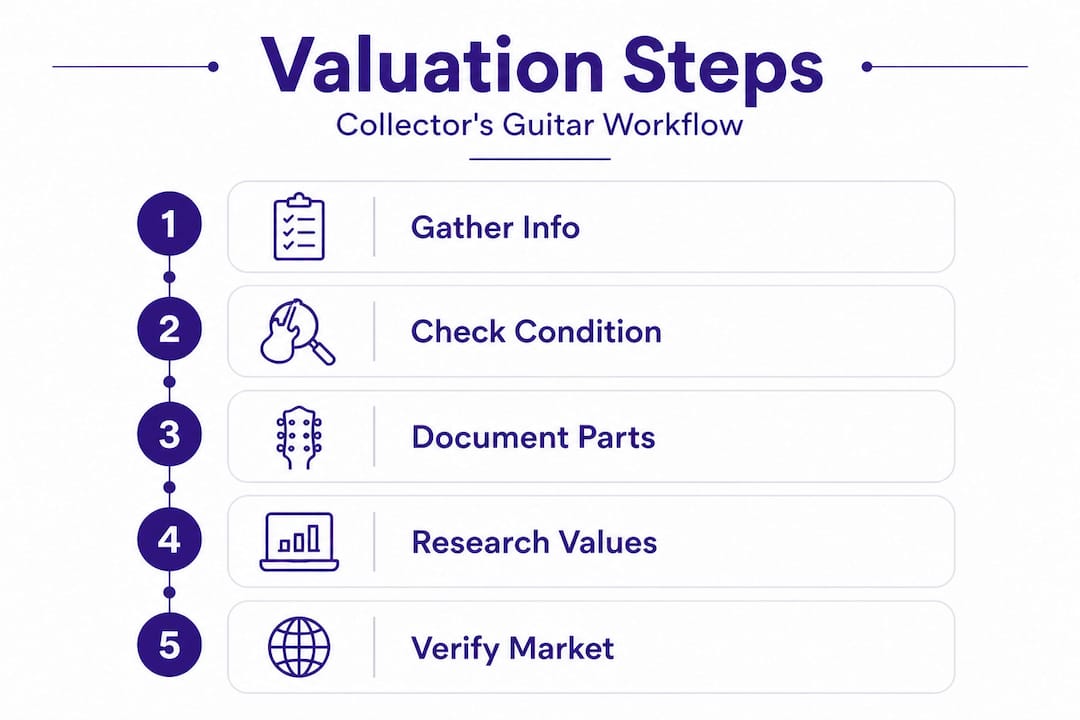
Once your materials are gathered, follow these steps to reach a precise and credible valuation. This workflow reflects current 2026 best practices, incorporating updated grading standards and market data that weren’t as accessible even two years ago.
The six-step process
-
Identify the instrument precisely. Confirm make, model, year of manufacture, and country of origin using the serial number. Cross-reference with manufacturer records, model-specific databases, or specialist forums. A 1959 Gibson Les Paul Standard and a 1960 example can differ by tens of thousands of dollars.
-
Verify authenticity. Examine hardware, finish, wood grain, binding, and electronics against documented specifications for that production year. Inconsistencies in screw types, tuner styles, or pickup covers are red flags. For high-value instruments, consider hiring a certified appraiser or luthier (a trained guitar builder and repairer) for this step.
-
Assess condition thoroughly. Condition grading follows a standard scale where player’s wear is generally acceptable, but cracks, neck repairs, and refinishes (the reapplication of finish to a guitar body) deduct heavily from the final figure. Use a grading scale like Mint, Excellent, Very Good, Good, Fair, and Poor, and document every flaw with a dated photograph.
-
Check for originality. Walk through every component: tuners, nut, bridge, pickups, electronics, finish, and even the strap buttons. Even one part replacement can reduce value by 10 to 50 percent. An all-original 1964 Fender Stratocaster commands dramatically more than the same model with a replaced pickguard or refinished neck.
-
Research market comparables. Search sold listings on Reverb, eBay, and recent auction results. Look for instruments that are as close as possible to yours in year, model, condition grade, and originality status. Three to five comparable sales from the past six months give the most accurate pricing signal.
-
Factor in rarity and current demand. Limited production runs, unique colorways, or regional market editions all affect the premium a guitar commands. The electric vs. acoustic valuation dynamics differ significantly, so make sure you’re using the right market segment for your comparables.
Important: A single non-original part replacement can quietly erase 10 to 50 percent of your instrument’s value, even if the replacement part is high quality. Buyers at the collector level are purchasing history, not just hardware.
Condition and originality impact at a glance
| Guitar status | Approximate value relative to all-original |
|---|---|
| All-original, excellent condition | 100% (baseline) |
| One replaced minor part (e.g., strap button) | 90 to 95% |
| Replaced tuners or pickguard | 70 to 85% |
| Non-original pickup or bridge | 50 to 70% |
| Partial or full refinish | 40 to 60% |
| Multiple replaced parts with refinish | 30 to 50% |
Pro Tip: When photographing your guitar for valuation purposes, shoot the serial number, interior label, headstock logo, nut, tuner buttons, and any unique identifying marks in natural daylight. These close-ups are worth more than a dozen full-body shots because they allow remote appraisers to make confident identifications quickly.

Key factors influencing guitar values in 2026
With the workflow in mind, understand what really impacts the final figure. The market in 2026 is more transparent and more competitive than ever, which means the factors that separate a $4,000 guitar from a $40,000 guitar are more clearly defined and more ruthlessly applied by serious buyers.
The main value drivers
- Model and year: Certain production years are simply worth more. A 1958 to 1960 Gibson Les Paul Standard is considered the holy grail of electric guitars. A 1969 example, while still desirable, sits in a very different price tier.
- Originality: As covered above, this is the single largest variable within your control. Protect every original part.
- Condition: Plays directly into the grade assigned during the assessment phase. Honest self-assessment here is critical.
- Rarity: Limited runs, factory errors that became beloved (like the “Burst” sunburst finish variation), or low production year numbers all push values higher.
- Provenance: Ownership history and documentation. A guitar that passed through the hands of a significant artist or was used on a famous recording carries a substantial premium. Provenance’s effect on value is one of the most underappreciated factors among newer collectors.
- Current market demand: Trends shift. In 2026, interest in certain Japanese-made vintage guitars from the 1970s has climbed steadily, while some previously hyped models have plateaued.
The numbers behind the 2026 market
The market in 2026 consistently favors electric guitars, with electrics representing 52 to 58 percent of collector preference in transactions. Online sales now account for 44 percent of all vintage guitar transactions globally, meaning pricing visibility has increased significantly.
The power of provenance is hard to overstate. A standard Epiphone acoustic that Noel Gallagher used to write and perform “Wonderwall” sold for $96,000, a figure that no condition grade or originality score could justify on its own. The story drove the value. You should check 2026 value trends regularly if you hold guitars as long-term investments, since market sentiment shifts faster than most collectors expect.
Common mistakes and troubleshooting in guitar valuation
Even with thorough steps, errors can still creep in. Here are the most frequent and expensive mistakes collectors make, along with practical ways to catch and correct them.
The top five valuation errors
-
Misidentifying the model or production year. Serial number databases are not always definitive. Fender, for example, had overlapping serial number sequences across production years in the 1970s. Always cross-reference with multiple sources and physical dating clues like pot codes (the date-coded stamps on potentiometers inside the guitar).
-
Underestimating the impact of replaced parts. Many sellers assume that a “correct spec” replacement part is equivalent to the original. It isn’t. Collector buyers at the premium level care deeply about whether parts are factory-installed, not just period-correct.
-
Neglecting provenance research. If you acquired your guitar at an estate sale or from a private seller, there may be a documented history you simply haven’t uncovered yet. A few hours of research can occasionally unearth a genuinely value-changing story.
-
Relying on outdated price guides. A price guide from 2022 or 2023 will not accurately reflect 2026 market conditions. The 2026 investment trends show a neo-vintage revival alongside corrections in some previously hyped categories, meaning older guide prices can be significantly off in both directions.
-
Ignoring current buyer behavior. What sells quickly and at a premium in 2026 is driven partly by generational taste shifts. Younger collectors are increasingly drawn to instruments from the 1980s and 1990s that their musical heroes played. Ignoring current guitar trends in favor of historical prestige alone can lead to overestimates.
Market reality check: The 2026 trend analysis points to a neo-vintage revival and steady appreciation for established trophy pieces, but also corrections for instruments whose values were driven primarily by hype rather than scarcity or genuine collector demand. Diversifying your collection across categories reduces exposure to any single trend reversal.
Pro Tip: To double-verify a valuation that seems too high or too low, search completed sales on Reverb and eBay using exact model and year keywords, then filter results to sold listings from the past 90 days. If you find three to five comparable sales clustering near a specific price point, that cluster is your most reliable market signal. If your appraised value sits far outside the cluster, request a reassessment with the comparable data in hand.
The real art of guitar valuation in 2026: Beyond the checklist
Having covered process and pitfalls, let’s take a step back and look at the bigger, often less quantifiable, picture.
We work with collectors who follow every step correctly, assemble perfect documentation, and still walk away uncertain about whether they landed on the right number. That uncertainty is not a failure of process. It’s a feature of a market that is partly rational and partly driven by narrative, nostalgia, and collector psychology.
A checklist can tell you that a guitar is all-original and in excellent condition. It cannot tell you whether the broader market is currently in a buying mood, whether a particular model is about to benefit from a documentary, a reunion tour, or a viral YouTube performance that reignites demand. These narrative catalysts are real and measurable in hindsight. They are very hard to predict in advance.
The collectors who consistently make smart decisions at auction or in private sales tend to be people who treat their valuation as a starting point for a conversation, not a final verdict. They know their data, but they also know the room. They understand that a guitar being sold to another collector for personal enjoyment carries different pricing dynamics than the same guitar being offered to a dealer looking to resell it at a markup.
Our strong recommendation is to use the systematic process outlined in this guide as your foundation, then layer in current market context by monitoring active listings, following collector communities, and watching long-term trends over time. For any instrument valued above $5,000, consult a specialist before committing to a sale price or purchase offer. The cost of that consultation is almost always less than the potential error.
Take your next step: Trusted guitar valuation and collecting resources
Ready to apply or validate your valuation? Here’s how to get reliable support.
Vintage Guitar World offers a full suite of resources built specifically for collectors navigating the 2026 market. Whether you’re assessing a single instrument or managing a broader collection, the detailed valuation explained guide walks through every technical and market consideration in depth.

For collectors who want a professional eye on their specific instrument, the expert advice for collectors service connects you directly with specialists who understand both the historical and market dimensions of vintage guitar pricing. If you want a clear, repeatable process you can use independently, the workflow step-by-step guide provides a detailed, printable framework you can use for every guitar in your collection going forward. Start there, and reach out when you need a second opinion.
Frequently asked questions
What is the most important factor in valuing a vintage guitar in 2026?
Originality is the single most critical factor; even one replaced part can reduce value by 10 to 50 percent, making it the highest-stakes variable in any collector-level assessment.
How do online sales impact guitar valuations today?
Online sales represent 44 percent of all vintage guitar transactions, which has significantly improved pricing transparency and made real-time market comparables accessible to any collector with an internet connection.
Can famous ownership or history increase my guitar’s value?
Absolutely. High-profile provenance can override condition concerns entirely and push a guitar’s price far beyond what its physical specifications would suggest, as demonstrated by instruments tied to celebrated artists selling for multiples of their spec-based value.
What’s the biggest market trend in 2026 for collectible guitars?
The neo-vintage revival is the dominant story, with traditional trophy pieces continuing to appreciate steadily while guitars whose values were inflated by recent hype are experiencing corrections.