












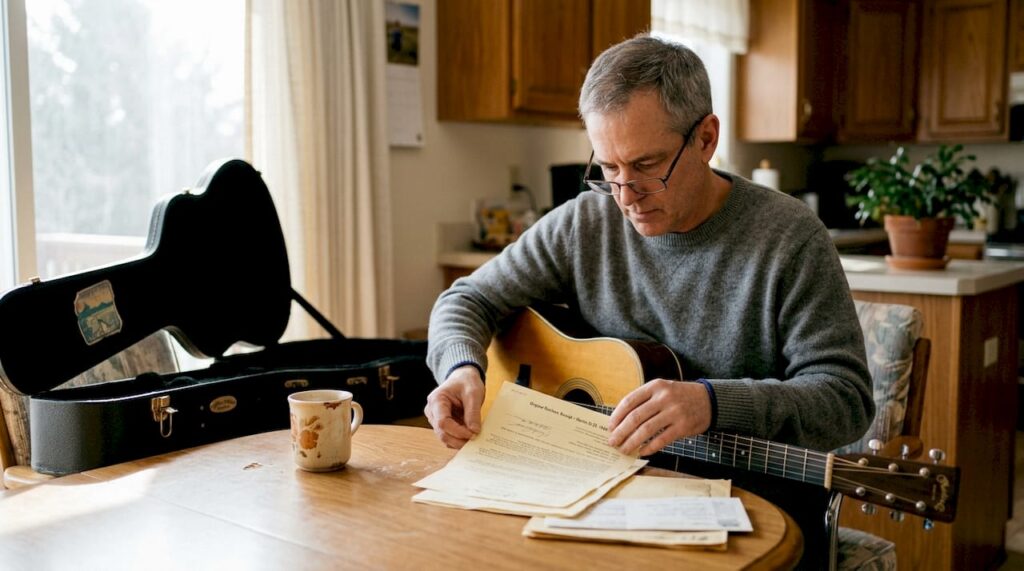

Many collectors assume provenance is just about a guitar’s age or visual appeal. In reality, guitar provenance transforms an instrument into a verifiable historical artifact by documenting its ownership, origin, and authenticity. This comprehensive chain of evidence protects you from counterfeits and can boost a vintage guitar’s value by 30 to 50 percent. Understanding how to establish, verify, and leverage provenance separates informed collectors from those vulnerable to fraud. This guide walks you through every step of building robust provenance documentation.
Table of Contents
- Key takeaways
- What is guitar provenance and why it matters
- Sources and records that establish guitar provenance
- Distinguishing provenance from authenticity and how to build provenance
- Applying provenance knowledge: protecting collectors and maximizing value
- Explore vintage guitars and master provenance
- How can I verify the provenance of a vintage guitar?
Key Takeaways
| Point | Details |
|---|---|
| Provenance confirms history | A complete documented history of ownership, origin, and authenticity turns a guitar into a verifiable artifact. |
| Manufacturer records matter | Factory records and serial data help verify dates and original specifications when available. |
| Evidence supports provenance | Spectrometer analysis and other tests provide objective proof of production era and detect refinishes. |
| Value rises with provenance | Documented provenance can raise prices and improve buyer confidence during resale. |
| Build with records and experts | Start capturing receipts, serials, photos, and expert assessments from the moment you acquire a guitar. |
What is guitar provenance and why it matters
Guitar provenance refers to the complete documented history of an instrument, including manufacturing details, ownership transfers, restoration work, and performance history. Unlike simple age verification, provenance establishes an unbroken narrative that proves a guitar’s legitimacy and historical significance. A 1959 Les Paul without provenance might sell for $200,000, while the same model with documented ownership by a famous musician could command $500,000 or more.
This documentation elevates guitars from functional instruments to cultural artifacts. When you can trace a Martin D-28 from its 1937 factory shipment through three generations of bluegrass musicians, you own a piece of musical history rather than just vintage wood and metal. Provenance answers critical questions: Was this guitar made when the label claims? Did it pass through notable hands? Has it been modified or restored?
The financial impact is substantial. Research shows documented provenance increases prices by 30-50%, protecting buyers from sophisticated counterfeits while giving sellers leverage in negotiations. For collectors, provenance serves as insurance against fraud and enhances long-term investment value.
Consider these provenance benefits:
- Verification of manufacturing date and specifications
- Protection against increasingly sophisticated forgeries
- Documentation of famous previous owners or performances
- Record of professional restorations and modifications
- Enhanced resale value and buyer confidence
Pro Tip: Start building provenance the moment you acquire a guitar. Photograph serial numbers, document the purchase with receipts, and record any verbal history from the seller. These initial records become the foundation of your provenance file.
“A guitar without provenance is like a painting without a signature. You might love it, but you can never truly know its story or prove its worth to others.”
Sources and records that establish guitar provenance
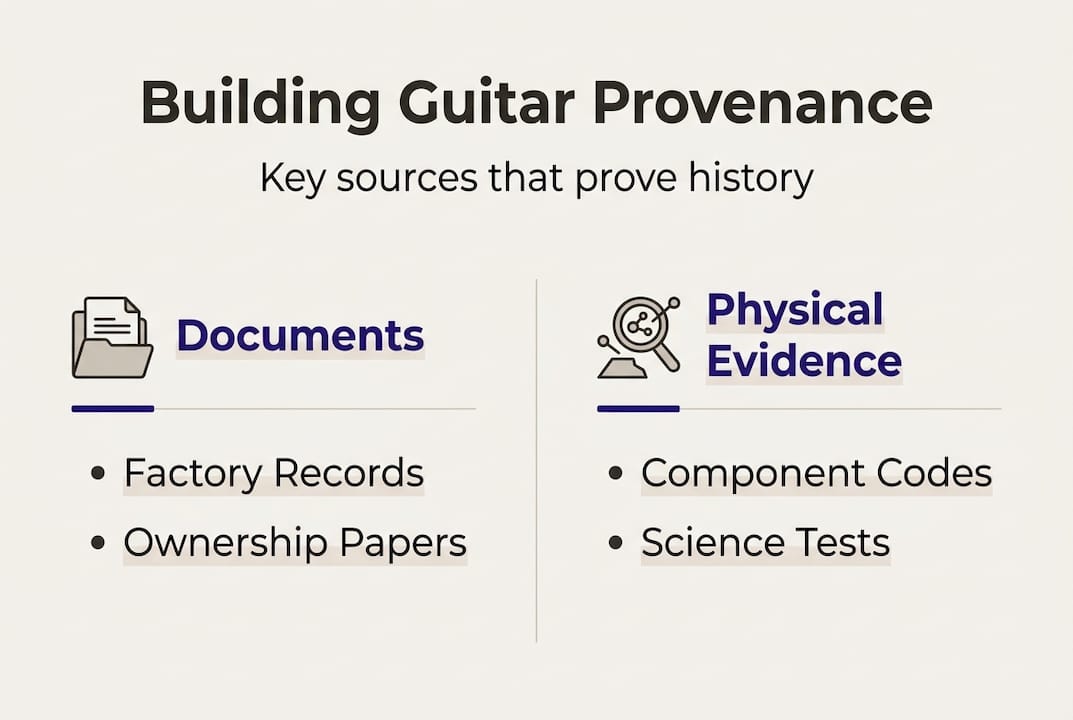
Establishing provenance requires multiple evidence streams that corroborate each other. Manufacturer records form the foundation, though availability varies dramatically by brand. Gibson maintains partial logbooks with gaps in coverage, Fender kept virtually no records before the 1980s, while Martin has preserved shipping logs and serial numbers dating to 1898. These archives can confirm production dates and original specifications when accessible.
Beyond factory records, physical components provide supporting evidence. Potentiometer date codes stamped on electronics reveal manufacturing periods, while side dot materials and binding styles correspond to specific production eras. Original cases with matching serial numbers strengthen provenance claims, as do sales receipts, warranty cards, and repair shop documentation. Each piece of evidence adds credibility to the overall narrative.
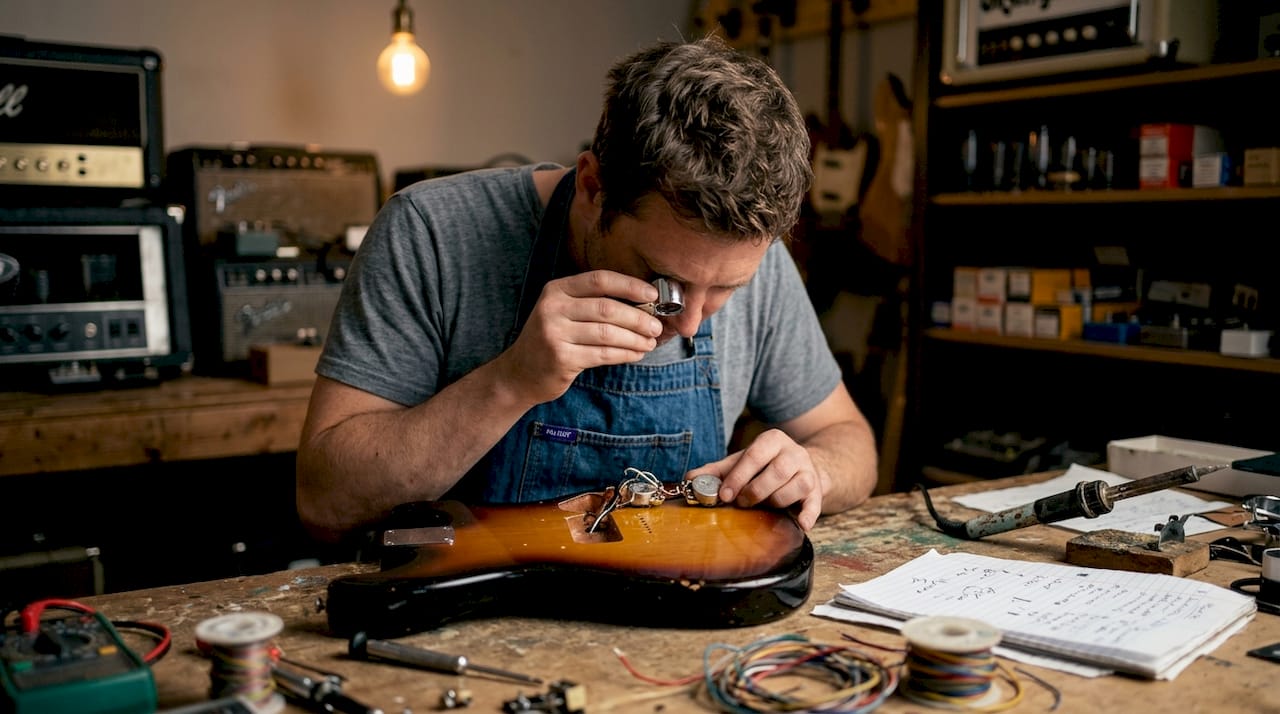
Modern science has revolutionized authentication. Vintage Verified uses spectrometers to analyze lacquer composition and pigment chemistry, creating chemical fingerprints that confirm production periods. These non-invasive tests detect refinishes and replacement parts invisible to visual inspection, providing objective data that complements documentary evidence.
Expert evaluation remains essential. Multiple specialists examining a guitar independently reduces bias and catches details individual inspectors might miss. Professional authenticators use detailed checklists covering construction methods, hardware evolution, and period-correct materials. Their reports become part of the provenance file, adding credibility through recognized expertise.
| Evidence Type | Reliability | Availability | Cost |
|---|---|---|---|
| Manufacturer archives | High | Variable by brand | Free to $100 |
| Component date codes | Medium | Always present | Free with knowledge |
| Scientific testing | Very High | Growing network | $200 to $500 |
| Expert authentication | High | Widely available | $150 to $400 |
| Original documentation | Very High | Rare on older guitars | N/A |
Combining these sources creates robust provenance. A 1960 Stratocaster with matching pot codes, Vintage Verified analysis confirming original nitrocellulose, and expert authentication forms a far stronger case than any single evidence type alone. Cross-reference every claim and seek multiple validators to build unassailable documentation.
Pro Tip: When researching manufacturer records, contact brand historians directly rather than relying on dealer claims. Gibson and Martin maintain archives accessible to owners, while independent researchers have compiled Fender production data from shipping records and employee interviews.
For comprehensive authentication frameworks, explore our vintage guitar authenticity guide and collector authentication methods. Before purchasing, review our testing protocols to understand evaluation standards.
Distinguishing provenance from authenticity and how to build provenance
Collectors often confuse provenance with authenticity, but these concepts serve different purposes. Authenticity examines physical originality through wood grain patterns, wear characteristics, and component matching. Provenance documents ownership history and contextual significance through paper trails and testimonials. A guitar can be 100% authentic in construction yet lack provenance, or have excellent provenance documentation despite period-correct repairs.
These elements complement rather than replace each other. Authenticity confirms a guitar matches its claimed specifications, while provenance explains how it reached your hands. Together, they create complete verification. A refinished 1958 Les Paul might fail strict authenticity standards but retain strong provenance if documentation traces the refinish to a specific repair shop in 1975.
Building comprehensive provenance requires systematic documentation:
- Gather all existing records including purchase receipts, previous owner contacts, and repair histories
- Photograph the guitar completely, capturing serial numbers, labels, and distinctive wear patterns
- Research manufacturer archives using serial numbers and model specifications
- Consult period catalogs and advertisements to verify original features
- Obtain expert authentication reports from multiple recognized specialists
- Interview previous owners to record oral histories and performance contexts
- Compile everything chronologically in a dedicated provenance file with digital backups
- Update documentation after any restoration work or ownership transfers
The chronological approach proves critical. Organize evidence by date to reveal the guitar’s journey through time. A 1965 Gretsch Country Gentleman’s provenance might start with factory shipping records, continue through a 1972 repair receipt, include a 1985 magazine article featuring the guitar, and conclude with your purchase documentation.
Value considerations require nuance. While provenance adds 15-25% premiums, condition remains the primary value driver. A mint 1963 Jazzmaster with minimal provenance typically outvalues a heavily played example with celebrity ownership. Provenance amplifies rather than creates value, with the greatest impact on already desirable instruments.
Common pitfalls undermine provenance efforts:
- Accepting dealer stories without independent verification
- Overlooking gaps in ownership history that raise authenticity questions
- Failing to document modifications and assuming originality equals value
- Relying on single expert opinions rather than multiple validations
- Neglecting to preserve digital copies of physical documentation
Pro Tip: Create a provenance timeline document that maps every known event in your guitar’s history. Include question marks for uncertain periods and actively research those gaps. This visual representation reveals where additional documentation would strengthen your case and guides future research efforts.
Apply these principles using our comprehensive provenance guide and vintage guitar buying checklist to avoid costly mistakes.
Applying provenance knowledge: protecting collectors and maximizing value
Robust provenance documentation serves as your primary defense against counterfeit guitars flooding the vintage market. As reproduction techniques grow more sophisticated, provenance reduces counterfeit risk by 60% by requiring forgers to fabricate entire ownership histories rather than just physical features. A fake 1964 Telecaster might fool visual inspection, but creating decades of supporting documentation proves nearly impossible.
This protection extends beyond obvious forgeries to subtler misrepresentations. Sellers might genuinely believe a 1970s guitar dates to the 1960s based on visual similarities. Provenance research reveals the truth through serial number verification and component dating, preventing expensive mistakes. For buyers, demanding comprehensive provenance shifts burden of proof to sellers and creates negotiating leverage.
The confidence factor transforms transactions. Buyers pay premium prices when provenance eliminates uncertainty about authenticity and history. Sellers with strong documentation close deals faster and command higher prices than comparable guitars lacking verification. This mutual confidence reduces transaction friction and supports healthy market dynamics.
Validating provenance claims requires systematic evaluation:
- Verify manufacturer records independently rather than trusting seller summaries
- Cross-reference serial numbers against known production data and anomaly reports
- Examine documentation for consistency in dates, names, and technical details
- Request contact information for previous owners to confirm transfer stories
- Consult multiple authentication services for consensus opinions
- Research any claimed celebrity connections through performance records and photographs
- Check repair shop documentation against business records and craftsman reputations
Market impact data illustrates provenance value:
| Provenance Level | Average Premium | Counterfeit Risk | Sale Timeline |
|---|---|---|---|
| No documentation | Baseline | High | 6-12 months |
| Basic records | 15-20% | Medium | 3-6 months |
| Comprehensive file | 30-50% | Very Low | 1-3 months |
| Celebrity ownership | 100-300% | Minimal | Days to weeks |
These premiums reflect reduced buyer risk and enhanced historical significance. A well-documented instrument offers investment security that undocumented guitars cannot match, regardless of physical condition. Savvy collectors prioritize provenance when building portfolios, knowing documentation preserves and enhances value over time.
Negotiation leverage flows from provenance strength. When selling, comprehensive documentation justifies premium pricing and deflects lowball offers. When buying, absence of provenance supports price reduction requests and creates opportunity to build documentation yourself. Understanding these dynamics positions you advantageously on either side of transactions.
Pro Tip: Before major purchases, invest in pre-purchase authentication from independent experts. The $300 to $500 cost proves trivial compared to discovering a $50,000 guitar is actually a $5,000 reproduction. Make authentication contingent on satisfactory results to protect yourself.
Deepen your collecting expertise with our 2026 vintage guitar collecting guide and authentication security practices.
Explore vintage guitars and master provenance
Now that you understand how provenance protects your investments and maximizes value, put this knowledge into practice. Vintage Guitar World offers curated collections where every instrument comes with detailed provenance documentation and expert authentication. Our specialists have assembled comprehensive histories for each guitar, providing the verification serious collectors demand.
Explore our guide to types of vintage guitars to understand how provenance requirements vary across classical, flamenco, acoustic, and electric instruments. Each category presents unique documentation challenges and opportunities.

Ready to acquire your next piece? Our expert buying guide walks you through evaluation frameworks that integrate provenance with condition assessment and market analysis. Once you own a vintage instrument, our acoustic guitar restoration guide helps preserve both playability and provenance value through proper conservation techniques.
How can I verify the provenance of a vintage guitar?
What methods verify guitar provenance most effectively?
Combine manufacturer archive research with expert authentication and scientific testing. Cross-reference serial numbers against production records, obtain multiple specialist evaluations, and consider spectrometric analysis for high-value instruments. Our authenticity verification guide details systematic validation protocols.
Which manufacturer records should I check first?
Start with serial number databases specific to your guitar’s brand. Martin maintains comprehensive shipping logs since 1898, Gibson offers partial archive access, and independent researchers have compiled Fender data from various sources. Contact brand historians directly for archive queries rather than relying on third-party summaries.
How does scientific testing support provenance validation?
Spectrometric analysis examines lacquer chemistry and wood composition to confirm production periods and detect refinishes. These non-invasive tests provide objective data that complements visual inspection and documentary evidence. Vintage Verified and similar services create chemical fingerprints that reveal manufacturing era with high accuracy.
What are common challenges in confirming provenance?
Incomplete manufacturer records, lost documentation from previous owners, and gaps in ownership history create verification obstacles. Pre-1970s guitars often lack comprehensive factory data, while instruments changing hands multiple times may lose paper trails. Systematic research and expert consultation help bridge these gaps.
Where can I find resources to build guitar provenance?
Manufacturer archives, vintage guitar forums, authentication services, and specialist dealers provide essential resources. Our collector authentication guide compiles expert validation methods and documentation strategies to strengthen your provenance files systematically.