














Choosing a vintage guitar can feel overwhelming. You face countless factors like craftsmanship quality, tonal character, condition assessment, and market value. This guide clarifies the key criteria you need to evaluate vintage guitars confidently. You’ll learn how to assess craftsmanship, understand unique tonal qualities, recognize historical significance, evaluate investment potential, and anticipate maintenance needs. Whether you’re a professional seeking superior tone or a collector building a portfolio, these insights simplify your decision.
Table of Contents
- How to Choose a Vintage Guitar: Key Selection Criteria
- Craftsmanship and Historical Significance of Vintage Guitars
- Tonal Characteristics Unique to Vintage Guitars
- Comparison with Modern Guitars: What Sets Vintage Apart?
- Investment Potential of Vintage Guitars
- Summary Comparison Table of Vintage Guitar Benefits
- Situational Recommendations: Choosing Vintage Guitars for Different Buyers
- Explore Premium Vintage Guitars and Expert Buying Guides
- Frequently Asked Questions About Vintage Guitars
Key Takeaways
| Point | Details |
|---|---|
| Definition and Criteria | Vintage guitars are typically 30+ years old, valued for superior craftsmanship and unique tonal qualities from aged materials. |
| Tonal Uniqueness | Aging wood loses roughly 10% density, creating warmer, richer resonance that modern guitars rarely match. |
| Historical Value | Iconic models associated with legendary musicians command premium prices and cultural significance. |
| Investment Potential | Rare models like the 1958-59 Gibson Explorer reach $1.35 million in 2026, but require expert authentication. |
| Maintenance Needs | Vintage guitars demand specialized care and climate control to preserve value and playability. |
How to Choose a Vintage Guitar: Key Selection Criteria
Selecting the right vintage guitar starts with understanding what makes an instrument truly vintage. Vintage guitars are typically defined as those made at least 30 years ago, meaning instruments from 1996 or earlier qualify in 2026. These guitars often embody superior craftsmanship through hand-selected premium materials and construction methods that modern mass production rarely replicates.
You’ll encounter three primary categories when shopping vintage: electric, acoustic, and classical guitars. The U.S. market shows strong preference for electrics, with 58% of guitar sales being electric guitars in 2026. This statistic reflects sustained interest in vintage electric models from iconic makers like Gibson, Fender, and Gretsch.
Authenticity and condition determine whether you’re getting genuine value. Learn to check vintage guitar authenticity through serial numbers, construction details, and maker marks. Original components, finish integrity, and structural soundness directly impact both playability and resale value.
Market factors also shape availability and pricing. Consider these practical criteria:
- Provenance documentation proving ownership history and original specifications
- Physical condition including fret wear, neck stability, and finish originality
- Tonal character matching your musical style and performance needs
- Price alignment with current market benchmarks for similar models
- Availability of replacement parts and qualified repair technicians
Before committing to any purchase, test vintage guitars for quality and value in person whenever possible. If buying remotely, request detailed photos, sound samples, and professional setup reports. Taking time to evaluate a used vintage guitar thoroughly prevents costly mistakes and ensures you acquire an instrument that meets your standards.
Craftsmanship and Historical Significance of Vintage Guitars
Post-WWII guitar makers developed handcrafted methods that produced instruments of exceptional quality. Skilled luthiers selected premium tonewoods, shaped necks individually, and assembled guitars with attention to detail that modern assembly lines cannot match. This human element created subtle variations that give each vintage guitar its unique personality.
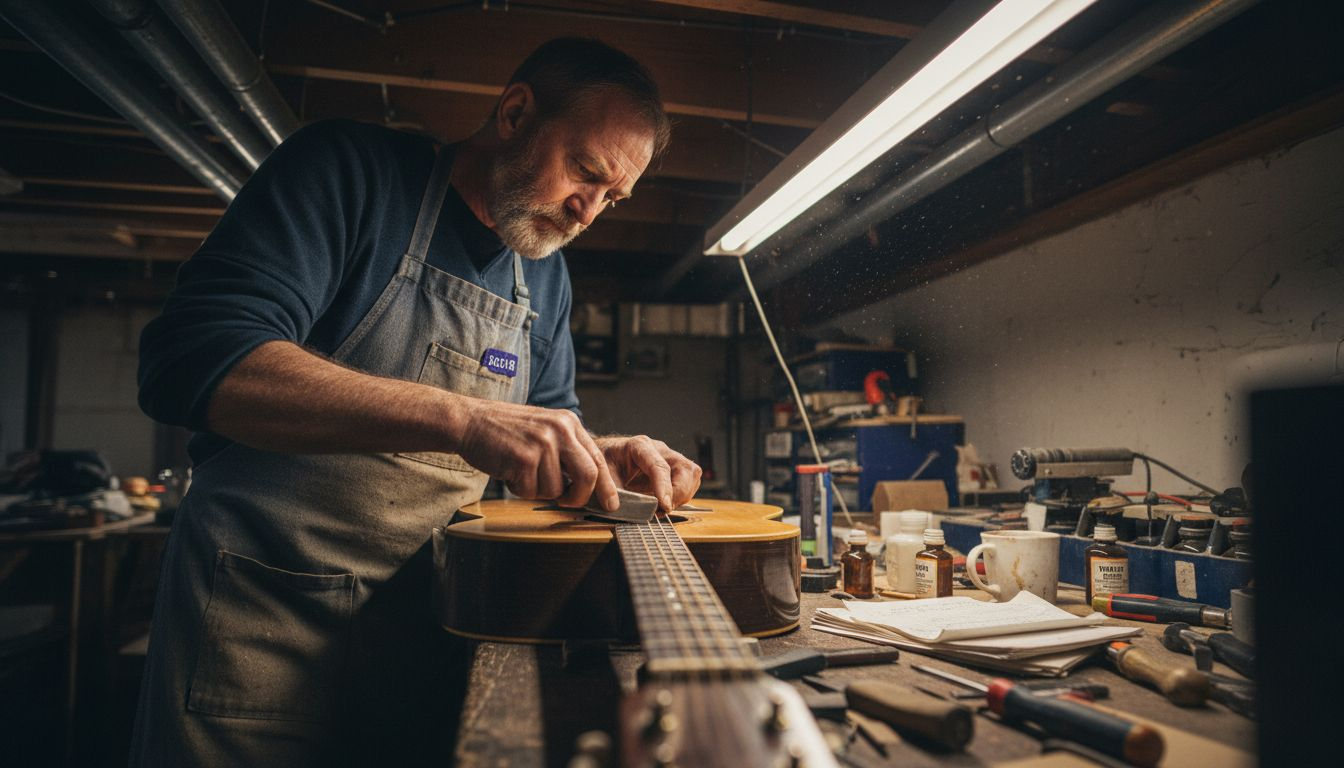
Premium materials distinguished vintage construction from contemporary alternatives. Brazilian rosewood, used extensively before trade restrictions, offered unmatched tonal complexity and visual beauty. Honduran mahogany necks provided stability and warmth. Sitka spruce tops aged into responsive soundboards that modern kiln-dried wood takes decades to replicate.
Historical significance, exemplified by iconic models associated with famous musicians, substantially increases value and cultural desirability. A 1959 Gibson Les Paul Standard commands premium prices partly because players like Jimmy Page and Eric Clapton made that model legendary. The guitar’s story matters as much as its specifications.
Craftsmanship directly affects playability and tonal character:
- Hand-carved necks offering unique feel and playing comfort
- Nitrocellulose finishes allowing wood to breathe and resonate freely
- Hide glue joints creating superior acoustic coupling between components
- Wax-potted pickups delivering vintage output and harmonic complexity
“The guitars built in the 1950s and 1960s represent a golden era when makers perfected designs that remain unsurpassed. Each instrument carries the signature of its builder’s hands and the cultural moment of its creation.”
Legendary makers like Leo Fender, Ted McCarty at Gibson, and the Martin family established construction standards that defined entire genres. Their innovations in electric guitar design, acoustic bracing patterns, and tonal engineering created templates still studied today. When you invest in their work, you acquire not just an instrument but a piece of musical history.
Professionals particularly value this heritage. Following buying tips for professionals helps you identify instruments where craftsmanship and history converge to create truly exceptional playing experiences.
Tonal Characteristics Unique to Vintage Guitars
Aging fundamentally transforms wood at the molecular level. Wood aging results in a roughly 10% density reduction through moisture loss and lignin breakdown. This physical change allows wood fibers to vibrate more freely, producing warmer and richer resonance that new guitars rarely achieve.
Tonal complexity develops gradually as wood cells crystallize and resin hardens. A 50-year-old spruce top responds to string vibration with nuanced overtones that younger wood cannot generate. The fundamental note remains strong while harmonic content becomes more sophisticated and musical. Players describe this quality as “openness” or “bloom” that makes vintage acoustics particularly satisfying.
Vintage electric guitars benefit from aged pickups and electronics equally. Original PAF humbuckers from the late 1950s sound markedly different from modern reproductions because their AlNiCo magnets have partially demagnetized and their coil wire has oxidized. These changes create output characteristics with reduced treble harshness and enhanced midrange warmth.
Follow this process to evaluate vintage tone properly:
- Play the guitar acoustically first to assess fundamental resonance and sustain.
- Test plugged tone across clean and overdriven settings to hear harmonic response.
- Compare directly with similar modern models to identify tonal differences.
- Record short samples to review objectively without showroom pressure.
- Consider how the tone fits your musical style and performance context.
Modern guitars typically emphasize clarity and consistency through controlled manufacturing. Vintage instruments trade some predictability for organic complexity and character. Neither approach is objectively superior; your preference depends on musical priorities and aesthetic values.
Pro Tip: When you cannot play an instrument in person, request high-quality audio recordings captured with professional microphones. Phone videos rarely convey true tonal character, especially subtle resonance qualities that distinguish exceptional vintage guitars.
Understanding these tonal differences helps you test vintage guitars tonal qualities effectively and make informed choices aligned with your sound goals.
Comparison with Modern Guitars: What Sets Vintage Apart?
Construction methods represent the clearest division between vintage and modern instruments. Vintage guitars emerged from small workshops where craftsmen shaped components individually. Modern production employs CNC machinery, laser cutting, and computer-aided design to achieve unprecedented consistency and precision. Each approach offers distinct advantages.
| Aspect | Vintage Guitars | Modern Guitars |
|---|---|---|
| Construction | Hand-crafted with individual variation | CNC precision with tight tolerances |
| Materials | Premium aged woods, often restricted species | Sustainable alternatives, engineered stability |
| Tone | Warm, complex, organic character | Clear, consistent, predictable response |
| Durability | Variable; depends on maintenance history | Engineered for stability and longevity |
| Value | Appreciates with rarity and condition | Depreciates initially, stabilizes later |
Durability and maintenance needs differ substantially. Vintage guitars require climate control, specialized setup knowledge, and sometimes hard-to-find replacement parts. Modern instruments use stable composite materials, standard components, and finishes resistant to environmental damage. You’ll spend more time and money maintaining vintage guitars, but many players consider this worthwhile for their unique qualities.
Market perceptions shape buying decisions beyond objective specifications. Collectors view vintage guitars as cultural artifacts with investment potential. Players seeking reliable tools for recording and touring often prefer modern alternatives with manufacturer warranties and consistent performance.
Modern guitars benefit from improved manufacturing precision and durability, but vintage guitars hold iconic status and unique tonal character that many players prefer. Norman Harris, owner of Norman’s Rare Guitars, acknowledges that contemporary makers now produce some of their best work in decades. Yet vintage instruments retain advantages in organic tone and historical significance.
Consider these factors when choosing:
- Performance context: studio, stage, or collection display
- Maintenance capacity: time, budget, and access to qualified technicians
- Tonal priorities: vintage warmth versus modern clarity
- Investment goals: appreciation potential versus playing utility
“Modern manufacturing has reached impressive quality levels, but vintage guitars offer something beyond specifications: the sound of aged wood, the feel of decades of playing, and the connection to musical history that new instruments cannot replicate.”
You can test and compare vintage and modern guitars side by side to determine which characteristics matter most for your needs. Neither category is universally superior; the right choice depends on your specific priorities and circumstances.
Investment Potential of Vintage Guitars
Vintage guitar values have appreciated dramatically over recent decades. High-value iconic models such as the 1958-59 Gibson Explorer can command prices up to $1.35 million in 2026, reflecting extreme rarity and sustained collector demand. Understanding what drives these valuations helps you make informed investment decisions.
Provenance documentation establishes authenticity and ownership history that directly impact value. Original sales receipts, factory shipping records, and professional appraisals create confidence for serious buyers. Guitars with celebrity ownership or recording session documentation command premium prices beyond their specifications alone.
Current price benchmarks for investment-grade models include:
| Model | Year | Condition | 2026 Price Range |
|---|---|---|---|
| Gibson Explorer | 1958-59 | Excellent Original | $800K – $1.35M |
| Gibson Les Paul Standard | 1959 | All Original | $400K – $600K |
| Fender Stratocaster | 1954 | Excellent | $60K – $100K |
| Martin D-45 | 1939 | Very Good | $150K – $250K |
Original condition matters enormously for investment value. Refinished guitars, replaced pickups, modified electronics, or structural repairs reduce worth substantially. Collectors pay premium prices for completely original instruments with minimal wear and all factory components intact.
Market trends show cyclical fluctuations influenced by economic conditions, collector demographics, and cultural factors. Historical significance increasing vintage guitar value remains consistent, but specific model popularity shifts over time. Staying informed about vintage guitar market trends 2026 helps you time purchases and sales strategically.
Restoration and maintenance present investment challenges. Professional work preserves playability but often reduces collectible value unless executed invisibly. You must balance playing enjoyment against preservation of originality. Some investors never play their guitars, storing them as purely financial assets.
Expert appraisal and certification provide essential protection for significant investments. Professional evaluators identify refinishes, replaced parts, and structural issues that affect value. Certification from recognized authorities increases resale confidence and potentially qualifies instruments for insurance coverage.
Pro Tip: Before investing substantial money in vintage guitars, consult specialists who can value collectible guitars accurately based on current market conditions. Their expertise prevents overpaying and identifies opportunities others miss.
Investment carries risks including market volatility, authentication challenges, and maintenance costs. Diversification across multiple instruments, makers, and eras reduces exposure to any single market segment. Treating vintage guitars as long-term holdings rather than short-term trades typically produces better returns.
Summary Comparison Table of Vintage Guitar Benefits
This consolidated table captures the essential advantages vintage guitars offer across five critical evaluation categories:
| Benefit Category | Key Advantages | Examples |
|---|---|---|
| Craftsmanship | Hand-selected premium woods; individual luthier attention; techniques lost to modern production | Brazilian rosewood backs; hand-carved necks; hide glue construction |
| Tonal Uniqueness | 10% wood density reduction; organic harmonic complexity; aged pickup characteristics | Warmer midrange; enhanced sustain; vintage PAF output |
| Historical Significance | Association with legendary musicians; cultural importance; documented provenance | Les Paul Standards from 1959; Clapton’s Blackie; pre-CBS Fenders |
| Investment Value | Appreciation potential; rarity premium; collector demand | Explorer prices reaching $1.35M; market trend stability |
| Maintenance Considerations | Specialized care requirements; climate sensitivity; parts availability challenges | Neck reset needs; finish checking; truss rod limitations |
Each category presents trade-offs you must evaluate against your priorities. Craftsmanship and tone appeal primarily to players seeking superior musical performance. Historical significance matters most to collectors building culturally important portfolios. Investment value attracts buyers treating guitars as alternative assets.
Maintenance considerations affect all ownership categories. You cannot enjoy vintage guitar benefits without accepting responsibility for proper care. Climate-controlled storage, humidity monitoring, and periodic professional setup keep these instruments performing optimally.
Understanding these benefits holistically helps you identify which vintage guitars align with your goals. A professional touring musician prioritizes different factors than a collector focused on appreciation potential. Neither approach is wrong; clarity about your objectives guides better decisions.
Situational Recommendations: Choosing Vintage Guitars for Different Buyers
Professional musicians seeking superior tone and playability should target mid-1950s Gibson Les Paul Standards or Fender Stratocasters from the same era. These instruments offer the aged wood resonance and pickup characteristics that define classic recorded tones. Their proven reliability on stage and in studio makes them practical working tools, not just collectibles.
Collectors pursuing investment and rarity value should focus on extremely limited-run models like 1958-59 Gibson Explorers, Flying Vs, or pre-war Martin dreadnoughts. These guitars appreciate consistently because supply remains fixed while demand grows. Prioritize all-original examples with documented provenance, even if asking prices seem extreme. Their scarcity justifies premium positioning.
Hobbyists balancing playability with budget constraints find excellent value in late 1960s through 1970s vintage guitars with documented professional restoration. These instruments offer genuine vintage character at more accessible prices. A 1968 Gibson ES-335 or 1972 Fender Telecaster provides authentic vintage experience without six-figure investment.
History-focused buyers should research specific makers, factories, and time periods that interest them culturally. A 1930s Gibson archtop connects you to jazz heritage. A 1964 pre-CBS Fender represents the final year before corporate acquisition. Matching instruments to historical moments you value personally increases ownership satisfaction beyond pure specifications.
Consider these priority alignments:
- Tone seekers: Emphasize playability, setup quality, and acoustic/electric character matching your style
- Investors: Demand documentation, original condition, and expert authentication before purchase
- Players: Balance vintage character with practical maintenance needs and parts availability
- Collectors: Focus on rarity, provenance, and cultural significance over playing condition
Budgeting for ownership extends beyond purchase price. Set aside funds for professional setup, climate control equipment, insurance coverage, and periodic maintenance. Vintage guitars cost more to own properly than initial acquisition suggests.
Pro Tip: Review a comprehensive checklist for buying vintage guitars before committing to any purchase. This systematic approach prevents overlooking critical factors that affect value, playability, and long-term satisfaction.
Your specific situation determines the right vintage guitar choice. Clarifying priorities before shopping focuses your search and prevents impulse purchases you later regret. Take time to match instrument characteristics with your actual needs rather than chasing models simply because others covet them.
Explore Premium Vintage Guitars and Expert Buying Guides
Vintage Guitar World provides comprehensive resources supporting confident vintage guitar acquisition and ownership. Our expert guide for collectors covers authentication, valuation, and market analysis in depth. You’ll find practical advice for every experience level.
Our detailed 7-point checklist for buying vintage guitars ensures you evaluate critical factors before committing to purchases. This systematic approach protects your investment and increases satisfaction with acquired instruments.

Explore our curated selection when you’re ready to shop premium vintage guitars backed by expert evaluation and certification. Each instrument undergoes rigorous assessment for authenticity, condition, and value. We stand behind every guitar we offer, providing the confidence serious collectors and players demand.
Frequently Asked Questions About Vintage Guitars
What defines a guitar as vintage?
A guitar typically qualifies as vintage when it reaches 30 years of age, meaning instruments from 1996 or earlier in 2026. However, true vintage status also considers the maker’s reputation, construction quality, and historical significance beyond just age.
How can I verify a vintage guitar’s authenticity?
Authentication requires examining serial numbers, construction details, wood species, hardware specifications, and finish characteristics against known factory standards. Professional appraisers use ultraviolet light, wood analysis, and detailed measurement to identify refinishes, replaced components, or fraudulent reproductions.
Do vintage guitars always sound better than modern ones?
Vintage guitars offer different tonal characteristics, not objectively superior sound. Aged wood produces warmer, more complex resonance that many players prefer, while modern guitars deliver clarity and consistency. Your musical style and personal preferences determine which sounds better for your needs.
What maintenance challenges should a vintage guitar owner expect?
Vintage guitars require climate-controlled storage maintaining 45-50% humidity, periodic neck adjustments as wood continues aging, specialized setup knowledge respecting original specifications, and sometimes difficult sourcing of period-correct replacement parts. Budget both time and money for proper ongoing care.
Is investing in vintage guitars risky?
Vintage guitar investment carries market volatility risk, authentication challenges, condition deterioration concerns, and liquidity limitations compared to traditional securities. However, rare models from respected makers have appreciated consistently over decades. Diversification, expert guidance, and long-term holding reduce risk substantially.