














TL;DR:
- Following a structured guitar resale workflow helps sellers avoid underpricing, disputes, and losses. Accurate condition grading, thorough documentation, targeted platform use, and disciplined negotiation maximize profit and efficiency. Patience and transparency build buyer trust, while careful packing and data tracking improve long-term success.
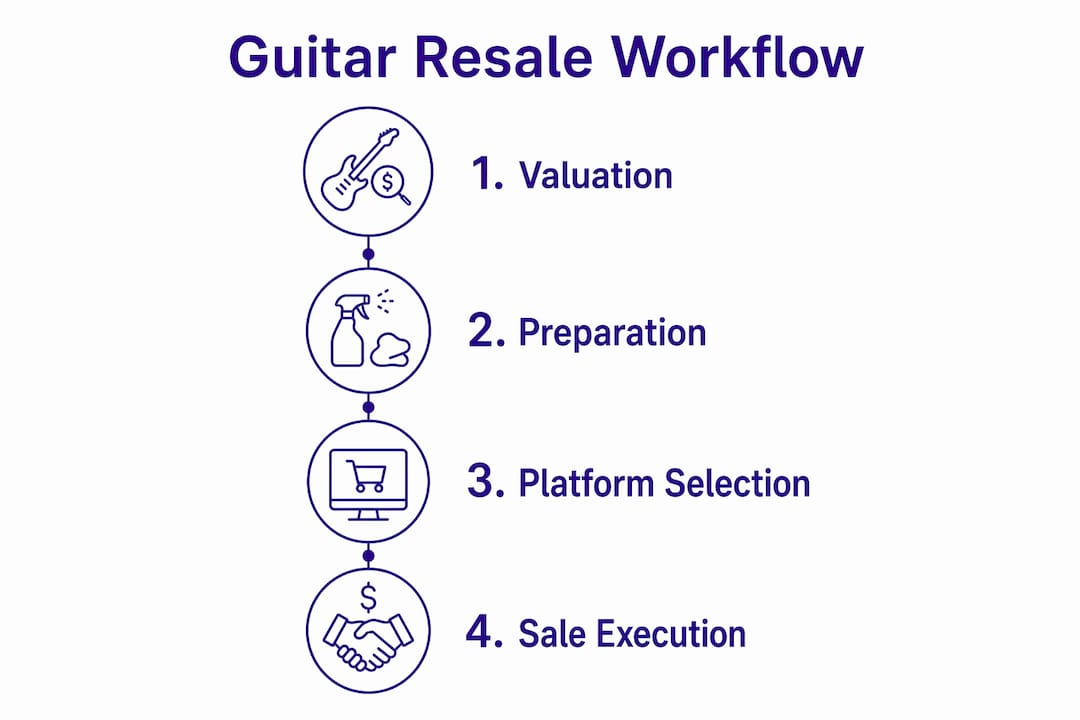
A workflow for professional guitar resale is the structured sequence of steps that takes a guitar from your hands to a buyer’s, at the right price, with minimal friction. Without a defined process, sellers routinely underprice instruments, lose buyer trust through incomplete listings, or absorb losses from shipping damage. The industry standard for this process covers four core stages: accurate valuation using condition grading, thorough preparation and documentation, platform selection, and professional sale execution. Sellers who follow each stage consistently close faster, earn more, and generate fewer disputes. Vintage-guitar-world applies this exact framework across its curated inventory of rare and professional instruments.
What does a workflow for professional guitar resale look like?
A professional guitar resale workflow is not a single action. It is a repeatable system built on four sequential stages that compound in value when done correctly.

The four stages are valuation, preparation, platform selection, and sale execution. Each stage feeds the next. A weak valuation produces a bad listing price. A bad listing price attracts the wrong buyers. Wrong buyers generate lowball offers and disputes. Getting the sequence right from the start prevents every downstream problem.
Sellers who treat resale as a one-off transaction rather than a repeatable process consistently leave money on the table. The goal of a structured guitar sales strategy is to make every sale predictable, not just profitable.
How to accurately value professional guitars for resale
Condition grading is the foundation of every accurate guitar valuation. The standard four-tier system assigns resale value as a percentage of original retail price: mint condition guitars fetch 70–85%, excellent condition 40–50%, good condition 30–40%, and fair condition 20–35% of retail price. That range is wide, which is exactly why grading matters before you set any price.
| Condition | Resale Value (% of Retail) | Typical Characteristics |
|---|---|---|
| Mint | 70–85% | No play wear, original parts, original case |
| Excellent | 40–50% | Minor surface marks, fully functional, complete |
| Good | 30–40% | Visible wear, possible minor repairs, playable |
| Fair | 20–35% | Heavy wear, missing parts, needs setup or repair |
Research completed sales prices, not asking prices. Asking prices reflect seller optimism. Completed sales reflect what buyers actually paid. That distinction alone can shift your pricing by 15–20% in either direction.
Factor in every cost before you finalize a number. Cleaning and setup costs must be included in your valuation math. A professional setup on a vintage acoustic can run $60–$100. That cost reduces your net return if you price without accounting for it. Vintage instruments require special care: cleaning improves perceived value, but over-restoring a vintage piece can actually reduce its collector appeal and price.
Documenting flaws, modifications, and serial numbers is the strongest protection against buyer disputes. A buyer who receives exactly what the listing described has no grounds for a complaint. Transparency in your valuation documentation also signals professionalism, which attracts serious buyers and discourages lowball offers.
Pro Tip: Use the guitar appraisal process as a cross-check on your self-assessed condition grade. A second opinion from a qualified appraiser often catches modifications or originality issues that change the value tier entirely.
Preparing professional guitars for resale: cleaning, documentation, and presentation
Preparation is where most sellers either build or destroy perceived value. A well-prepared guitar sells faster and at a higher price. A poorly presented one, regardless of quality, attracts skepticism and low offers.
Cleaning and physical condition
Clean the instrument thoroughly before photographing or listing it. Remove fret grime, polish the body, and condition the fretboard. For vintage guitars, use products appropriate to the finish type. Nitrocellulose lacquer reacts badly to many modern polishes. A clean guitar photographs better and signals to buyers that the seller cares about the instrument.
Do not over-restore. Refinishing a vintage guitar or replacing original hardware to make it look “new” removes the patina that collectors pay a premium for. The goal is clean and honest, not artificially pristine.
Documentation and accessories
Gather every original item that came with the guitar: the case, strap, tools, hang tags, certificates, and receipts. Original cases alone can add meaningful value to a vintage instrument. List every accessory explicitly in the listing. Buyers notice when sellers are thorough, and completeness reduces the “what am I actually getting?” anxiety that kills deals.
Use the collector’s condition guide to build a written condition report before you list. A written report forces you to examine every detail systematically, which produces a more accurate description and a stronger listing.
Photography and video
- Shoot 12–15 photos minimum in natural or daylight-balanced artificial light
- Cover the front, back, headstock, fretboard, nut, bridge, pickups, control cavity, and any flaws
- Photograph every scratch, ding, or modification at close range
- Record a short video demonstrating the guitar’s tone and playability
- Show the serial number clearly in at least one photo
Pro Tip: Shoot flaw photos against a contrasting background. A light scratch on a sunburst finish disappears in a photo taken against a dark background. Buyers who discover undisclosed flaws on arrival will dispute the sale. Show everything.
Packing for shipping
Professional packing protocol requires loosening the strings to relieve neck tension, padding the headstock heavily, and double-boxing the instrument. The headstock is the most vulnerable point on any guitar in transit. A cracked headstock on a vintage instrument can reduce value by 30–50% and triggers immediate buyer disputes. Use at least two inches of foam or bubble wrap on all sides inside the inner box, then place that box inside a larger outer box with additional padding.
What platforms work best for selling guitars online?
Platform selection is a financial decision, not just a convenience choice. Each channel carries different fee structures, audience quality, and sale speed trade-offs.
Music-focused platforms attract serious buyers who understand instrument value. Total fees on these platforms typically run 8–9% of the sale price. That lower fee, combined with a buyer base that already understands what they are looking for, produces faster sales and fewer lowball offers compared to general marketplaces.
General marketplaces offer massive reach but charge higher fees, typically 6.35–13.25% depending on category and seller tier. Use an eBay fee calculator before listing to model your actual net return after fees. The broader audience also means more buyers who do not understand instrument value, which increases the volume of lowball offers and uninformed questions.
| Sales Channel | Typical Fee Range | Audience Quality | Sale Speed |
|---|---|---|---|
| Music-focused platforms | 8–9% total | High (serious buyers) | Fast |
| General marketplaces | 6.35–13.25% | Mixed | Moderate |
| Local shops (consignment) | 15–25% commission | Moderate | Slow to moderate |
| Large retailers (buyout) | 30–50% below market | N/A | Immediate |
Selling to large retailers yields 30–50% less than market value. That is a significant discount. The trade-off is immediate cash and zero effort on listing, photography, or shipping. For sellers who prioritize speed over return, it is a legitimate option. For sellers who want maximum profit, it is the worst choice.
The most effective multi-platform strategy starts with music-focused platforms for the first 2–3 weeks. If the guitar remains unsold, expand to general marketplaces to capture a wider audience. This sequence maximizes your chance of reaching a serious buyer first, before absorbing higher fees on a broader platform.
- List on music-focused platforms first for targeted reach
- Expand to general marketplaces after 2–3 weeks without a sale
- Use local consignment for instruments that are difficult to ship safely
- Reserve retailer buyouts for situations where speed outweighs profit
How to execute the sale: negotiation, communication, and shipping
Negotiation follows a clear tactical framework for professional sellers. Accept offers within 10% of asking price quickly. Counter offers 10–20% below asking with a firm middle-ground number. Decline offers 30% or more below asking without extended negotiation. This framework protects your minimum acceptable price while keeping serious buyers engaged.
Communication standards
Respond to buyer inquiries within 24 hours. Slow responses signal disorganization and give buyers time to find another seller. Answer every question directly, even if the answer is already in the listing. Buyers who feel heard and respected close faster and leave better feedback.
Be transparent about condition details in every message. If a buyer asks about a specific flaw, describe it precisely. Vague answers create doubt. Doubt kills deals.
Numbered steps for managing multiple offers
- Log every offer with the buyer’s username, offer amount, and timestamp
- Respond to the highest offer first within your negotiation framework
- Hold lower offers without declining until the top offer resolves
- If the top offer falls through, move to the next in sequence
- Never accept two offers simultaneously on the same instrument
Pro Tip: Read the negotiation guide for collectible guitars before setting your floor price. Knowing your absolute minimum before any offer arrives removes emotion from the negotiation entirely.
Return policy and shipping insurance
State your return policy explicitly in every listing. A clear “no returns except for item not as described” policy protects you while remaining fair to buyers. Purchase shipping insurance for every guitar valued above $200. The cost is minimal relative to the risk. A damaged guitar without insurance coverage results in a full refund out of your pocket, plus the cost of the damaged instrument.
Key Takeaways
A successful guitar resale process requires accurate condition grading, thorough documentation, platform-matched listing strategy, and disciplined negotiation to protect both profit and buyer trust.
| Point | Details |
|---|---|
| Condition grading sets price | Use the mint-to-fair scale to price guitars at 20–85% of retail before listing. |
| Documentation prevents disputes | Record flaws, modifications, and serial numbers in every listing to protect against buyer conflicts. |
| Platform choice affects net return | Music-focused platforms charge 8–9% total fees and attract more serious buyers than general marketplaces. |
| Professional packing is non-negotiable | Loosen strings, pad the headstock, and double-box every guitar to prevent transit damage. |
| Negotiation needs a floor price | Set your minimum acceptable price before any offer arrives to remove emotion from the process. |
What I’ve learned from watching sellers get this wrong
The most common mistake in guitar resale is not underpricing. It is skipping documentation. Sellers who list a guitar with three photos and a one-line description are not saving time. They are generating buyer questions, lowball offers, and post-sale disputes that cost far more time than a thorough listing would have.
The second mistake is platform impatience. Sellers who move to general marketplaces after three days on a music-focused platform are not being strategic. They are paying higher fees to reach lower-quality buyers because they could not wait two weeks. Patience on the right platform consistently outperforms urgency on the wrong one.
Transparency is not just an ethical standard. It is a financial one. Buyers who receive exactly what they expected leave positive feedback, return for future purchases, and refer other buyers. Buyers who feel misled do the opposite, loudly. The sellers who build the strongest resale businesses are the ones who treat every listing as a permanent record of their reputation.
The data from completed sales is the most underused tool in this entire process. Sellers who track what actually sold, at what price, on which platform, and in what condition, build a pricing model that gets sharper with every transaction. That data is free. Most sellers ignore it entirely.
— Vintage
Where Vintage-guitar-world fits into your resale research
Sellers who understand what makes an instrument genuinely valuable price with confidence and attract better buyers. Vintage-guitar-world provides the reference depth to build that understanding.

The types of vintage guitars guide covers the features, history, and investment characteristics of the instruments most commonly traded in the professional resale market. For sellers working with handcrafted or rare instruments, the guitar valuation workflow walks through the appraisal process step by step. Vintage-guitar-world’s catalog and educational resources give sellers the context to present instruments accurately, price them correctly, and close with confidence.
FAQ
What is the first step in a guitar resale workflow?
Accurate condition grading is the first step. Assign a grade of mint, excellent, good, or fair before setting any price, since condition directly determines resale value as a percentage of original retail.
How do I price a used guitar for resale?
Price based on condition grade and completed sales data, not asking prices. Mint guitars sell for 70–85% of retail; fair condition instruments typically sell for 20–35%.
Which platform is best for selling guitars online?
Music-focused platforms are the best starting point for selling guitars online. They charge lower total fees (around 8–9%) and attract buyers who already understand instrument value, which reduces lowball offers and speeds up sales.
How should I pack a guitar for shipping?
Loosen the strings to relieve neck tension, pad the headstock heavily, and place the guitar in a well-padded inner box inside a larger outer box. Purchase shipping insurance for any guitar valued above $200.
How do I handle lowball offers professionally?
Accept offers within 10% of asking price quickly, counter offers 10–20% below with a firm middle number, and decline offers 30% or more below asking. Set your floor price before any offer arrives to keep negotiations unemotional.