














TL;DR:
- Guitar certification involves formal assessments of technical skills and musicianship through structured graded exams or professional credentials. These programs, like RCM, ABRSM, and Trinity, evaluate repertoire, technique, sight-reading, aural skills, and theory, supporting balanced skill development. Certification documents a musician’s performance level and provides recognition for academic, professional, or licensing purposes, but differs entirely from vintage instrument authentication.
Guitar certification is the formal process by which a musician’s technical proficiency and musicianship are evaluated through standardized graded exams or professional credential programs. These structured assessments span multiple levels, from beginner grades through advanced diplomas such as the Associate (ARCT) designation, and they serve musicians, teachers, and collectors in distinct ways. Understanding what guitar certification means, and what it does not mean, saves you time, money, and confusion whether you are preparing for a university audition or authenticating a vintage instrument.
What is guitar certification, and why does it matter?

Guitar certification is a formal skill assessment that evaluates a musician’s technical proficiency and musicality across progressive levels, from Preparatory or Grade 1 through advanced diplomas. Programs like the Royal Conservatory of Music (RCM), the Associated Board of the Royal Schools of Music (ABRSM), and Trinity College London each use structured graded frameworks, typically spanning 10 levels plus diploma tiers. The Baltimore Classical Guitar Society, for example, offers 1–15 evaluation levels with a $35 registration fee per assessment. That range signals how seriously the field treats incremental skill development.
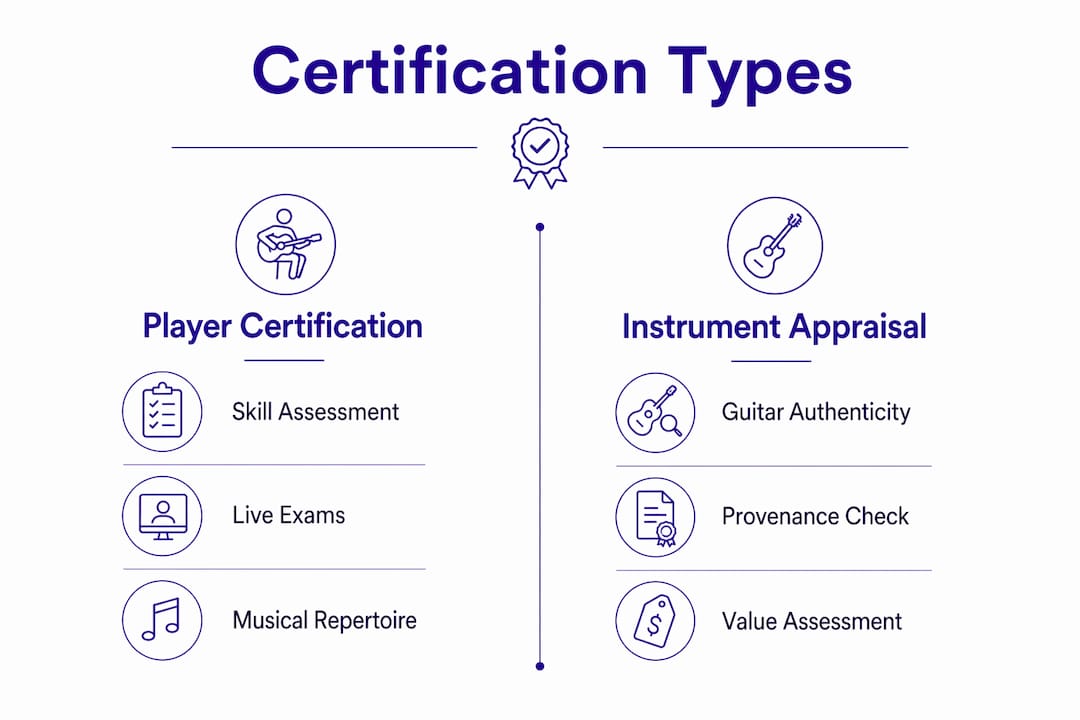
The term “guitar certification” covers two distinct concepts that often get conflated. The first is player certification, which measures a musician’s performance skills, theory knowledge, and musicianship. The second is instrument certification, which involves authenticating a guitar’s provenance, age, and value. This article addresses both, because collectors and musicians frequently search for the same term with very different needs in mind.
What are the main types of guitar certification programs?
The guitar certification process divides cleanly into two categories: graded performance exams and professional teaching credentials. Knowing which type fits your goal is the first decision you need to make.
Graded performance exam programs include:
- RCM (Royal Conservatory of Music): Grades 1–10 plus the Associate diploma (ARCT). Widely recognized by North American university music programs.
- ABRSM: Grades 1–8 plus three diploma levels (DipABRSM, LRSM, FRSM). Globally recognized, with exams available in over 90 countries.
- Trinity College London: Grades 1–8 plus performance diplomas. Accepts both live and video submission formats.
- Baltimore Classical Guitar Society: A 1–15 level system with structured repertoire requirements and a $35 per evaluation fee.
Professional teaching certificate programs serve a different purpose. Institutions like AIMM (Atlanta Institute of Music and Media) require formal application processes including auditions and transcript submissions. The Music Teachers National Association (MTNA) and the Registry of Guitar Tutors (RGT) offer teaching credentials that establish recognized pedagogical standards. These programs teach technique, pedagogy, and evaluation methods, functioning more like vocational education than performance exams.
The format of assessment also varies. Some programs require a live jury exam before a panel of adjudicators. Others, like Trinity, accept video submissions, which expands access for students in remote areas. Registration and membership conditions apply to most programs, so check requirements well before your target exam date.
What does the guitar certification process involve?
The guitar certification process tests a defined set of skills at each grade level. Understanding what examiners evaluate helps you prepare efficiently rather than just logging practice hours.
- Repertoire. You perform a set number of pieces from a prescribed list, typically three to four works spanning different styles and periods. Higher grades demand greater technical complexity and interpretive depth.
- Technique. Scales, arpeggios, and etudes are tested separately from repertoire. At Grade 5 and above in most systems, technical demands increase sharply. Many students underestimate how much disciplined daily practice of scales and arpeggios is required at advanced levels.
- Sight-reading. You receive an unseen passage and perform it in real time. This skill is frequently neglected during informal practice, which is exactly why certification programs formalize it.
- Aural skills. Examiners test your ability to identify intervals, rhythms, and melodic patterns by ear. This component rewards consistent ear training over months, not last-minute cramming.
- Music theory. Written theory components accompany most graded systems from Grade 5 onward. RCM, for instance, requires co-requisite theory exams at higher levels.
- Musicianship and interpretation. At diploma level, examiners assess phrasing, dynamics, and stylistic understanding, not just technical accuracy.
Advanced certification preparation takes months of structured daily practice beyond repertoire alone. Students who treat higher grades like a song recital consistently fall short on sight-reading and aural components. The discipline required at Grade 8 or Associate level is comparable to preparing for a conservatory entrance audition.
Pro Tip: Build sight-reading into every single practice session from Grade 3 onward. Fifteen minutes daily compounds into a significant advantage by the time you reach Grade 6 or higher.
What are the benefits and limitations of guitar certification?
Guitar certification delivers concrete advantages, but it is not the right path for every player. Matching the certification type to your actual goals matters more than pursuing credentials for their own sake.
Key benefits include:
- Structured progression. Graded programs provide a roadmap that promotes balanced skill development, including theory and sight-reading that self-directed players routinely skip.
- University admissions recognition. High-level certifications at Grades 8–10 or Associate diploma level are recognized by university music admissions committees internationally, supporting academic auditions and career portfolios.
- Professional credibility for teachers. Certifications like MTNA and RGT standardize teaching approaches and give instructors internationally recognized credentials. Parents and students increasingly look for certified teachers when choosing instruction.
- Measurable milestones. Passing a grade provides a tangible achievement that sustains motivation, particularly for younger students who need external benchmarks.
- Discipline and performance confidence. The intangible long-term benefit of certification is the confidence built through structured study and performing under pressure. That skill transfers directly to stage performance.
“Certification is not the destination. It is the training ground that builds the habits serious musicians rely on for the rest of their careers.”
Limitations worth considering:
Students focused on pop, rock, or songwriting may find classical certification programs restrictive. The repertoire lists in RCM and ABRSM lean heavily toward classical and baroque styles. If your goal is to write original music or perform in a band, a teaching certificate from Berklee Online or a genre-specific program may serve you better than a graded classical exam system. Certification is a quality control tool, not a universal measure of musical worth.
How does player certification differ from vintage guitar appraisal?
This distinction matters enormously, especially for collectors. Player certification and instrument authentication are entirely separate processes with different purposes, different professionals involved, and different outcomes.
| Feature | Player certification | Instrument appraisal |
|---|---|---|
| What is assessed | Musician’s skill and musicianship | Guitar’s provenance, age, and condition |
| Who conducts it | Exam boards (RCM, ABRSM, Trinity) | Luthiers, auction specialists, appraisers |
| Output document | Grade certificate or diploma | Provenance letter or valuation report |
| Primary audience | Students, teachers, university applicants | Collectors, insurers, buyers, sellers |
| Relevance to value | No effect on instrument market value | Directly affects resale and insurance value |
Collectors seeking to verify a vintage guitar’s authenticity need provenance documents or expert appraisals, not a player’s grade certificate. A 1959 Gibson Les Paul Standard, for example, requires authentication from a specialist who can assess hardware, finish, serial numbers, and construction details. That process has nothing to do with the owner’s ability to play the instrument.
The confusion arises because both processes use the word “certification.” When a seller advertises a guitar as “certified,” they may mean it has been appraised by an expert, not that it passed a music exam. Always ask which type of certification is being referenced before making a purchasing decision.
Pro Tip: When buying a vintage or collectible guitar, request the specific documentation type. A provenance letter from a recognized luthier or auction house carries real financial weight. A player’s grade certificate does not.
For players exploring the differences between classical, Spanish, and concert guitar traditions, understanding guitar type distinctions helps clarify which certification path aligns with your instrument and repertoire goals.
Key takeaways
Guitar certification serves two distinct purposes: measuring a musician’s skill through graded exams, and authenticating an instrument’s provenance through professional appraisal.
| Point | Details |
|---|---|
| Two types of certification | Player skill certification and instrument appraisal are separate processes with different professionals and documents. |
| Graded exam systems | Programs like RCM, ABRSM, and Trinity span beginner to advanced diploma levels and are recognized internationally. |
| Exam components | Repertoire, technique, sight-reading, aural skills, and theory are all tested, not just performance. |
| Benefits for teachers | Credentials like MTNA and RGT standardize teaching methods and build professional credibility. |
| Collectors need appraisals | Vintage guitar authentication requires provenance documents from luthiers or specialists, not player certificates. |
Why I think most players misread what certification actually gives them
I have spent years working with musicians and collectors at Vintage-guitar-world, and the same misunderstanding comes up repeatedly. Players treat certification as a finish line. Collectors assume a “certified guitar” means the player who owned it was accomplished. Both readings miss the point.
The real value of graded certification is not the certificate itself. It is the months of structured practice that force you to confront weaknesses you would otherwise ignore. Nobody naturally gravitates toward sight-reading drills or aural training. Certification programs make those skills non-negotiable, and that is precisely where their value lives.
For collectors, the word “certification” on a listing should trigger a question, not confidence. Ask for the specific document, the issuing authority, and what exactly was assessed. A guitar’s craftsmanship and authenticity checklist tells you far more about an instrument’s value than any player credential attached to its history.
What I find genuinely interesting about 2026 is how video submission formats are expanding access to graded exams globally. A student in rural Montana can now submit a Trinity exam via video with the same rigor as a student in London. That shift is making formal certification more relevant to more players than at any previous point. The intersection of technology and traditional assessment is worth watching closely.
— Vintage
Explore vintage and handcrafted guitars with Vintage-guitar-world

At Vintage-guitar-world, we specialize in rare, restored, and handcrafted instruments that represent the full spectrum of guitar heritage. Whether you are a collector seeking a documented vintage piece or a musician looking for an instrument worthy of your advancing skills, our curated selection covers classical, flamenco, acoustic, and electric guitars with full provenance detail. Explore our guide to vintage guitar types, history, and investment to understand what separates a collectible instrument from a standard production guitar. For players ready to invest in craftsmanship that matches their certification-level skills, browse our handcrafted guitar collection and discover instruments built to last generations.
FAQ
What does guitar certification mean for a musician?
Guitar certification means a musician has passed a formal assessment of their technical skills, repertoire, and musicianship at a defined grade level. Programs like RCM, ABRSM, and Trinity issue certificates that are recognized by universities and music institutions internationally.
How do I get guitar certified through a graded program?
Register with an exam board such as RCM, ABRSM, or Trinity, prepare the required repertoire and technical components for your target grade, and sit either a live jury exam or submit a video assessment. Fees and membership requirements vary by organization and grade level.
Are guitar certifications recognized by universities?
High-level certifications at Grades 8–10 or Associate diploma level are recognized by university music admissions committees and support academic auditions and career portfolios internationally.
What is the difference between a player certificate and a guitar appraisal?
A player certificate documents a musician’s skill level assessed by an exam board. A guitar appraisal documents an instrument’s authenticity, condition, and market value assessed by a luthier or specialist appraiser. The two documents serve entirely different purposes.
Is guitar certification worth it for adult learners?
Guitar certification provides structured skill development that benefits adult learners by formalizing theory, sight-reading, and technique alongside repertoire. Adults who play informally often find that working toward a grade fills significant gaps in their musical foundation.