













TL;DR:
- Sustainable guitar sourcing involves obtaining materials in ways that protect forests, respect communities, and meet regulations without compromising quality. As endangered tonewoods become scarcer and regulations tighten, builders increasingly use certified, reclaimed, or alternative woods while transparent supply chains become essential. Buyers can support ethical practices by seeking FSC certification, CITES compliance, and considering vintage instruments to reduce environmental impact.
Most guitar players have never thought about where the wood in their instrument actually came from. That changes fast once you learn that some of the world’s most prized tonewoods are running out. What is sustainable guitar sourcing? It’s the practice of obtaining guitar materials in ways that protect forests, respect labor conditions, and comply with international regulations, without sacrificing the quality that musicians demand. This guide breaks down the concepts, materials, and real industry shifts behind eco-friendly guitar sourcing, so you can make smarter decisions the next time you’re shopping for an instrument.
Table of Contents
- Key takeaways
- What is sustainable guitar sourcing?
- Traditional tonewoods vs. sustainable alternatives
- How guitar manufacturers are adapting
- What buyers should look for
- My take on the future of guitar materials
- Explore sustainable choices at Vintage-guitar-world
- FAQ
Key takeaways
| Point | Details |
|---|---|
| Sustainability is now standard | Certified woods and transparent supply chains are reshaping how guitars are built and sold. |
| Regulations raise costs | CITES compliance adds 8–15% to landed guitar costs, pushing makers toward alternatives. |
| Buyers drive change | Roughly 40% of mid-tier buyers factor certified wood claims into their brand choices. |
| Alternative woods perform well | Substitutes like sapele, ovangkol, and torrefied maple deliver excellent tone alongside lower environmental impact. |
| Vintage guitars reduce demand | Choosing well-maintained vintage instruments removes new raw material demand from the equation entirely. |
What is sustainable guitar sourcing?
Sustainable guitar sourcing means obtaining every piece of wood and material in a guitar’s construction through methods that don’t permanently deplete the resources used. That sounds simple. In practice, it covers a chain of decisions that starts in a forest and ends in a music store.
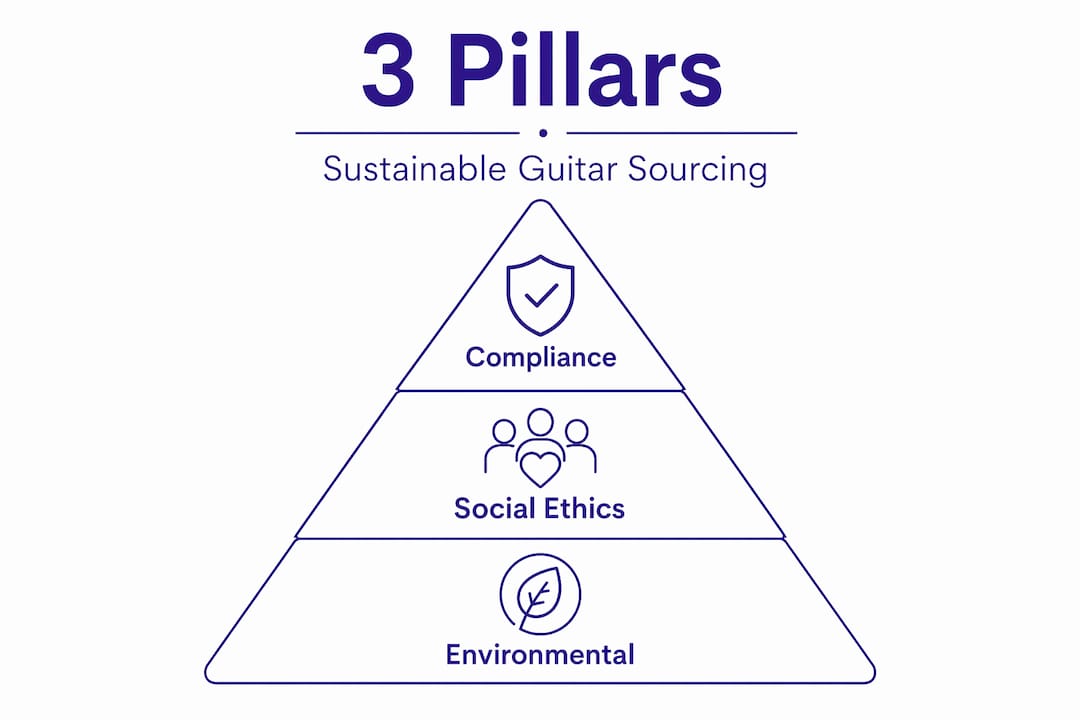
The three pillars of sustainable sourcing are environmental responsibility, social ethics, and regulatory compliance. On the environmental side, this means harvesting timber at rates forests can replenish, avoiding old-growth trees, and supporting reforestation. On the social side, it means paying fair wages to logging communities and not funding illegal operations. Regulatory compliance means meeting the requirements of international frameworks like CITES (the Convention on International Trade in Endangered Species) and the U.S. Lacey Act, both of which restrict trade in endangered or illegally sourced wood species.
One of the clearest markers of ethical guitar production is Forest Stewardship Council (FSC) certification. When a guitar’s wood carries an FSC label, it means an independent third party has verified the entire chain of custody from forest to factory. That’s a meaningful guarantee, not just a marketing claim.
Here’s what separates sustainable timber from the traditional exotic tonewoods players have treasured for decades:
- Traditional exotic woods (rosewood, ebony, Brazilian rosewood) grow slowly, often in biodiversity-rich regions, and have been heavily harvested over the past century.
- Certified sustainable woods come from managed forests where harvesting is planned, tracked, and limited to what regenerates naturally.
- Reclaimed and urban woods are salvaged from demolished structures, fallen urban trees, or manufacturing offcuts, requiring no new forest harvest at all.
Pro Tip: When a brand claims “sustainable sourcing,” ask specifically whether they hold FSC chain-of-custody certification. Generic sustainability language without third-party verification is not the same thing.
Understanding how wood types interact with tone and value also matters here, because sustainable sourcing isn’t just an ethical checkbox. It shapes the actual sound and longevity of the instrument you hold.
Traditional tonewoods vs. sustainable alternatives
For most of the 20th century, guitar builders had almost unlimited access to old-growth woods that happened to be extraordinary for building instruments. Sitka spruce for tops, Brazilian rosewood for backs and sides, ebony for fingerboards, mahogany for necks. These woods became the sonic standard.

That era is over. International regulations and genuine scarcity have fundamentally changed the material options on the table.
The species under pressure
- East Indian rosewood: Still widely used but now governed by CITES Appendix II, requiring export permits and compliance documentation.
- Ebony: Takes up to 100 years to mature, making it one of the slowest-regenerating tonewoods in commercial use.
- Brazilian rosewood: Strictly protected under CITES Appendix I. New instruments cannot legally use it. Its presence in vintage guitars is one reason pre-1969 instruments command extraordinary prices.
- Mahogany: Several species now face harvest restrictions in their native regions.
Sustainable alternatives worth knowing
| Traditional Wood | Sustainable Alternative | Tonal Character |
|---|---|---|
| East Indian rosewood | Ovangkol | Warm, balanced, similar midrange |
| Ebony | Richlite (composite) | Smooth, consistent, long-lasting |
| Brazilian rosewood | Sapele | Bright with complex overtones |
| Mahogany | Sipo / Khaya | Rich low-end, comparable resonance |
| Spruce (old-growth) | Torrefied maple | Dry, open, aged-wood response |
Alternative tonewoods like pau ferro and ovangkol are now widely adopted specifically to sidestep the regulatory burden and sourcing risk of rosewood. Many players who’ve spent time with these woods report that the tonal difference is far smaller than expected, particularly after the instrument has been played in over time.
Richlite deserves a specific mention. It’s a paper-composite material that machines like wood, feels smooth under the fingers, and doesn’t require any forest harvest. It’s now used on fingerboards across several major production guitars, and most players can’t distinguish it by feel alone.
Pro Tip: If you’re evaluating a new guitar, ask whether the fingerboard is genuine ebony or a certified alternative. Sustainability of sourcing also reflects on guitar craftsmanship quality, since responsible builders document their material choices.
How guitar manufacturers are adapting
The guitar industry’s shift toward ethical guitar production didn’t happen voluntarily or overnight. Regulatory pressure combined with genuine scarcity forced manufacturers to rethink supply chains that had been running on autopilot for decades. What’s emerged is a mix of vertical integration, certification programs, and genuine material innovation.
Here’s how the industry is responding:
-
Vertical integration of supply chains. Taylor Guitars now owns an ebony mill in Cameroon, giving the company direct control over how wood is harvested, processed, and documented. This is one of the most ambitious sustainable sourcing moves in the industry, and it’s changed how Taylor builds fingerboards at scale.
-
Accepting imperfection as a feature. Taylor introduced variegated ebony fingerboards, shifting market expectations away from the idea that only jet-black, uniform ebony is “quality.” In reality, lighter streaked ebony is acoustically identical. The color preference was purely cosmetic, and it was causing huge amounts of perfectly usable wood to be discarded.
-
FSC-certified production lines. Martin Guitar’s Biosphere guitar uses 100% FSC-certified woods, including certified Sitka spruce, sapele, and maple, demonstrating that high-quality instruments can be built entirely within sustainable frameworks.
-
Community forestry investment. Sustainable sourcing requires more than buying certified wood. It means funding reforestation, scientific research, and community partnerships to secure future supplies of slow-growing species. Some manufacturers now contribute directly to these programs as part of their sourcing contracts.
-
Design adaptation to available materials. Rather than forcing rare woods into existing templates, forward-thinking builders are redesigning instruments around what’s sustainably available. This includes thinner wood profiles, multi-piece construction, and hybrid material combinations that reduce material waste.
“Investing in sustainable forestry and timber due diligence is crucial to securing the future of tonewoods used in guitars.” — Taylor Guitars
The regulatory side adds real financial pressure. CITES compliance adds 8 to 15% to landed costs for guitars that still use regulated species. That’s a meaningful number in a competitive market, and it’s one reason alternative tonewoods are growing in adoption across mid-tier and premium lines alike.
What buyers should look for
Knowing how to source sustainable guitars as a buyer requires more than good intentions. You need to know what signals actually mean something and which ones are just packaging.
Start with these specifics when evaluating any guitar purchase:
- Look for FSC chain-of-custody certification, not just claims of “sustainably sourced” or “eco-friendly.” Certification is verifiable. Marketing language isn’t.
- Check for CITES compliance documentation on any guitar using rosewood or ebony. If a builder uses regulated species, they should be able to provide the paperwork trail.
- Research the brand’s material transparency. Do they list the species, origin, and certification status of the woods used? Brands serious about ethical guitar production make this information easy to find.
- Consider instruments made with alternative tonewoods. The benefits of sustainable guitars built with certified alternatives are real, both for tone consistency and resale documentation.
- Think about vintage. A well-maintained instrument from the 1960s or 1970s requires no new resource extraction at all. Buying a handmade or vintage guitar extends the life of existing materials and honors the craftsmanship already invested in them.
Pro Tip: Certified sustainable woods and transparent supply chains are now a key differentiator in the mid-tier market segment. If a brand in the $500 to $1,200 range can’t tell you where their wood came from, that’s worth noting before you buy.
Price is a factor too. Sustainability-certified instruments can cost more, partly because compliance documentation and responsible sourcing carry real costs. But that premium also represents genuine supply chain integrity, not just a label.
My take on the future of guitar materials
I’ve spent years at Vintage-guitar-world looking at guitars from across the 20th century, handling instruments built with Brazilian rosewood, old-growth mahogany, and Adirondack spruce that you simply cannot replicate today. And honestly? That scarcity is not something the industry can reverse by wanting to.
What I’ve come to believe is that sustainability isn’t a trend or a compromise. It’s the only path forward that keeps guitar making alive. The builders who understood this early, the ones who invested in mill ownership, community reforestation, and material research, are the ones whose instruments will still be playable in 50 years. The ones who treated rare woods as an infinite resource are running out of options.
I’ve also noticed something interesting in how alternative materials are aging. Instruments built with well-selected ovangkol or sapele from 15 years ago are sounding better now than they did when they left the factory. Wood opens up over time, and these species have more acoustic complexity than their reputation suggests.
The deeper issue for players is this: the relationship between musician and material has always been intimate. You choose a guitar partly because of what it’s made of. Sustainable sourcing doesn’t ask you to give that up. It asks you to expand your understanding of what “quality material” means, beyond scarcity-based prestige and toward something built to last.
The best thing you can do right now, beyond your next purchase, is stay curious. Read sourcing disclosures. Ask brands questions. Support builders who publish their supply chain data. Every buying decision is a small vote for the kind of guitar industry that exists 30 years from now.
— Vintage
Explore sustainable choices at Vintage-guitar-world

At Vintage-guitar-world, the guitars we curate aren’t just beautiful instruments. They represent decades of considered craftsmanship, often built with the finest tonewoods available at the time of their construction. Choosing a vintage guitar is one of the most genuinely sustainable decisions a player can make. No new forest is touched. No compliance documentation is needed. The material investment was made generations ago.
Browse our guide to types of vintage guitars to understand what features, history, and tonal character each era offers. If you’re weighing the tradeoffs between original instruments and newer builds, our vintage vs. reissue comparison gives you the full picture. For collectors who already own instruments worth preserving, our acoustic guitar restoration guide covers everything you need to know about keeping your investment in playing condition.
FAQ
What does sustainable guitar sourcing mean?
Sustainable guitar sourcing means obtaining the wood and materials used in guitar construction through methods that protect forests, comply with international regulations, and respect the communities involved in harvesting. It includes using FSC-certified timber, reclaimed wood, and responsible alternative tonewoods.
Why is rosewood difficult to source sustainably?
Rosewood is regulated under CITES Appendix II, requiring export permits and compliance documentation for international trade. This adds 8 to 15% to landed costs and has pushed many manufacturers to adopt alternatives like ovangkol and pau ferro.
Are alternative tonewoods as good as traditional ones?
In most applications, yes. Woods like sapele, ovangkol, and torrefied maple deliver tone comparable to their traditional counterparts, particularly after the instrument has been played regularly over time. Richlite composite fingerboards are now widely accepted as functional equivalents to ebony.
How can I verify a guitar’s sustainability claims?
Look for FSC chain-of-custody certification, CITES documentation for regulated species, and brand transparency about wood species and origin. Generic “eco-friendly” language without third-party verification is not sufficient proof of sustainable sourcing.
Is buying a vintage guitar a sustainable choice?
Yes. Purchasing a vintage instrument requires no new forest harvest and extends the life of materials that were already responsibly invested decades ago. It’s one of the most straightforward ways to practice eco-friendly guitar sourcing as an individual buyer.