














TL;DR:
- Handcrafted guitars are highly responsive to environmental changes and require proper care to maintain their value and tone. Utilizing the right tools, routine cleaning, humidity regulation, and professional maintenance are essential for preserving these instruments over time. Documenting repairs and provenance enhances long-term value and historical integrity.
You notice it one afternoon: a hairline crack creeping along the top of your treasured handcrafted guitar, or a finish that’s lost the luminous glow it had when you first unboxed it. That sinking feeling is familiar to anyone who owns an instrument built by hand, and it’s completely avoidable. Handcrafted guitars are constructed with tonewood selected and joined by skilled luthiers, which makes them far more responsive to environmental changes and cleaning missteps than factory instruments. The good news is that with the right tools, a disciplined routine, and solid knowledge, you can protect your guitar’s structure, tone, and resale value for decades.
Table of Contents
- Essential tools and materials for handcrafted guitar care
- Cleaning and maintaining handcrafted guitar surfaces
- Humidity and climate control for handcrafted guitars
- String maintenance, replacement, and setup best practices
- Preserving value: Provenance, repairs, and expert documentation
- What most guitar owners miss about handcrafted guitar care
- Explore more vintage guitar expertise and collectability resources
- Frequently asked questions
Key Takeaways
| Point | Details |
|---|---|
| Clean safely | Always use microfiber cloths and avoid household cleaners to protect delicate finishes on handcrafted guitars. |
| Control humidity | Maintain stable humidity between 40-60% with two-way regulators to prevent cracks and glue issues. |
| Routine string care | Change strings every 1-3 months and inspect regularly for corrosion or wear. |
| Document maintenance | Keep detailed records of repairs and setups to validate provenance and maximize instrument value. |
| Consult experts | Seek professional setups biannually and choose luthiers for major repairs to ensure longevity and collectible worth. |
Essential tools and materials for handcrafted guitar care
Before you can properly execute a care routine, you’ll need to assemble the right set of tools for handcrafted guitar maintenance. Having the correct supplies on hand from day one is the difference between preserving a fine instrument and accidentally degrading it.
Must-have cleaning and care supplies:
- Microfiber cloths (at least 3 to 4 dedicated cloths: one for the body, one for the neck, one for hardware)
- Guitar-specific polish (nitrocellulose-safe if your instrument has a vintage lacquer finish)
- Fretboard conditioner (lemon oil for unfinished rosewood or ebony, not maple)
- String winder and string cutter for safe, fast string changes
- Soft-bristled detailing brush for reaching around tuning machines and bridge pins
Humidity control essentials:
- Two-way humidity regulator packs such as Boveda 49% or 72-hour packs designed specifically for instrument cases
- Digital hygrometer to monitor actual relative humidity inside the case (not just the room)
- Hard-shell case with a good seal, which amplifies the effectiveness of humidity packs
Acoustic guitar maintenance tips like these form the baseline of responsible ownership, but what you avoid is just as critical as what you use. Microfiber cloths for cleaning body and neck remove sweat, oils, and dust effectively without scratching delicate finishes, while harsh chemicals, alcohol, household cleaners, and even olive oil on fretboards can cause irreversible surface damage.
| Product type | Safe to use? | Notes |
|---|---|---|
| Guitar-specific polish | Yes | Match to your finish type |
| Microfiber cloth | Yes | Wash regularly without fabric softener |
| Household glass cleaner | No | Dissolves nitro finishes |
| Rubbing alcohol | No | Strips lacquer and dries wood |
| Olive or cooking oil | No | Attracts grime, degrades fretboard |
| Lemon oil (fretboard grade) | Yes | Unfinished fretboards only |
Pro Tip: Label your microfiber cloths with a small piece of tape. Using the same cloth on oily strings and then on your guitar’s nitrocellulose body is a common way to accidentally transfer grime and cause micro-scratches.
Cleaning and maintaining handcrafted guitar surfaces
With the right materials on hand, you’re ready to execute a safe and effective cleaning regimen. The key is separating your routine into daily, weekly, and monthly tasks so that no single session becomes overwhelming.
Post-session cleaning (every time you play):
- Wipe down the strings with a dry microfiber cloth from the bridge to the nut, running the cloth under and over each string.
- Wipe the back of the neck where your thumb and palm make contact. Sweat is slightly acidic and degrades finishes faster than most players realize.
- Lightly wipe the body, focusing on areas around the soundhole, below the bridge, and the lower bout near your forearm.
- Store the guitar in its case, never on an open stand in a dry or sunny room.
Monthly deep clean and fretboard conditioning:
- Remove all strings before conditioning the fretboard.
- Apply a small amount of lemon oil (fretboard grade) to a clean cloth, not directly to the wood.
- Work the oil into each fret segment with a circular motion, then wipe dry.
- Polish the body with a guitar-specific polish, using one cloth to apply and a separate one to buff.
- Restring immediately so the neck tension remains balanced.
“Clean with a soft dry cloth after every session; replace strings frequently for professional players.” — Caring for your archtop guitar
The most common mistake players make is reaching for whatever cleaning product is nearby. A single wipe with a kitchen cleaner can strip the finish from a hand-applied nitrocellulose lacquer in seconds, leaving a dull patch that requires a professional refinish to fix. Avoiding harsh chemicals isn’t optional. It’s the rule that separates a well-preserved collectible from an instrument that’s lost its finish integrity and, with it, a significant portion of its market value.
Pro Tip: For spot cleaning around the bridge or tuners where a cloth won’t reach, wrap a dry microfiber cloth around a toothpick to lift grime without touching the finish with anything abrasive.
Humidity and climate control for handcrafted guitars
Once your instrument is spotless, it’s time to address the single biggest environmental risk to its health: humidity and temperature. Wood is hygroscopic (it absorbs and releases moisture from the air), and handcrafted guitars made from book-matched tonewoods are especially sensitive because the luthier-selected pieces are thinner and more acoustically optimized than factory-grade tops.
Ideal humidity ranges:
| Guitar type | Target RH range | Risk zone low | Risk zone high |
|---|---|---|---|
| Acoustic handcrafted | 45 to 55% | Below 40% | Above 60% |
| Classical and flamenco | 45 to 55% | Below 40% | Above 65% |
| Archtop handcrafted | 30 to 60% RH | Below 35% | Above 65% |
| Pre-war and vintage | 45 to 52% | Below 40% | Above 58% |
Humidity control is paramount for handcrafted guitars: low humidity below 40 to 45% causes wood to shrink and crack, while high humidity above 55 to 60% causes swelling and glue joint failure. Two-way humidity regulation systems are the most reliable solution because they both add and remove moisture as needed, rather than only humidifying.
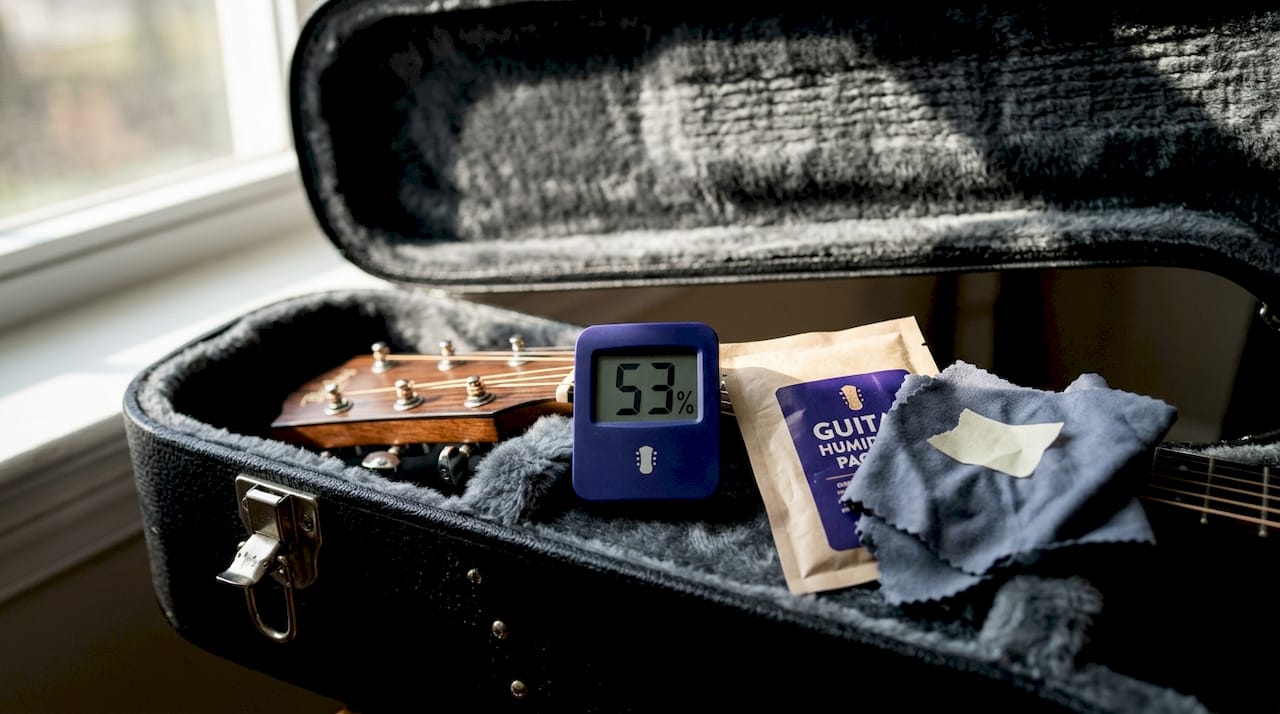
Monitoring with a hygrometer and avoiding temperature fluctuations greater than 10 degrees Celsius is essential for any instrument stored between sessions. Leaving a guitar in a car, near a heating vent, or next to an air conditioning unit creates exactly the kind of rapid swing that splinters wood at the glue seams.
Troubleshooting climate problems:
- Low humidity symptoms: Sharp fret ends extending past the fretboard edge, a sunken top, or audible buzzing caused by lowered action
- High humidity symptoms: Swollen top, sluggish tuning stability, and a musty smell inside the case
- Remedy for under-humidification: Place a two-way pack inside the guitar’s soundhole humidifier slot and in the case compartment simultaneously; check daily for the first week
- Remedy for over-humidification: Remove humidity packs, open the case in a temperature-controlled room (not outdoors), and allow the wood to equalize slowly over several days
Pro Tip: A $15 to $25 digital hygrometer placed inside the case near the headstock gives you a real-time humidity reading that’s far more accurate than guessing from a room thermostat. Check it every time you open the case and you’ll catch a problem before it becomes a repair bill.
String maintenance, replacement, and setup best practices
With climate under control, it’s time to focus on the element that directly shapes your guitar’s sound and feel: the strings. Old strings don’t just sound dull; they create uneven tension, promote fret wear, and can break unpredictably in the middle of a performance or practice session.
String replacement intervals:
- Professionals and daily players: Change strings every 2 to 4 weeks. High-output playing loads strings with sweat and oils faster than casual sessions.
- Regular enthusiasts: Change strings every 1 to 3 months to prevent rust, breakage, and tone degradation.
- Collectors with display instruments: Change strings every 4 to 6 months even if the guitar is rarely played, as static tension and oxidation still degrade them.
Safe string-changing process:
- Loosen each string a full step before cutting to avoid a sudden tension release that can stress the top.
- Remove strings one at a time, keeping some tension on the neck throughout the change.
- Clean the now-exposed fretboard immediately before restringing.
- Wind new strings neatly around the tuning post with at least 2 to 3 wraps for proper seating.
- Stretch the strings gently after tuning to pitch, then retune. Repeat twice for faster stabilization.
Professional setup milestones:
- Twice per year: A professional setup (truss rod check, nut slot inspection, action adjustment) is especially important after seasonal humidity shifts; every 6 months post-seasonal changes is the standard recommendation for players and collectors alike.
- After any climate event: If your guitar was exposed to unusually dry or wet conditions, schedule a luthier inspection before resuming regular play.
- Before and after touring: Road conditions expose instruments to repeated temperature and humidity fluctuations that can shift neck relief and action.
Spotting string problems before they break:
- Look for visible discoloration or rust near the ball end or wound sections
- Run your fingernail along wound strings; a rough, gritty texture means the winding is starting to unravel
- Listen for a “dead” or flat tone on a specific string even after tuning, which signals core fatigue
Pro Tip: Keep a small notebook or digital note in your phone dated with each string change and the brand used. When a set lasts unusually long or short, you’ll have data to refine your replacement schedule.
Preserving value: Provenance, repairs, and expert documentation
Beyond day-to-day care, true collectors and musicians concerned with value must also think long-term: documentation and professional-grade repairs. A handcrafted guitar is an investment that appreciates when properly maintained and depreciates rapidly when its history is unknown or its repairs are poorly executed.
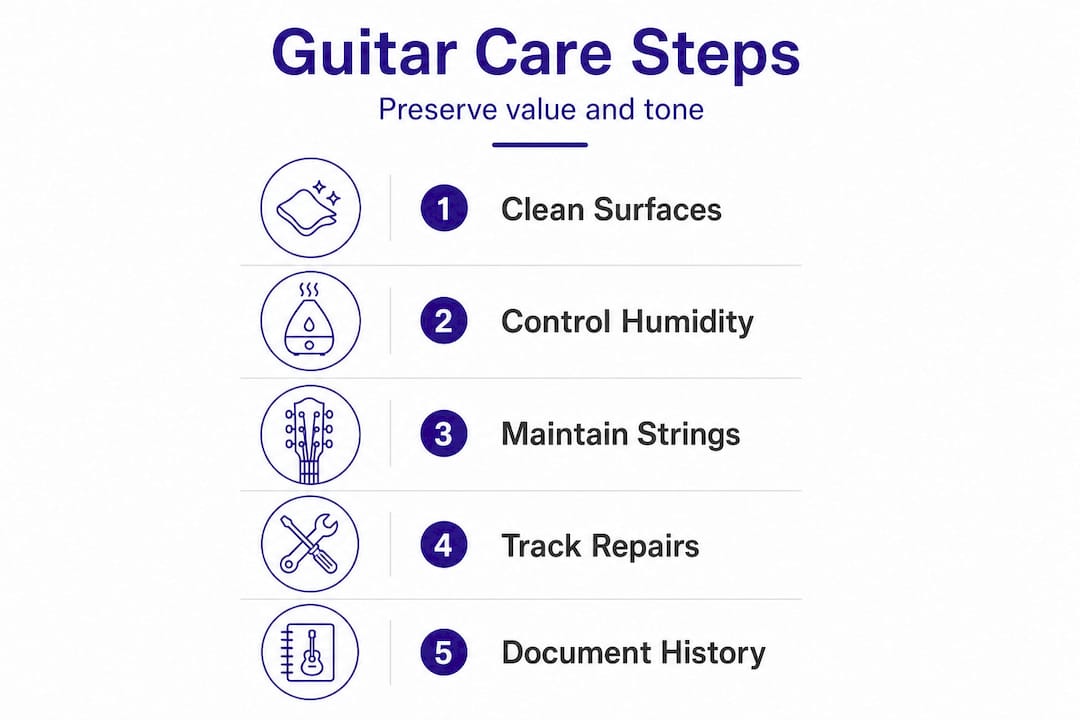
Why provenance documentation matters:
A guitar with a documented repair history, original parts, and certified authentication commands significantly higher prices at auction and on the collector market. The guitar provenance guide explains how to build and organize this documentation in a way that satisfies both insurers and potential buyers.
What to document:
- Every string change, including date and brand
- Any repair or adjustment, including who performed it and what parts were replaced
- Climate events that may have affected the instrument (floods, heat waves, long-distance transport)
- Any valuation or certification performed by a recognized authority
- Photographs taken at regular intervals to show the instrument’s evolving condition
“Conservative repairs, original materials, professional luthier guidance, and documented work history are essential for pre-war and vintage instruments.” — Complete guide to pre-war Martin guitars
For vintage instruments specifically, prioritizing provenance documentation to preserve value is the single most protective action a collector can take. Non-original parts, cosmetic “upgrades,” and undocumented bridge replacements have historically reduced resale value by 20 to 40% on significant pre-war and luthier-built guitars.
When to call a luthier (not just a repair tech):
- Visible cracks in the top, back, or binding that extend more than a few millimeters
- Fret ends that need dressing or complete refretting on a valuable instrument
- Neck resets on acoustic and classical guitars (a structural adjustment that should never be DIYed)
- Any repair on a guitar valued over $2,500
For guidance on doing this well, the restoration tips for vintage guitars and the broader vintage guitar care guide are strong starting points. For hardware-specific decisions like bridge modifications, a reference like this tremolo bridge guide can help you understand which changes are reversible and which are permanent.
What most guitar owners miss about handcrafted guitar care
Most articles tell you to wipe down your guitar and buy a Boveda pack. That’s necessary, but it’s not the whole picture. After years of working with vintage and handcrafted instruments, the overlooked factor isn’t any one product or technique. It’s the compounding effect of small decisions made consistently over time.
A missed humidity spike here, an undocumented fret leveling there, a bridge replaced with non-original material to save $50 on a luthier bill. None of these feel catastrophic in isolation. Together, they can reduce a guitar’s value by thousands of dollars and, more importantly, sever the historical continuity that makes a handcrafted instrument meaningful.
We’ve seen players invest in beautiful archtops and classical instruments, only to store them on open wall hangers in rooms with unchecked humidity. They clean the surface perfectly but never think about the internal bracing slowly shifting under chronic moisture stress. The value of provenance for collectors isn’t a paperwork formality. It’s the story of stewardship, and buyers pay a real premium for instruments with an unbroken story.
One contrarian view worth considering: the assumption that keeping a guitar in “original condition” means never touching it. That’s wrong. Playable, well-maintained instruments in stable condition consistently outperform neglected originals at auction. A guitar that has been regularly strung, professionally set up, and carefully humidified will have better structural integrity than one left in an attic for 30 years in original strings.
Blend DIY care with timely professional attention. Know your limits, especially for neck resets and crack repairs. And treat documentation as part of the instrument itself, not an afterthought.
Explore more vintage guitar expertise and collectability resources
Ready to go beyond care into deep expertise and investment? We’ve built a set of resources specifically for collectors and players who want to understand what makes a handcrafted guitar worth owning and preserving.
Whether you’re exploring what sets fine instruments apart at the build level or researching which vintage models hold their value best, these guides are written from direct experience with rare and collectible instruments.

Explore craftsmanship in handcrafted guitars to understand what separates a luthier-built instrument from production alternatives, or browse the detailed vintage guitar features and history guide for investment context. When you’re ready to find your next instrument, the full curated vintage guitars for sale inventory includes authenticated, well-documented pieces across classical, acoustic, flamenco, and electric categories.
Frequently asked questions
What humidity level is ideal for storing a handcrafted guitar?
The ideal humidity range for handcrafted guitars is generally 30 to 60%, with most experts recommending 45 to 55% as the safest target to prevent cracks or swelling.
How often should strings be replaced on a handcrafted or vintage guitar?
Strings should be changed every 1 to 3 months depending on use, or more frequently for professional players, to maintain tone quality and avoid structural stress.
Are household cleaners safe for cleaning handcrafted guitars?
No. Microfiber cloths and guitar-specific products are the only safe options; avoid harsh chemicals, alcohol, and household cleaners that can strip delicate lacquer finishes instantly.
How important is provenance and documentation for vintage guitar collectors?
Very important. Provenance documentation significantly increases a guitar’s collectible value and provides the authentication trail buyers and insurers require.
Can high or low humidity damage occur suddenly, or is it gradual?
Both are possible. Sudden humidity drops or spikes can cause immediate cracking or swelling, while gradual long-term fluctuations lead to glue joint failure and structural instability that’s harder to detect early.