













TL;DR:
- Vintage acoustic guitars feature hand-built construction, scalloped bracing, and thin nitro finishes for superior tone.
- Brands like Martin and Gibson from their peak eras are highly prized for craftsmanship and historical significance.
- Authentic vintage guitars offer unique sound qualities and collector value rooted in age, rarity, and original materials.
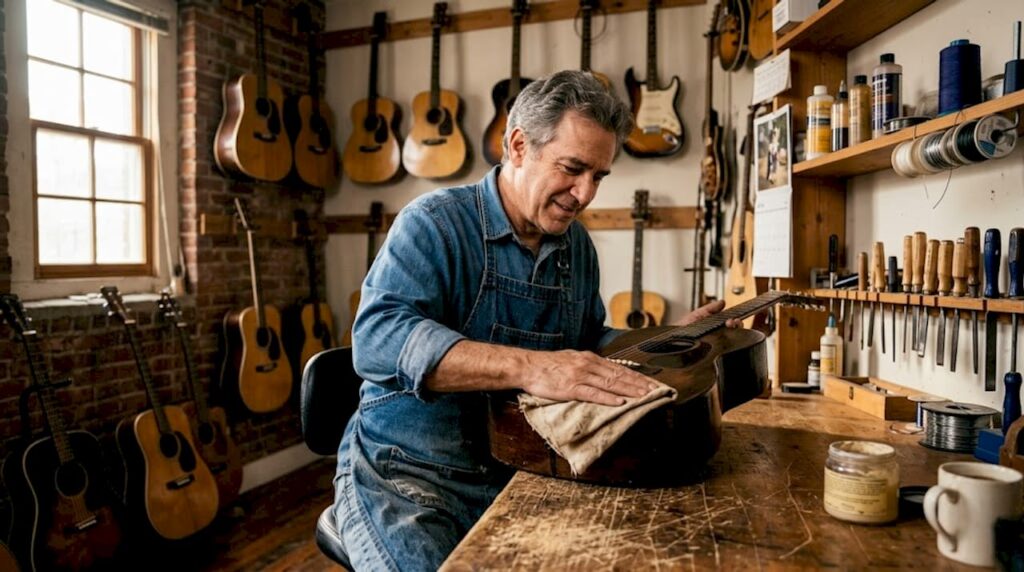
Walk into any serious collector’s space and you’ll notice something immediately. A 1940s Martin or a 1950s Gibson sits in a place of honor, not as a relic, but as a living, breathing instrument. The assumption that newer equals better falls apart the moment you strum a pre-war Martin and hear those complex, layered tones that modern production simply cannot replicate. Vintage acoustic guitars built during these golden eras featured hand-built construction, scalloped bracing, and traditional joinery techniques that continue to outshine today’s mass-produced offerings in tone, feel, and long-term collector value.
Table of Contents
- Craftsmanship: The foundation of vintage appeal
- Iconic brands and models: Martin vs Gibson
- Sound qualities that make vintage acoustics unique
- Collector value and investment insights
- A fresh perspective: What most guides overlook about vintage acoustics
- Find your vintage acoustic: Resources and next steps
- Frequently asked questions
Key Takeaways
| Point | Details |
|---|---|
| Unmatched craftsmanship | Vintage acoustics feature traditional hand-built methods and materials that modern guitars rarely replicate. |
| Distinctive sound profiles | Models like Martin D-28 and Gibson J-45 produce unique tones, making them prized by players and collectors. |
| Collector value & investment | Authentic vintage guitars often appreciate in value and offer reliable long-term collector appeal. |
| Historical significance | The heritage of iconic brands and models adds character and context, boosting desirability. |
Craftsmanship: The foundation of vintage appeal
With the foundation laid, let’s examine exactly what sets the build quality of vintage acoustics apart from modern instruments.
When you hold a well-preserved vintage acoustic, the first thing a seasoned player notices is how the guitar feels responsive before you even play a note. That responsiveness comes directly from how it was built. Vintage luthiers, particularly at Martin and Gibson during their peak decades, approached each instrument as a handcraft project, not a production quota. That distinction matters enormously.
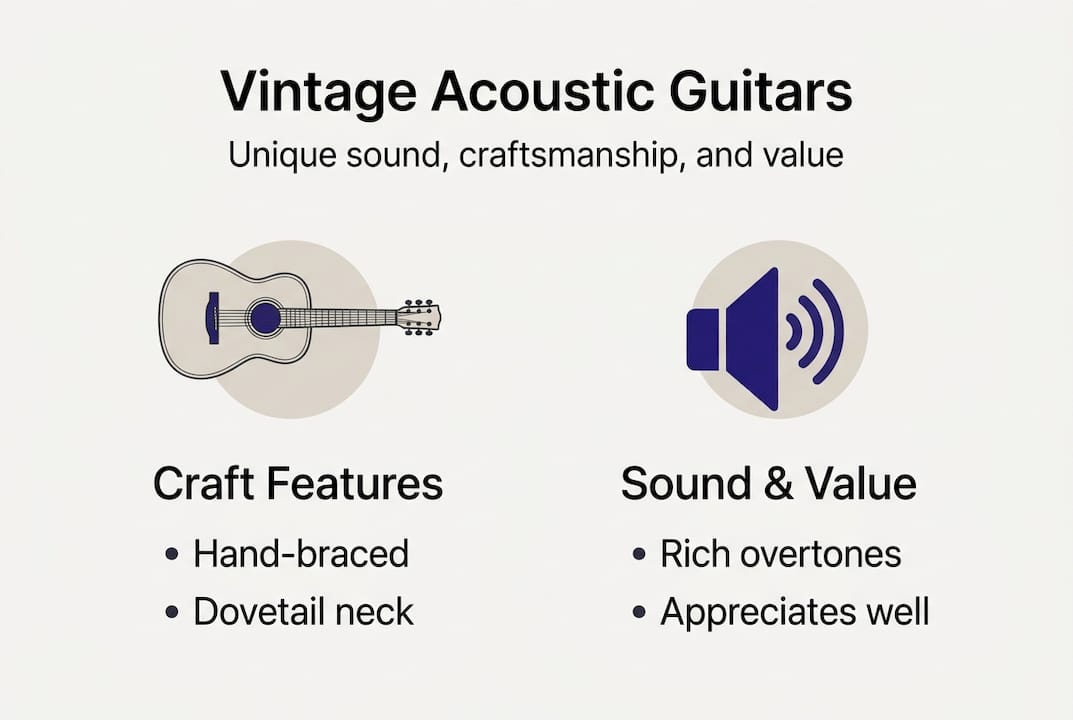
The single most impactful structural difference is hand-scalloped X-bracing. In the factory environment of today, bracing is CNC-cut to uniform specifications. In the pre-war era, a skilled craftsman would carve each brace by hand, tapering and scalloping the wood to precise tolerances developed through years of experience. This creates a top that flexes more freely and responds to a wider range of frequencies. The result is a more dynamic sound with greater sensitivity to playing touch.
Joinery is another overlooked factor. Traditional dovetail neck joints, crafted with tight tolerances and fitted by hand, transfer string vibration into the body more efficiently than modern bolt-on or mortise joints. That efficient transfer is part of why vintage acoustics “bloom” when you play them, producing notes that expand rather than decay immediately.
Finish chemistry also plays a direct role in tone. Thin nitrocellulose finishes allow wood vibration in a way that thicker modern lacquers simply cannot. Modern polyurethane finishes, while durable and cost-effective, essentially create a plastic shell around the wood, dampening its natural resonance. Nitrocellulose, applied in thin coats, cures over decades to become almost part of the wood itself.
Here’s a quick comparison of key construction differences:
| Feature | Vintage acoustic | Modern production |
|---|---|---|
| Bracing | Hand-scalloped, tapered | CNC-cut, uniform |
| Neck joint | Hand-fitted dovetail | Bolt-on or modern mortise |
| Finish | Thin nitrocellulose | Thick polyurethane |
| Wood selection | Hand-graded tonewoods | Standardized grades |
| Assembly | Handcrafted, fitted | Machine assembled |
Signs of genuine hand-built construction you should look for:
- Slight asymmetry in bracing placement visible through the soundhole
- Tool marks from hand planes on interior surfaces
- Irregular but tight glue joints at the heel and neck block
- Natural checking (fine cracks) in the finish as nitro ages
Understanding guitar craftsmanship at this level gives you a real edge when evaluating instruments. The handcrafted guitar excellence visible in golden-era instruments is the result of decades of refined technique, not accident.
Pro Tip: Use a small mirror and a penlight to inspect the interior bracing of any vintage acoustic you’re considering. Hand-scalloped braces will show visible taper and slight tool marks. Uniform, machine-cut braces will look perfectly smooth and symmetrical. That visual difference alone can tell you a great deal about how an instrument was made and how it will sound.
Iconic brands and models: Martin vs Gibson
Understanding craftsmanship naturally leads us to the legendary brands and instruments that exemplify it.
Martin and Gibson are not just guitar companies. They are the defining forces behind what most collectors consider the golden standard for acoustic tone and build quality. Each brand produced instruments during specific eras that represent the absolute peak of acoustic guitar making, and knowing those eras helps you buy smart.
Martin’s golden era spans roughly the 1930s through the mid-1940s. During this period, Martin refined the dreadnought body style and combined it with forward-shifted scalloped bracing, Adirondack spruce tops, and Brazilian rosewood back and sides. The Martin guitars history of this era is really a story of perfecting acoustic projection for working musicians who needed volume before amplification existed.
Gibson’s peak era sits in the 1950s and into the early 1960s. Gibson took a different approach, favoring mahogany and maple combinations that produced warmer, punchy tones with a strong midrange presence. The J-45, introduced in 1942 but refined through the 1950s, became the singer-songwriter’s instrument of choice. The Hummingbird, introduced in 1960, added decorative flair alongside that same warm Gibson character.
Here’s how the signature models stack up:
| Model | Brand | Era | Tonal character | Best for |
|---|---|---|---|---|
| D-28 | Martin | 1930s-1960s | Clear, projecting, complex overtones | Flatpicking, bluegrass |
| D-18 | Martin | 1940s-1950s | Warm, focused, mahogany clarity | Fingerpicking, folk |
| J-45 | Gibson | 1950s | Warm midrange, woody bass | Strumming, songwriting |
| Hummingbird | Gibson | 1960s | Punchy, dynamic, rich | Rhythm playing, country |
The tonal contrast between these two brands is well documented. Martin’s balanced projection, with its clarity and complex overtones on the D-28 and D-18, suits flatpicking and intricate fingerstyle playing. Gibson’s warm midrange punch and woody bass response on the J-45 and Hummingbird fits strumming-heavy styles and vocal accompaniment far better. Neither is objectively superior. They are optimized for different musical contexts.
The four reasons collector value links directly to legacy:
- Provenance and documentation: Instruments with known ownership histories or original cases command premiums of 20 to 40 percent above comparable examples without documentation.
- Originality of parts: Replacing a tuning machine or bridge saddle with non-original hardware reduces value significantly, even when done with quality parts.
- Period-correct materials: Brazilian rosewood, Adirondack spruce, and hide glue construction are no longer standard, making original examples genuinely irreplaceable.
- Historical context: An instrument made during a factory’s creative peak carries more cultural weight and collector demand than even a superior-condition later example.
The sound and craftsmanship connection is what ultimately separates legend from mere history. These guitars earned their reputations by working hard on stage and in studios for decades.
Sound qualities that make vintage acoustics unique
Iconic models demonstrate the theory, but what about the actual sonic experience vintage acoustics deliver?

Playing a genuine vintage acoustic is often described as a discovery. Musicians who have spent years on modern instruments frequently report that their first extended session with a quality vintage Martin or Gibson changes their understanding of what acoustic tone can be. That reaction is not nostalgia. It has a physical explanation.
Wood aging is the central factor. Over decades, the cellular structure of spruce and mahogany tops undergoes a gradual drying and crystallization process. Resins within the wood cells redistribute, and the wood becomes lighter and stiffer relative to its mass. This is the single biggest reason vintage vs new guitars sound so different even when construction methods are identical. A new guitar needs years of playing to develop this character. A vintage guitar already has it.
The tonal vocabulary of vintage acoustics includes several qualities that players consistently report:
- Bloom: Notes that swell and expand after the initial attack, creating a three-dimensional quality
- Complex overtones: Rich harmonic content above the fundamental note, producing what players describe as “color” in the tone
- Dynamic sensitivity: The instrument responds dramatically to light versus heavy playing, giving the player expressive control
- Warm low end: Bass frequencies feel full and woody rather than boomy or thin
“The difference between a vintage acoustic and a new one isn’t just about age. It’s about the intersection of materials, construction, and decades of vibration working together to open up the wood.”
Martin’s complex overtones contrast clearly with Gibson’s warm midrange, but both share that quality of dimensional, responsive tone that thin nitrocellulose finishes enhance by allowing the wood to move freely. That finish aging is as important as the wood aging beneath it.
Weight also tells part of the story. Pre-war Martins typically weigh between 3.2 and 3.8 lbs, a range that reflects their lightweight construction philosophy. Lighter instruments vibrate more freely, and that freedom translates directly into acoustic output and tonal complexity.
Understanding acoustic vs electric vintage tone helps put this in context. The aging process that benefits acoustic guitars is even more pronounced without electronic amplification masking the instrument’s natural voice.
Pro Tip: When testing a vintage acoustic, play the same chord very softly and then gradually build to full volume. A quality vintage instrument will reward both dynamics equally, giving you complex tone at low volume and full projection at high volume. A lesser instrument will either sound thin when played softly or choke when strummed hard.
Collector value and investment insights
After exploring sound, let’s turn to what makes these guitars prized investments and collector treasures.
The vintage acoustic guitar market has shown consistent appreciation over the past three decades. While other collectible markets fluctuate with economic conditions, genuinely rare and well-documented vintage guitars have retained and grown their value because the supply is fixed and demand from players and collectors continues to rise. You cannot make more 1937 Martin D-28s.
Pre-war Martin construction, with its hand-built assembly and scalloped bracing, represents craftsmanship that modern mass production genuinely cannot replicate, making those instruments permanently irreplaceable. That irreplaceability is the foundation of collector value.
Key steps to evaluating a vintage acoustic before purchase:
- Research the serial number: Both Martin and Gibson maintained detailed production records. Cross-reference the serial number against published databases to confirm the year, model, and original specifications.
- Inspect for repairs and modifications: Headstock repairs, replaced braces, and refrets all affect value. Expect a price reduction proportional to the significance of any work done.
- Assess originality: Original tuners, bridge plate, nut, and saddle indicate an instrument that has been well maintained rather than repeatedly modified.
- Check neck geometry: Vintage acoustics can develop neck angle issues over decades. A properly set neck should allow comfortable action without excessive saddle height.
- Play it acoustically: No amount of documentation replaces the actual sound. An instrument that doesn’t respond well likely has hidden structural issues.
What genuinely drives value in the collector market:
- Rarity of the specific model: Limited-run instruments or early examples of important models command significant premiums
- Condition relative to age: A guitar in exceptional original condition for its age is exponentially more valuable than one in average condition
- Celebrity or musician provenance: Documented ownership by a significant musician can multiply value dramatically
- Original case and documentation: Factory cases, original receipts, and period photographs all add credibility and value
Understanding the signs of collectible guitars separates confident buyers from those who pay too much for ordinary examples. The tools to evaluate vintage guitars carefully, including professional inspection and certification services, are available to anyone willing to use them.
Pro Tip: Never buy a significant vintage acoustic without a professional evaluation from someone who specializes in that specific era and brand. A one-hour consultation with an expert can save you thousands by identifying issues that are invisible to the untrained eye, including repaired cracks, replaced tops, and altered necks.
A fresh perspective: What most guides overlook about vintage acoustics
Most writing about vintage acoustics focuses on specs, brand hierarchies, and price charts. That information matters, but it consistently misses the deeper reason why these instruments hold such power over serious players and collectors.
The real magic is in the story a guitar carries. Every wear mark, every repaired crack, every dark patch from years of hand oils is evidence of a life actively played. That history isn’t damage. It’s authenticity. A pristine, unplayed vintage guitar is interesting as an artifact. A well-loved one with known history is something different entirely.
There’s also the uncomfortable truth that market value and personal value frequently conflict. We’ve seen players pass on extraordinary instruments because they didn’t match some published price benchmark, only to regret it years later. The guitars that matter most in a player’s life are rarely the ones that look best on a spreadsheet.
Why we love vintage guitars ultimately comes down to this: the best vintage acoustic for you is the one that makes you play better and feel more connected to the instrument. Trust that instinct alongside the research, not instead of it.
Find your vintage acoustic: Resources and next steps
Ready to take your understanding further? Here are expert resources to continue your vintage acoustic journey.
At Vintage Guitar World, we’ve built our platform around exactly the kind of informed, passionate buying experience that vintage acoustics deserve. Whether you’re beginning to explore the types of vintage guitars available across different eras and styles, or you’re ready to invest in a specific golden-era piece, our curated listings include detailed provenance, condition reports, and expert evaluations on every instrument.

Our handcrafted guitars guide gives you the background knowledge to evaluate what you’re looking at before you commit. We also offer testing appointments, valuation services, and certification, giving you the confidence that comes from working with specialists who understand this market deeply. Browse our current inventory and let the guitars do the talking.
Frequently asked questions
What makes vintage acoustic guitars sound different from modern guitars?
Vintage acoustics generally feature hand-built construction, scalloped bracing, and thin nitrocellulose finishes that allow wood to vibrate more freely, producing richer resonance and tone than modern lacquer-coated instruments.
Are certain vintage brands more collectible than others?
Yes, models from Martin and Gibson, especially pre-war and golden-era models from the 1930s through 1950s, are the most highly sought after due to their craftsmanship, historical significance, and irreplaceable materials.
How can I tell if a vintage acoustic is genuine?
Look for hand-built construction signs like scalloped bracing, traditional joinery, original hardware, and period-correct materials, then cross-reference the serial number against published brand records.
What are the biggest advantages to owning a vintage acoustic guitar?
Vintage acoustics offer unique tone from aged tonewoods, genuine collector value, and golden-era craftsmanship that modern mass production cannot replicate, making them both exceptional instruments and lasting investments.