














Finding the true value of an old guitar goes well beyond its age or finish. Many collectors and musicians discover that not every decades-old instrument delivers the sonic magic or investment appeal of genuine vintage treasures. Recognizing what sets authentic vintage guitars apart—like meticulous craftsmanship, original materials, and proven performance—can elevate your collection and stage sound. This article brings serious collectors and professional players closer to the real qualities and myths surrounding vintage guitars, helping you separate legend from lasting value.
Table of Contents
- Old Guitars Defined And Common Misconceptions
- How Wood Aging Affects Guitar Tone
- Craftsmanship And Materials In Vintage Guitars
- Role Of Electronics And Hardware Changes
- Comparing Vintage Guitars With Modern Counterparts
Key Takeaways
| Point | Details |
|---|---|
| Understanding Vintage Status | A guitar qualifies as vintage typically around 30-40 years old, but actual value depends on craftsmanship, materials, and historical significance, not just age. |
| Quality Over Age | Older guitars are not always better; factors like wood quality, construction techniques, and maintenance history significantly influence performance and tone. |
| Preservation of Playability | Many vintage guitars are still playable with proper maintenance, debunking the myth that they are solely fragile artifacts. |
| Craftsmanship Matters | The superior craftsmanship and material selection in vintage guitars contribute to their tonal richness, compared to mass-produced modern alternatives. |
Old Guitars Defined And Common Misconceptions
When collectors and musicians talk about “old guitars,” they’re not just referring to any instrument that’s been sitting in an attic for decades. Vintage guitars represent instruments valued specifically for their age, craftsmanship, historical significance, or superior tonal qualities. Understanding what actually qualifies as vintage helps you separate genuine collectibles from ordinary aged instruments.
What Makes a Guitar “Vintage”?
A guitar typically enters vintage status around 30-40 years of age, though the definition varies by context. Pre-war instruments and those manufactured by renowned builders command attention regardless of age. The real marker isn’t just the calendar—it’s whether the instrument possesses demonstrable value to collectors, musicians, or historians.
Mass production fundamentally changed the guitar industry after the 1960s, affecting both quality and desirability. Earlier handcrafted instruments often showcase superior materials and construction methods compared to factory-produced models. This distinction matters enormously when evaluating what you’re actually looking at.
Common Misconception #1: Older Always Means Better
Many people assume that simply existing for longer automatically makes a guitar superior. This assumption misses a crucial reality: manufacturing quality, materials sourcing, and craftsmanship vary dramatically across different eras and makers.
A mass-produced electric guitar from 1975 won’t necessarily outperform a well-constructed instrument from 1995. The critical factors include:
- Wood quality and aging of the body and neck materials
- Original hardware and whether it’s been replaced
- Construction techniques used during manufacturing
- Specific maker and their reputation for consistency
- Condition history and how the instrument was maintained
Age alone doesn’t guarantee superior tone—craftsmanship, materials, and maintenance history matter far more.
Common Misconception #2: All Vintage Guitars Sound Better
The romantic notion that vintage automatically means tonally superior leads collectors astray. Some older instruments absolutely sound magnificent. Others sound mediocre or worse than contemporary alternatives.
Factors that genuinely influence tone include wood density, construction bracing patterns, and finish type—none of which correlate perfectly with age. An instrument can be 60 years old and sound uninspiring if it was poorly constructed initially or subjected to harmful storage conditions.
Common Misconception #3: Vintage Means Unplayable
People often believe old guitars are fragile museum pieces unsuitable for actual performance. This overlooks the reality that many vintage instruments were built to survive serious use. Quality vintage guitars can be perfectly playable with proper setup and maintenance.
However, decades of temperature fluctuations, humidity changes, and mechanical wear do take their toll:
- Frets wear flat, requiring leveling or replacement
- Truss rods may need adjustment to compensate for neck shifts
- Hardware connections loosen over time
- Finish checking and lacquer cracking develop naturally
These issues are repairable, not terminal.
The Real Definition: Beyond Romance
Vintage guitars deserve appreciation based on honest evaluation, not mythology. Understanding what makes guitars collectible involves examining historical significance, rarity, and genuine tonal merit—not just age.
Your role as a collector is to look past sentimental narratives and assess each instrument’s actual condition, craftsmanship, and performance potential.
Pro tip: When evaluating a vintage guitar, ignore its age initially and focus instead on visible construction quality, wood appearance, and hardware condition—these tangible factors predict playability and value far better than the manufacture date alone.
How Wood Aging Affects Guitar Tone
Wood doesn’t remain static after a guitar leaves the factory. Over decades, the material undergoes subtle but significant transformations that reshape how your instrument resonates. Understanding these changes reveals why a 50-year-old guitar often sounds fundamentally different from its brand-new equivalent.
The Science of Wood Transformation
Tonewood species respond to aging in predictable ways that directly influence tone. Softwoods like spruce, commonly used in soundboards, become lighter and more resonant as they age. This shift happens because moisture content stabilizes and wood fibers compress under decades of string tension.
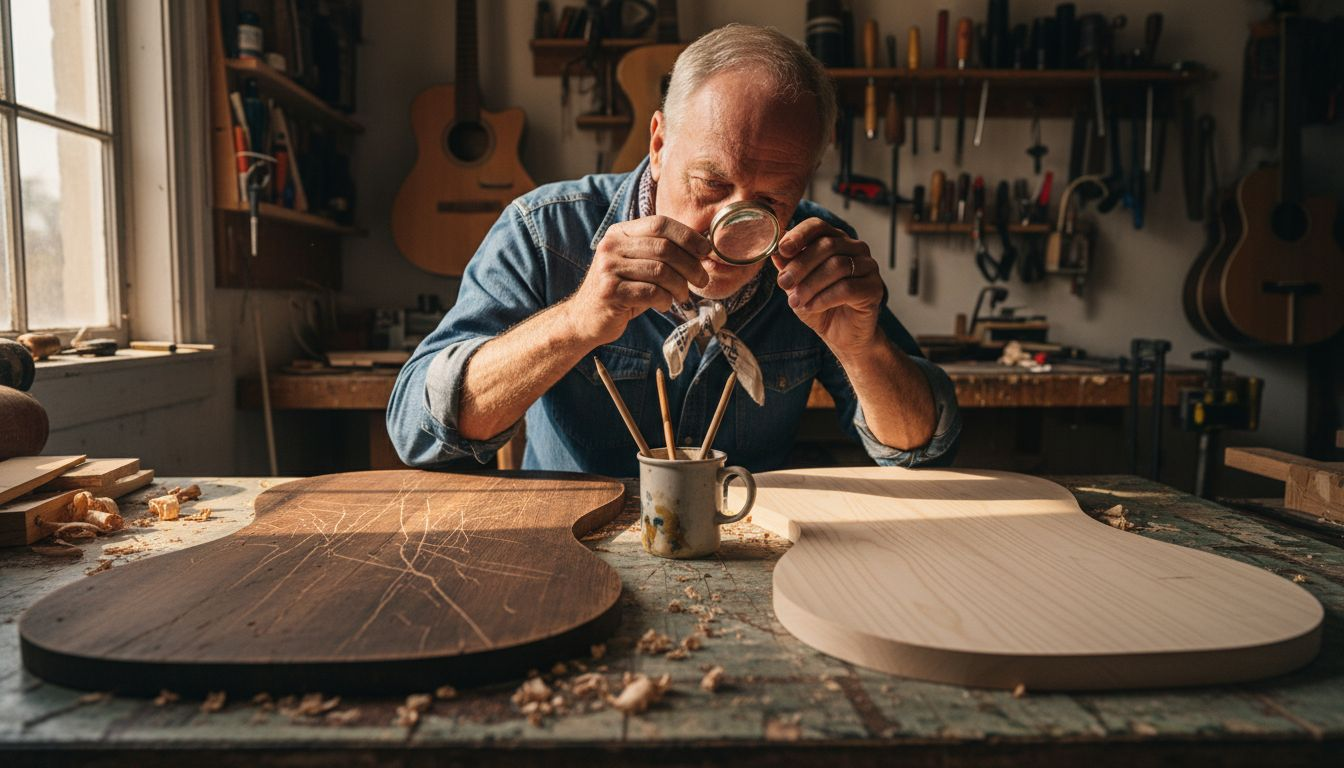
Hardwoods used in the back, sides, and framing work differently. They contribute structural support while adding warmth and sustain characteristics. As these materials age, they also experience density shifts that alter how vibrations travel through the instrument.
How Moisture Loss Improves Resonance
Wood freshly cut contains significant moisture that gradually evaporates over time. This drying process directly affects the stiffness-to-weight ratio—the relationship between how rigid wood becomes and how heavy it remains.
As wood loses moisture:
- The material becomes lighter without losing structural integrity
- Vibrations travel more efficiently through the wood fibers
- The acoustic response becomes more pronounced and articulate
- Tonal character shifts toward greater clarity and definition
This is why vintage guitars often display superior brightness compared to new instruments made from similar wood species.
Structural Changes Under String Tension
Your guitar experiences constant stress. Strings pull with hundreds of pounds of force, causing the wood to compress and settle over time. This compression isn’t damage—it’s actually beneficial for tone development.
The neck gradually adjusts its relief. The top subtly changes shape. The overall structure becomes more stable and responsive to vibration. Think of it as the wood “learning” how to work with the applied forces.
For quick reference, see how wood aging impacts guitar tone and playability:
| Wood Aging Effect | Impact on Tone | Impact on Stability |
|---|---|---|
| Moisture loss | Greater clarity and resonance | Improved responsiveness |
| Compression under tension | Enhanced sustain | More balanced neck relief |
| Finish changes | Brighter, nuanced sound | Protects wood, controls aging |
This table summarizes how wood transformation influences vintage guitar quality.
Wood aging doesn’t just happen—it actively improves acoustic properties when combined with proper storage conditions.
The Role of Finish in the Process
Guitar finishes protect wood but also affect how aging occurs. Thicker lacquer finishes allow slower moisture evaporation, creating a gradual transformation. Thinner finishes permit faster changes.
Over time, finish materials become more brittle while the wood underneath continues evolving. This dynamic creates tonal shifts as the acoustic properties of both materials change independently.
Condition Matters as Much as Time
Not all old guitars have aged gracefully. Temperature swings, humidity fluctuations, and neglect can damage the aging process. A guitar stored in a climate-controlled environment sounds dramatically better than one subjected to garage temperature extremes.
Proper guitar care throughout a guitar’s life accelerates positive aging while preventing deterioration. The relationship between environment and wood chemistry determines whether age becomes an asset or liability.
The Tonal Sweet Spot
Most professionals agree vintage guitars reach their sonic peak around 30-50 years old. At this point, wood has stabilized without becoming brittle or overly dry. Beyond 70 years, some instruments begin showing diminishing returns as wood becomes too dense.
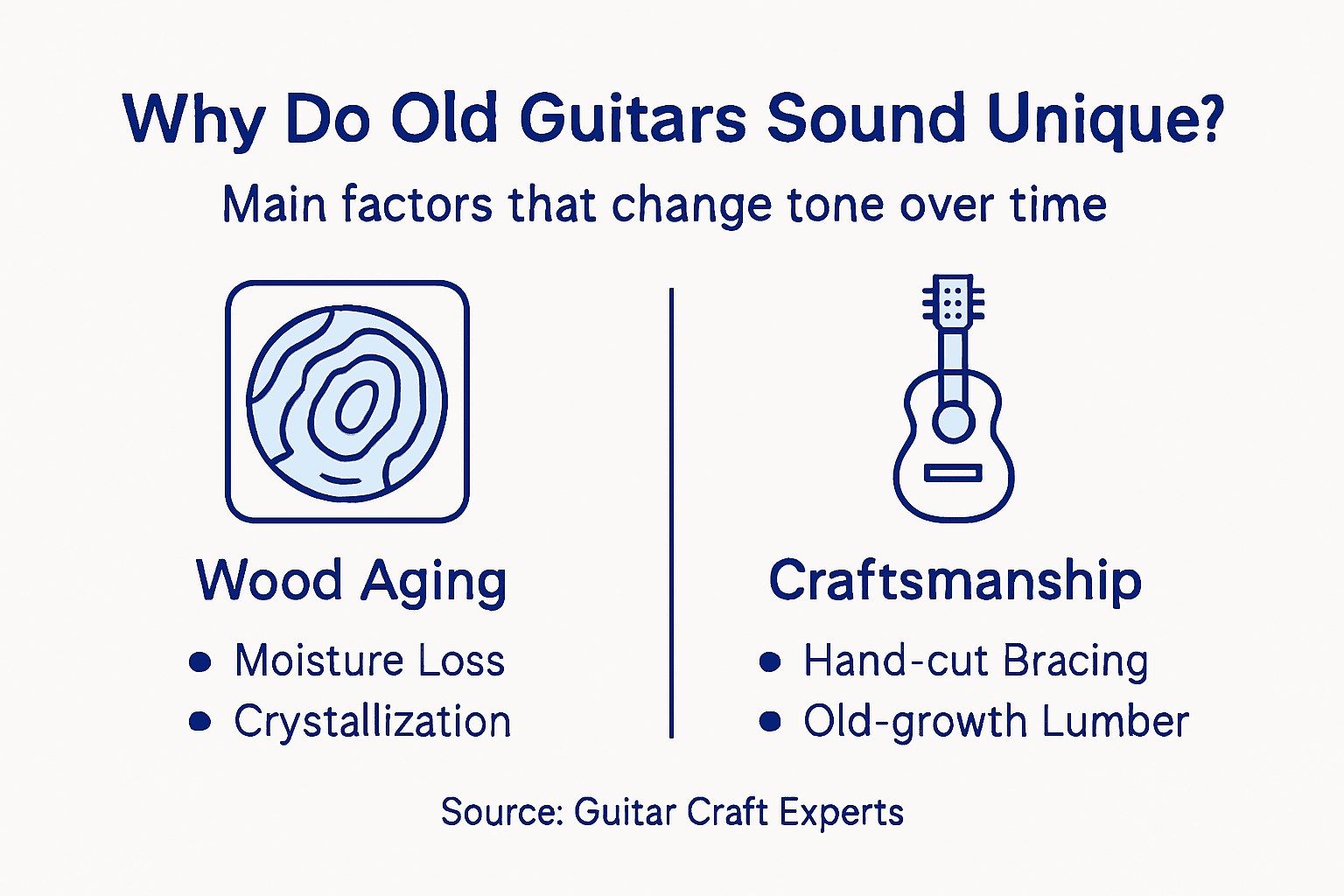
This explains why mid-century instruments often outperform both brand-new and extremely ancient guitars tonally.
Pro tip: Store your guitar in a stable environment (45-55% humidity, 65-75°F) to encourage positive aging; avoid extreme temperature swings that crack wood fibers and undo decades of beneficial transformation.
Craftsmanship And Materials In Vintage Guitars
The difference between a vintage guitar and a mass-produced modern instrument often comes down to how it was built and what materials went into its construction. Hand-crafted guitars from decades past showcase meticulous attention to detail that factories simply cannot replicate at scale. This craftsmanship directly translates to superior tone, playability, and durability.
Hand-Crafted Precision vs. Factory Production
Vintage guitars were built by skilled luthiers who treated each instrument as a unique creation. Traditional guitar construction involved hand-fitting every component, from the body joinery to the fretwork. Modern mass production prioritizes speed and consistency, which inherently compromises the customization that defines great instruments.
A vintage builder would spend weeks on a single guitar. Modern factories produce dozens daily. This fundamental difference shapes everything from how precisely the bracing fits to how evenly the frets are leveled.
Material Selection and Availability
Vintage manufacturers selected woods based on both availability and acoustic properties. Historic wood choices for guitar bodies reveal how builders adapted to supply constraints while achieving exceptional results. Ash, alder, and maple became iconic materials not just by accident but through deliberate sonic decisions.
Older suppliers often provided higher-grade lumber than what’s available today. Growth patterns in vintage wood stocks differ significantly from contemporary sources, affecting density and tonal characteristics.
Quality of Joinery and Assembly
Vintage guitars showcase meticulous joinery that modern production shortcuts. Hand-glued joints fit with precision tolerances that machines struggle to match consistently. This attention to fit affects how vibrations travel through the instrument.
Key construction differences include:
- Hand-carved braces fitted individually to each top
- Precise fret slots cut and dressed by experienced technicians
- Custom neck angles tailored to body dimensions
- Carefully fitted hardware with minimal gaps
These details accumulate into measurable tonal advantages.
Hardware and Components
Vintage guitars typically featured heavier, more robust hardware than modern budget alternatives. Tuning machines were machined from quality metals with smooth action. Bridge pins, saddles, and nuts received careful attention.
Modern manufacturing often substitutes lighter materials and simplified designs to reduce costs. Vintage builders understood that hardware quality directly affects sustain, tuning stability, and overall resonance.
Superior materials and meticulous assembly create instruments that improve with age rather than deteriorate.
The Tonal Signature of Craftsmanship
When you play a well-crafted vintage guitar, you’re experiencing the cumulative effect of hundreds of small decisions. Each choice—wood selection, brace placement, hardware quality, finish type—contributes to the final sound.
A poorly crafted new guitar won’t improve significantly with age. A well-built vintage instrument continues developing tonally for decades because its foundation is solid.
Why This Matters for Collectors
Understanding craftsmanship helps you identify genuinely superior instruments versus merely old ones. Types of vintage guitars reveal how different builders approached construction problems, each developing signature techniques.
Investment-grade vintage guitars share a common thread: they were built with expertise, quality materials, and time investment that modern production cannot economically replicate.
Pro tip: When evaluating a vintage guitar, examine the quality of internal bracing, hardware fit, and fret dressing before considering sound—these visible markers of craftsmanship predict long-term tonal development and playability far better than appearance alone.
Role Of Electronics And Hardware Changes
Electric guitars rely on electronics and hardware to convert string vibrations into amplified sound. Over decades, these components have evolved dramatically, creating fundamental differences between vintage and modern instruments. Understanding these changes reveals why a 1960s guitar sounds distinctly different from a contemporary model.
How Pickups Shape Vintage Tone
Pickup technology and design profoundly affects the character of your guitar’s sound. Early single-coil pickups had specific impedance characteristics that modern pickups rarely replicate. These vintage designs naturally compressed dynamics and added harmonic complexity that players sought for decades.
Humbucking pickups, introduced in the mid-1950s, offered noise reduction but changed tone fundamentally. The shift from single-coil to humbucking represented a major sonic departure that continues affecting how guitars sound today.
Electronic Components and Circuitry
Vintage guitars used different potentiometers, capacitors, and wiring configurations than modern instruments. These component choices directly impact tone shaping and responsiveness. A 250k potentiometer sounds warmer than a 500k version because it rolls off treble more aggressively.
Older capacitors deteriorated over time, which ironically created desirable tonal characteristics. Modern replacements restore pristine function but can eliminate the warmth collectors prize in vintage instruments.
Bridge and Tuning Hardware Evolution
Vintage bridges were typically simple, solid designs that transmitted vibrations efficiently. Modern bridges often feature elaborate systems that prioritize tuning stability over tonal transmission. This trade-off represents a fundamental shift in design philosophy.
Tuning machine quality also evolved:
- Early machines featured heavier, more inert components
- Modern machines prioritize precision and quick tuning
- Lighter materials reduce guitar weight but affect sustain
- Vintage machines created more stable, sustained notes
The Impact of Hardware Materials
Electric guitar hardware developments show how material science changed instrument construction. Vintage hardware used denser metals that added mass and complexity to the instrument. This weight distribution contributed to sustain and tonal depth.
Modern hardware prioritizes cost-effectiveness and weight reduction. Lighter tuning machines and bridges improve playability but diminish the physical resonance characteristics that define vintage tone.
Wiring and Signal Path Differences
Vintage guitars often featured simpler wiring schemes with fewer switching options. This simplicity meant less signal loss and more direct transmission from pickup to amplifier. Modern guitars add sophisticated switching and routing that provides flexibility but introduces impedance changes.
Older electronics generated natural compression and harmonic saturation. Modern components maintain cleaner signal transmission, which some players perceive as clinical or sterile compared to vintage warmth.
Electronics and hardware changes aren’t improvements—they’re trade-offs between different sonic priorities and manufacturing economics.
Reproduction vs. Original Components
Many vintage guitars have had electronics and hardware replaced over the years. Reproduction pickups attempt to recreate vintage characteristics but rarely match originals exactly. Rewiring with modern components fundamentally alters how the guitar responds.
Originally-wired vintage guitars with period-correct components maintain their distinctive character. This is why collectors seek unmodified instruments that preserve the original electronics.
Pro tip: Before replacing vintage electronics or hardware, understand that original components—even worn ones—contribute to the instrument’s signature tone; modern replacements prioritize functionality over the tonal characteristics that make vintage guitars special.
Comparing Vintage Guitars With Modern Counterparts
When you place a vintage guitar next to a modern equivalent, the differences become immediately apparent. Yet understanding what separates them requires looking beyond surface appearance. The gap between vintage and modern instruments reveals fundamental shifts in manufacturing philosophy, material sourcing, and design priorities.
Craftsmanship vs. Consistency
Vintage guitars represent individual creations built by skilled craftspeople who took weeks perfecting each instrument. Modern production prioritizes consistency and affordability, manufacturing dozens of guitars daily using standardized processes.
This difference shapes everything. A vintage luthier would adjust bracing based on the specific wood’s characteristics. Modern factories apply identical bracing patterns across hundreds of instruments, which improves predictability but eliminates customization.
Materials and Wood Quality
Vintage guitars frequently showcase superior craftsmanship due to their hand-built construction and aged wood sources. Modern manufacturers use younger growth timber and wood from different sources, which affects density and tonal character.
Key material differences include:
- Vintage wood came from old-growth forests with tighter grain patterns
- Modern wood sources utilize younger trees with larger growth rings
- Aging changes wood characteristics that new material cannot replicate
- Finish types evolved, affecting how wood matures over time
The Cost of Consistency
Modern production emphasizes consistency through technology and standardization. Every guitar leaves the factory with identical specifications and predictable performance. This reliability benefits beginners and ensures quality control.
However, this standardization eliminates the variation that makes vintage instruments unique. Each vintage guitar has subtle character differences that modern factories specifically engineered out of their process.
Here’s a concise comparison of vintage and modern guitars:
| Aspect | Vintage Guitars | Modern Guitars |
|---|---|---|
| Construction | Handcrafted, unique detailing | Factory-made, standardized specs |
| Materials | Old growth, dense woods | Young timber, varied sources |
| Electronics | Simple, period-specific wiring | Complex, flexible switching |
| Value Potential | Appreciates over time | Stable, rarely increases |
This table highlights key differences in craftsmanship and materials.
Tonal Character and Complexity
Vintage guitars typically produce warmer, more complex tones with natural compression. Modern guitars emphasize clarity and note definition, responding more linearly across the frequency spectrum.
This isn’t better or worse—it’s a fundamental choice. Vintage builders prioritized warmth and sustain. Modern manufacturers prioritize clarity and consistency.
Vintage and modern guitars aren’t competing standards—they represent different manufacturing philosophies and sonic priorities.
Hardware and Electronics Philosophy
Vintage hardware emphasized mass and durability, which affected sustain and resonance. Modern hardware prioritizes efficiency and cost reduction, utilizing lighter materials and simplified designs.
Pickups evolved similarly. Vintage pickups had specific impedance characteristics that created natural tone shaping. Modern pickups maintain cleaner signal transmission with less inherent coloration.
The Cost Factor
Vintage guitars command premium prices due to rarity and desirability. Modern guitars offer superior value for beginners because factories can produce them efficiently.
However, value and cost differ significantly. A budget modern guitar costs less but won’t improve tonally over decades. An investment-grade vintage guitar costs more but appreciates in value and develops richer tone with age.
Why Some Modern Guitars Try to Copy Vintage
Manufacturers recognize the appeal of vintage tone, so contemporary brands intentionally mimic vintage characteristics. They use aged wood, thicker finishes, and vintage-style components to recreate that warmth.
Yet replication remains imperfect. Authentic vintage character emerges from genuine aging, original materials, and historical construction methods—elements that modern production cannot fully recreate.
What Collectors Actually Value
Collectors seek vintage instruments for authenticity and historical significance alongside tonal merit. A guitar that belonged to a respected musician carries value beyond its sonic characteristics. This context matters enormously to serious collectors.
Modern guitars lack this historical dimension. No matter how excellent, a new instrument cannot offer the investment potential or historical narrative that vintage guitars provide.
Pro tip: When comparing vintage and modern guitars, test them through amplification—electronic characteristics often reveal differences that unplugged playing masks, helping you understand whether vintage warmth or modern clarity suits your specific playing style.
Discover the True Sound of Vintage Guitars with Expert Guidance
The unique tonal qualities of old guitars come from a complex blend of aged wood, meticulous craftsmanship, and period-specific hardware and electronics. Understanding these key factors can feel overwhelming if you are searching for an authentic vintage instrument that truly resonates with your playing style and collector’s goals. Common struggles include distinguishing genuine vintage craftsmanship from mass-produced replicas and finding well-maintained guitars whose tone has developed through decades of positive wood transformation.
At Vintage Guitar World, we specialize in offering handpicked, expertly evaluated guitars that embody the rich history and superior tonal character described in this article. Whether you seek classic acoustics, electric guitars with original electronics, or rare finds with immaculate craftsmanship, our curated collection helps you experience the aging process and build quality firsthand.

Explore our comprehensive range today and find the vintage guitar that not only sounds different but truly sounds better. Visit our shop to access detailed product descriptions, historical insights, and personalized advice. Don’t miss the chance to own a piece of musical heritage that improves with time.
Frequently Asked Questions
What makes old guitars sound different from new guitars?
Old guitars have unique tonal qualities due to the aging process of the wood, which loses moisture and changes density, enhancing the resonance and clarity of sound. Additionally, the craftsmanship and materials used in vintage guitars often differ significantly from factory-produced modern instruments.
Does age alone determine the sound quality of a guitar?
No, age alone does not guarantee superior sound quality. Factors such as craftsmanship, materials, construction techniques, and maintenance history play a crucial role in the tonal characteristics of both vintage and modern guitars.
Why do some vintage guitars sound better than their modern counterparts?
Vintage guitars typically use higher-quality materials and exhibit superior craftsmanship, resulting in a warmer and more complex tone. Aging also allows the wood to develop its acoustic properties, which can enhance sound quality over time.
How does the wood aging process affect the tone of a guitar?
The wood aging process affects a guitar’s tone by stabilizing moisture content and compressing wood fibers, which improves the stiffness-to-weight ratio. This leads to greater resonance and articulation, often making older guitars sound brighter and more nuanced than new ones.