




Yes, insure any guitar worth more than the standard carrier limit. Before you book a shipment, take three steps: photograph and briefly video the instrument from every angle, including the serial number, get a value document (invoice or appraisal) ready, and decide between a carrier’s ad valorem add-on or a specialist policy. Skip any of these, and a legitimate damage claim can still get denied.
TL;DR:
- Declaring an instrument’s actual value through ad valorem insurance is essential for vintage or high-value guitars, as standard carrier liability caps at around 500 euros.
- Proper packing, including double-boxing with a gap and photographic proof, significantly reduces claim denials caused by inadequate packaging.
- Specialist insurers offer faster payout and better coverage for used or vintage guitars when accompanied by documented market value or appraisal.
- Insurance premiums for guitars generally range from 0.75% to 1.25% of the declared value, with higher-value instruments often requiring formal appraisals.
- Filing a successful claim depends more on meeting packing standards and providing thorough documentation than on the insurance policy itself.
Table of Contents
- Versandversicherung Gitarre: How Carrier Liability and Declared Value Work
- Packing Standards Insurers Actually Expect
- Carrier Add-On vs. Specialist Insurer vs. Formal Appraisal
- What Shipping and Insurance Actually Cost
- Filing a Claim: The Order of Operations
- How Vintage Guitar World Approaches Packing and Appraisal
- Why Most Guitar Shipping Advice Gets the Priorities Backwards
- Get Your Guitar Appraised and Ready to Ship
- Sources
- FAQ
Versandversicherung Gitarre: How Carrier Liability and Declared Value Work
Every shipment already carries some coverage, but it’s thinner than most sellers assume. Carriers like DHL cap their standard liability at a modest figure, often cited around 500 € for a lost or damaged parcel, regardless of what the guitar inside is actually worth. That number comes from freight liability conventions (the CMR framework governing road transport in Europe), which caps compensation by weight, not by the item’s market value. A $2,000 archtop and a $50 beginner guitar get the same payout ceiling under basic coverage.
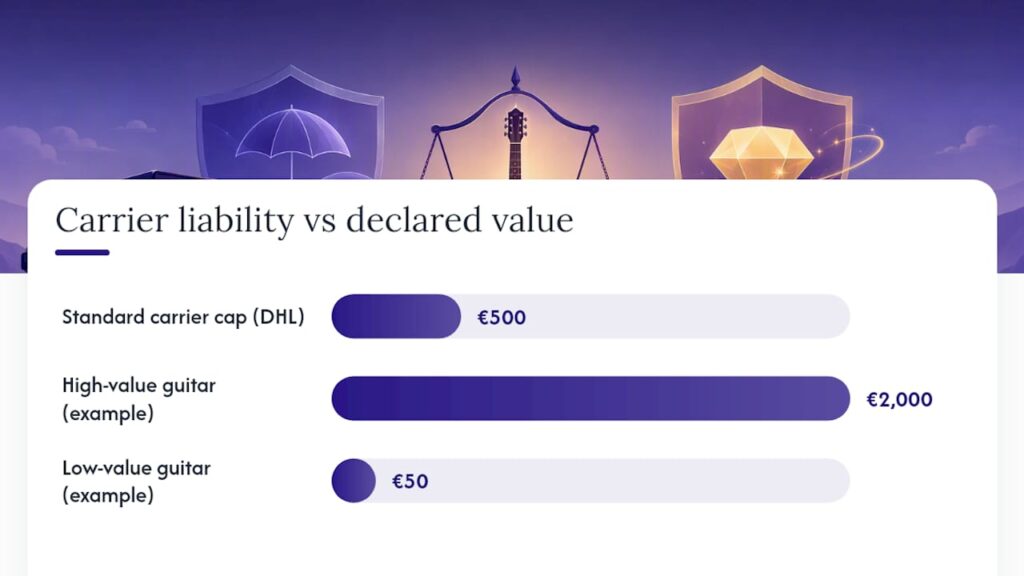
This is where “versandversicherung gitarre” (guitar shipping insurance) becomes a separate purchase, not a checkbox. Declaring a higher value, known as ad valorem insurance, lets you insure the instrument for what it’s actually worth. The premium scales with that declared figure rather than being a flat fee, which is why a vintage instrument costs more to insure than a factory-fresh import.
A few exclusions trip up sellers every year:
- Used, vintage, or “collector” instruments sometimes face extra scrutiny or exclusion clauses unless you can document market value.
- Claims involving inadequate packaging get denied outright, regardless of declared value.
- Cosmetic damage (finish checking, minor dings) is frequently excluded even when structural damage is covered.
Specialist insurers built for musical instruments, such as Claisy, explicitly underwrite used and refurbished gear when the seller can show documented value, which standard carrier add-ons often can’t match.
Packing Standards Insurers Actually Expect
Insurers don’t pay claims on good intentions. They pay when the packaging matches what their own guidelines describe, and that’s a specific, checkable standard, not a vague “pack it well.”
- Start with a hard case. A gig bag alone almost never satisfies an insurer’s packing requirement.
- Loosen the strings slightly to reduce neck tension during handling.
- Fit a neck collar or dense foam block to stop the headstock from snapping forward on impact.
- Wrap the cased guitar and immobilize any loose hardware (tuning pegs, pickup selectors) inside the case.
- Box the wrapped case, then box that box again, leaving roughly a 6 cm gap between the inner and outer boxes on every side.
- Fill every void with packing paper, air pillows, or foam. Nothing should shift when you shake the box gently.
This double-boxing approach with a defined clearance gap is the same method DHL’s own instrument shipping guidance recommends, and it’s echoed across specialist packing resources for a reason: the gap absorbs shock before it reaches the case.
Documentation matters just as much as the physical packing. Before you seal the box, take dated photos of the full instrument, close-ups of any existing wear, and a clear shot of the serial number. A short video walkthrough helps too. Keep a copy of the invoice or appraisal, and hold onto the original box and packing materials until the shipment arrives safely, since insurers sometimes ask for them if a claim is filed.
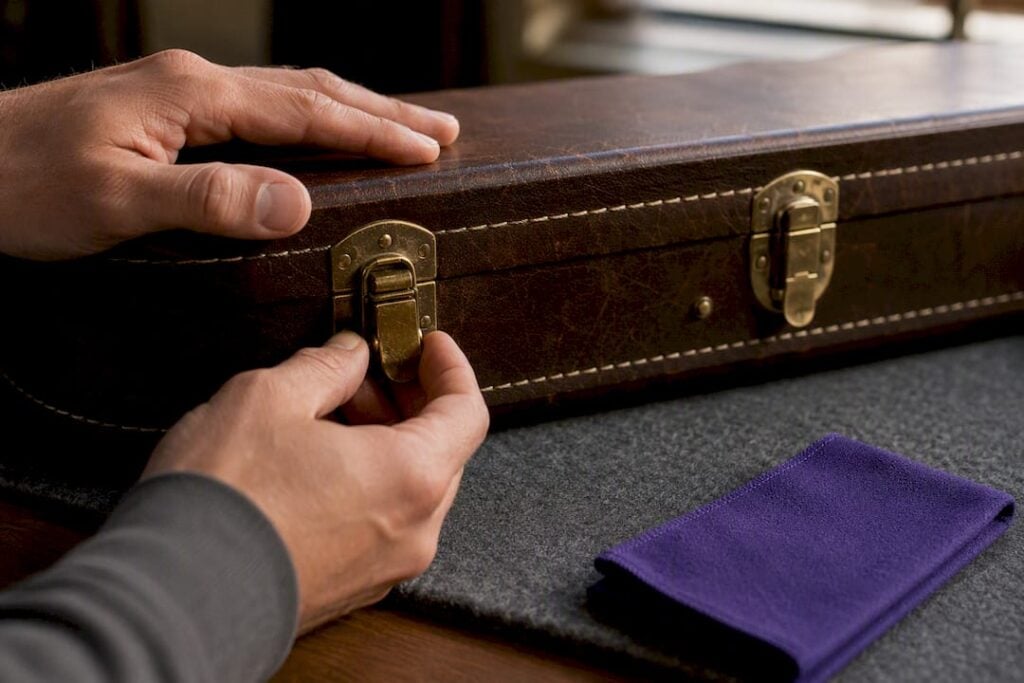
Pro Tip: Photograph the inside of the case lid and the case latches too. Insurers increasingly ask for proof the case itself was intact and closed properly before shipping, since a cracked latch is a common argument for denying a claim.
Industry estimates suggest 15% to 25% of instrument shipping claims get denied specifically because the packaging didn’t meet the required standard. That’s not a small margin of error. If you only take one thing from this section, take the double-box method with photographic proof it was followed.
Carrier Add-On vs. Specialist Insurer vs. Formal Appraisal
Not every shipment needs the same level of coverage, and picking the wrong route usually costs you time when a claim goes sideways.
- Carrier add-on insurance is the easiest to buy, since you tick a box at checkout. The tradeoff is a claims process that leans heavily on paperwork and can take weeks to resolve, and coverage limits that may not stretch to a genuinely valuable instrument.
- Specialist third-party insurers built around musical instruments, like the model Claisy offers, typically use ad valorem pricing and advertise faster payout windows. These providers are also more willing to insure used or vintage guitars when you supply proof of market value.
- Household or dedicated musical-instrument insurance can cover a guitar in transit, but for anything vintage or collectible, insurers usually require a formal appraisal before they’ll write a policy that reflects true value rather than a guessed replacement cost.
- Sellers who ship often (dealers, gigging musicians offloading gear regularly) benefit from negotiating rates with a specialist insurer rather than paying per-shipment carrier premiums every time.
The instrument’s value and condition should decide the route, not convenience alone. A $300 acoustic probably doesn’t need a formal appraisal. A 1962 Gibson does.
What Shipping and Insurance Actually Cost
Ad valorem premiums typically fall in a roughly 0.75% to 1.25% range of the declared value, though exact rates vary by provider and shipment volume. Treat these as planning ranges, not quotes.
By the numbers: On a guitar declared at $2,000, that works out to somewhere between $15 and $25 in insurance premium alone, on top of the base shipping cost.
Shipping cost itself depends on the box category. A standard parcel rate applies until the package crosses a size or weight threshold, after which it moves into “sperrgut” (oversized) or freight pricing, often carrying a real surcharge because a cased guitar in a double box frequently exceeds normal parcel dimensions.
Rough scenario planning:
- Low-value instrument ($200 to $500): standard parcel shipping plus a small ad valorem add, often under $10 in extra premium.
- Mid-value instrument ($1,000 to $3,000): oversized parcel or light freight pricing, with insurance premium landing in the $10 to $35 range depending on the declared figure.
- High-value or vintage instrument ($5,000+): freight-tier shipping, specialist insurance premium scaled to declared value, and often an appraisal fee on top if you don’t already have a current valuation on file.
Budget for the appraisal separately if the instrument needs one. It’s a one-time cost that pays for itself the moment you have to prove value to an insurer.
Filing a Claim: The Order of Operations
The moment you spot damage, before you even open the case fully, photograph the outer box exactly as it arrived, including any crushed corners or torn tape. Note the delivery date and time. Don’t discard the boxes.
Then gather what the insurer will ask for:
- The original shipping receipt showing the declared value.
- Your ad valorem or insurance confirmation.
- Photos and video taken before shipping, plus new photos of the damage.
- An invoice or appraisal establishing the instrument’s value.
- The serial number, matched against your pre-shipping documentation.
Timing varies by provider. Standard carrier claims often stretch across several weeks of back-and-forth paperwork. Some specialist insurers advertise decisions within 48 to 72 hours when documentation is complete on submission, though that speed depends entirely on having everything ready up front.
Most denials trace back to the same three causes: packaging that didn’t meet the required standard, damage reported too late after delivery, or missing proof of the declared value. Avoid all three, and most legitimate claims go through without a fight.
How Vintage Guitar World Approaches Packing and Appraisal
Our own workflow for preparing an instrument for sale or shipment starts the same way every time: a testing appointment, followed by condition photographs and serial documentation, then professional packing built around the same double-box, neck-support principles carriers expect. You can walk through the full process in our step-by-step packing guide.
A formal appraisal is recommended whenever an instrument is vintage, has collector significance, or crosses a value threshold where “estimated worth” isn’t good enough for an insurer. This appraisal serves as documentation if a claim is filed and can help prevent disputes.
Why Most Guitar Shipping Advice Gets the Priorities Backwards
Most shipping guides treat insurance like the main event and packing like an afterthought. That’s backwards. Insurers don’t pay claims because you bought a policy. They pay because you can prove the instrument was packed to a recognized standard and that its value was documented before anything went wrong. The policy is just the mechanism; the proof is what actually gets you paid.
The conventional wisdom also underestimates how often “insured” shipments still get denied. A 15% to 25% claim rejection rate tied to packaging failures means a meaningful share of sellers who did buy insurance still lost money, simply because they skipped the neck collar or didn’t leave enough clearance in the outer box.
If you take one thing from this article, prioritize the packing and documentation step over shopping for the cheapest policy. A mediocre policy backed by excellent packing and proof of value pays out. An excellent policy backed by a gig bag and no photos often doesn’t. For vintage or high-value instruments specifically, get the appraisal before you ever get a quote, not after a claim gets questioned.
— Vintage
Get Your Guitar Appraised and Ready to Ship
A carrier’s basic coverage tops out around $500 in liability, but a genuinely valuable or vintage guitar needs proof of what it’s actually worth before an insurer will pay a claim on it. Vintage Guitar World’s certificates and value appraisals give you exactly that documentation, prepared by people who evaluate vintage and collector instruments daily, not a generic online estimator.

Additional services such as instrument restoration and commission sales are sometimes offered to assist with conditioning and sales processes. Each service produces the kind of paper trail (condition reports, documented market value, restoration records) that insurers ask for when a claim gets filed. If your guitar needs a valuation before its next shipment, book an appraisal through our main services page and get the documentation sorted before you ever tape a box shut.
Sources
- Musikinstrumentenversicherung: Leitfaden für Profis 2026 | Claisy
- How to ship a guitar and other instruments internationally
- Gitarre per DHL versenden: Kosten, Verpackung, Versicherung — inside-out-live
- Do Shipping Companies Insure Guitars? | Gear Aficionado
FAQ
What does it cost to ship a guitar?
Cost depends on the box’s size and weight category, since a double-boxed guitar often crosses into oversized or freight pricing rather than standard parcel rates. Add ad valorem insurance on top, typically in the 0.75% to 1.25% of declared value range, and appraisal fees if the instrument needs one.
Can you send a guitar through the regular postal system?
Yes, but a standard parcel service only covers the carrier’s basic liability limit, often around 500 €, unless you buy additional declared-value coverage. For anything worth more than that, upgrading coverage before shipping is the safer move.
How much does DHL charge to ship a guitar?
The exact rate depends on package dimensions and weight, since a cased guitar in a double box frequently qualifies as oversized freight rather than a standard parcel. Check current rates and packing requirements directly through DHL’s instrument shipping guidance before booking.
How should you pack a guitar for shipping?
Use a hard case, loosen the strings, and add neck support before closing the lid. Double box the case with roughly a 6 cm gap between the inner and outer box, filling every void so nothing shifts, following the same method DHL recommends for instrument transport.
Does Vintage Guitar World help with insured shipping documentation?
Yes. Vintage Guitar World provides value appraisals and certificates that serve as the proof-of-value documentation insurers request when a claim is filed. Current pricing for these services is available directly through the Vintage Guitar World site.