


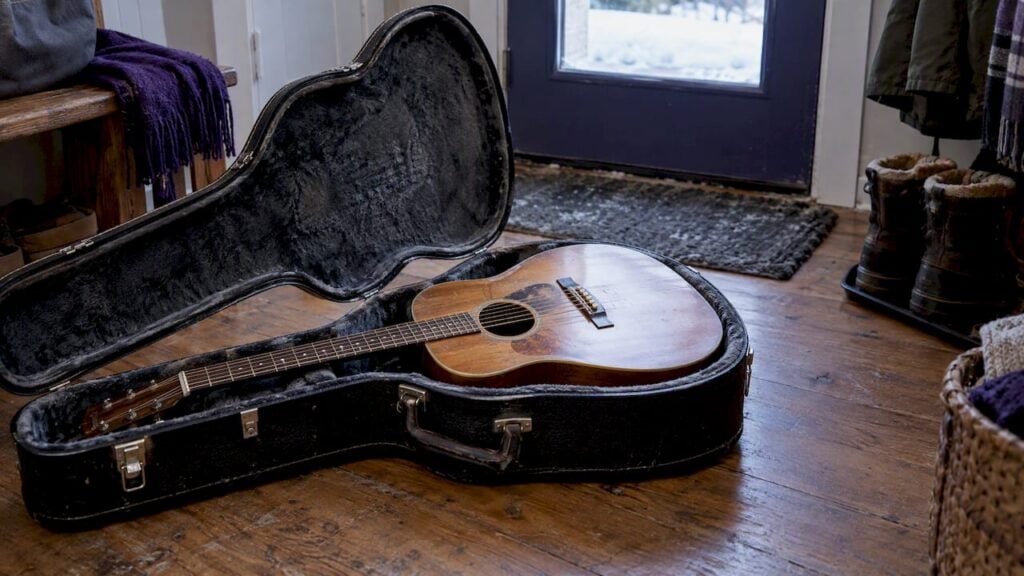

Keep your guitar’s humidity stable and warm it up slowly. Put a hygrometer in the case, aim for 40–55% relative humidity (RH), and add a humidity pack if the reading drops below that. When you bring a cold case inside, leave it closed and wait before you open it, because rushing is how condensation forms.
TL;DR:
- For stored equipment, aim for 40–55% RH; readings up to about 60% are acceptable, while chronic levels above 65% are risky.
- Keep the case off the floor and away from exterior walls, windows, and heaters, and avoid airtight plastic that can trap moisture against the finish.
- Use passive packs for low humidity and check sponge humidifiers during dry spells; never place a wet sponge on wood or a humidifier beneath strings.
- After warming, open the case only when its hygrometer reading is steady, then wait longer before playing; electric guitars need extra time before plugging in.
- A vintage guitar with finish checking, separating glue, or a growing crack needs specialist attention; for long term storage, reduce string tension only slightly.
Table of Contents
- 1. Why winter weather puts case-stored guitars at risk
- 2. Which temperature and humidity targets should you follow?
- 3. How to store a guitar in its case this winter: a checklist
- 4. What should you do when you bring a cold guitar indoors?
- 5. Which humidity-control options work best in a case?
- 6. A collector’s view on preserving a guitar through winter
- 7. Need a second opinion on a winter-stressed guitar?
- FAQ
- Sources
1. Why winter weather puts case-stored guitars at risk
Winter hits a guitar from two sides: cold air outside and dry heated air inside. The real danger is the moment of transition. When a cold instrument meets warm, humid air, moisture condenses on its surface, the same way a cold glass sweats on a summer day. The temperature at which that happens is called the dew point.
Condensation is the main short-term risk when cold surfaces meet warm, humid air, and metal parts react first. Wood and glue follow, and the damage is often gradual and invisible at first.
Typical trouble spots:
- A guitar left in a cold car overnight, then carried into a warm house
- A case stored in a cold basement, then moved to a heated living room
- A case resting against an exterior wall or window that gets cold at night
- Heated rooms where the air turns far drier than it was outdoors
2. Which temperature and humidity targets should you follow?
Think of humidity as the number to watch and temperature as the thing to keep steady. Aim for a room that stays comfortable without big swings, rather than one that cycles between a chilly night and a blasting heater.
For stored equipment, a good target is 40–55% RH, still acceptable up to about 60%, and chronically risky above 65%, according to StageAID’s storage guide. For guitars, we stay within the 40–55% target for stored equipment, which is the window we explain in our guide to optimal humidity for a guitar.
- Put a small hygrometer inside the case, since that reading reflects what the wood actually experiences.
- Keep a second one in the room to see how the room compares with the case.
- If the case reads low, add moisture. If it reads high, let the room air out before you adjust anything.
3. How to store a guitar in its case this winter: a checklist
Run through these steps whenever you put a guitar away for the cold months.
- Wipe down the instrument and make sure it is completely dry.
- Place a hygrometer in the case near the soundhole, without touching any wood.
- Add a passive humidity pack or an in-case humidifier if the reading is below your target.
- Store the case off the floor, away from exterior walls, windows and heat sources.
- Skip airtight plastic wrapping, which can trap moisture against the finish.
If the guitar has to ride in a vehicle, keep the trip short and park in the shade. A car is a poor storage place because its temperature swings fast. For longer moves, a shipping service for musical instruments can help you plan safe transport, and our general guide on how to care for, protect and store your guitar covers the basics.
Pro Tip: For long-term storage only, ease string tension slightly, but never detune dramatically. For a vintage instrument, ask a specialist before changing anything.
4. What should you do when you bring a cold guitar indoors?
The reason to wait is simple: slow warming keeps the instrument and the surrounding air from crossing the dew point all at once. Cold-to-warm transitions are when condensation and rust form first, so patience is your best tool.
- Keep the case closed and set it in a room with a moderate temperature.
- The bigger the gap between outside and inside, the longer you wait. A mild chill needs less time than a deep freeze.
- Open the case only once the in-case hygrometer reads steady.
- Give it more time before you play.
- For an electric guitar, wait even longer before plugging in. Electronics and metal hardware condense first, and moisture near a live circuit is a bad mix.
Players in this community thread agree that a case protects well against cold air, and that trouble starts when the instrument moves between climates.
5. Which humidity-control options work best in a case?
Different tools solve different problems, so match the option to your situation.
- Passive humidity packs: Single-use or rechargeable packs suit low-maintenance corrections when RH drifts low.
- Sponge or wick humidifiers: These do more when the indoor air stays dry for weeks, but they need monitoring so you do not over-wet the case.
- Electronic monitors and controllers: Collectors who want precise numbers and alarms will like these.
- Silica or desiccant packs: They help when the case is too humid, but they can over-dry the interior if you leave them in too long.
Never set a wet sponge directly on the wood, and never cram a humidifier between the strings and the top. We cover the trade-offs in more detail in our piece on whether a guitar humidifier is useful.
Pro Tip: Change one thing at a time and check the hygrometer again. Stacking several fixes at once makes it hard to see what actually worked.
6. A collector’s view on preserving a guitar through winter
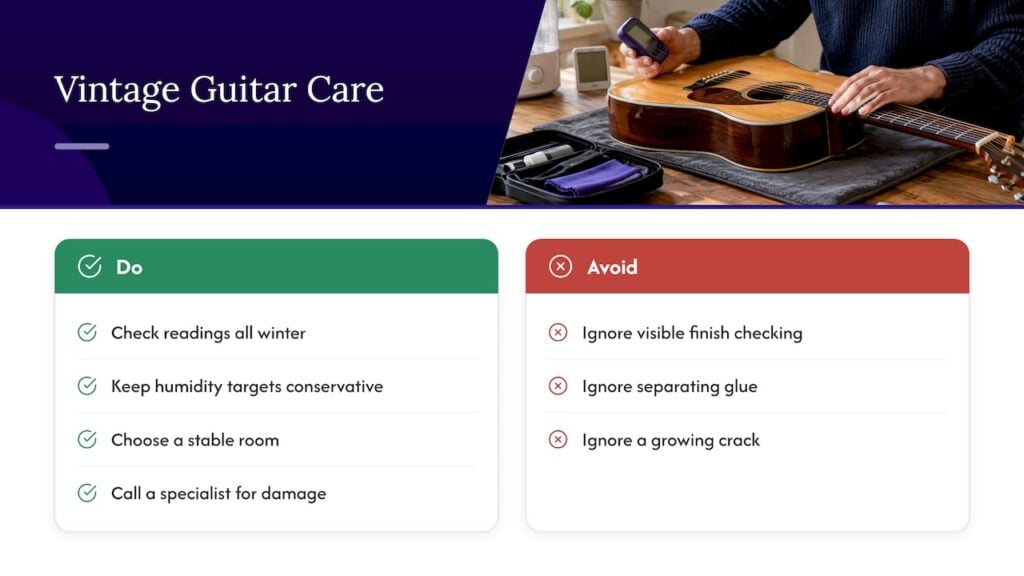
Most winter damage is slow, and that is exactly why it gets ignored. For vintage instruments, we keep humidity targets conservative and we check the readings all winter, not just when the heating comes on. Old finishes and hide glue are less forgiving than modern ones, and a stable room beats a clever gadget.
Know when to stop fixing things yourself. Visible finish checking, a glue line that is starting to separate, or a crack that grows all call for a specialist. We offer testing appointments, restoration and valuation, so you can get a clear read on a guitar before small problems turn into expensive ones. Our guide to storing vintage instruments for serious collectors goes deeper.
— Vintage
7. Need a second opinion on a winter-stressed guitar?
If a cold snap left your guitar with a lifted fret, a new crack or a cloudy finish, we can help. Our restoration service assesses the damage and repairs structural and finish problems. We also provide valuation and certification.

- Restoration for finish and structural issues
- Valuation and certification
- Testing appointments
Suspect damage? Contact us through our shop and ask for an inspection or a restoration quote.
FAQ
What humidity is best for a guitar in winter?
Aim for 40–55% RH inside the case. For stored equipment, up to roughly 60% is still acceptable, while readings above 65% are risky. A hygrometer in the case tells you where you stand.
How should you store a guitar in the best way?
Keep it in its case, off the floor and away from exterior walls, windows and heaters. Add a hygrometer and a humidity pack if the reading runs low. Our storage guide lays out the full routine.
Does a case protect a guitar from cold air?
Yes, a case buffers against cold air well, and players commonly report that the real trouble starts when the guitar moves between climates, as this forum discussion shows. Keep it closed and let it warm up slowly.
Can you bring a guitar on a plane?
Check your airline’s rules before you travel, since cabin policies differ. Whichever you choose, keep the guitar in a sturdy case and let it adjust slowly to the cabin or hotel room afterward.
Sources
- Equipment sicher lagern & transportieren – so geht’s | StageAID
- Hat kalte Luft negative Auswirkungen?