












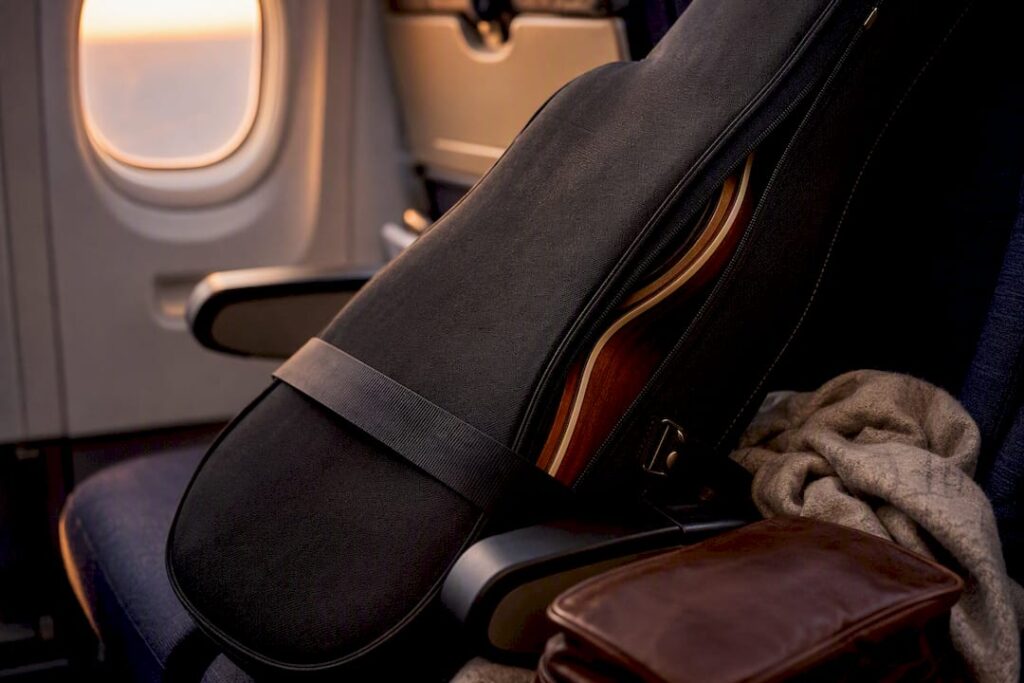

Yes, you can usually bring a guitar on a plane, but success depends on airline policy, guitar size, and how well you prepare. Try cabin carry-on first. If the gate agent says no, gate-check it as a fallback, or book an extra seat for maximum peace of mind. Whatever you do, never hand it over in a flimsy gig bag as regular checked baggage.
TL;DR:
- Airlines vary in policy, so confirming dimension limits, fees, and booking an extra seat at least 48 hours in advance is essential.
- A padded soft case offers better protection for cabin travel than a simple gig bag, but a hard case is necessary for checked baggage.
- Using a fragile gate-check tag reduces handling risks, and getting it in writing helps prevent disputes at the gate.
- Proper packing, including padding the headstock and removing loose accessories, minimizes damage during transit.
- Documentation such as appraisals, photos, and CITES paperwork for certain woods protect high-value instruments against loss or legal issues.
Table of Contents
- Gitarre Im Flugzeug: Carry-On, Gate-Check, or Extra Seat?
- What Size and Weight Limits Actually Apply?
- Which Guitar Case Actually Protects Your Instrument?
- Preflight Packing Checklist Before You Leave Home
- How to Work the Check-In Counter and the Gate
- Do You Need CITES Paperwork for International Flights?
- Insurance and What to Do If Your Guitar Is Damaged
- How Vintage Guitar World Supports Traveling Guitar Owners
- Recommendations for Choosing Airlines With Musician-Friendly Policies
- Best Practices for Transporting Electric Guitars With Electronics Onboard
- Tips for Preparing and Carrying Additional Guitar Accessories
- What the Research Actually Tells Us About Flying With a Guitar
- Sources
Gitarre Im Flugzeug: Carry-On, Gate-Check, or Extra Seat?
The transport method you choose changes everything about your guitar’s odds of arriving intact. There’s no single right answer here, because the best option depends on your specific instrument, your route, and how much risk you can stomach.
Carry-on is the lowest-risk path when it works. If your case fits in the overhead bin or a cabin closet and the airline allows it, this keeps your guitar under your own eyes the entire flight. British Airways explicitly permits large musical instruments in the cabin when they meet its size conditions, and other legacy carriers follow similar logic.
Gate-checking is the most common compromise for guitars that almost fit but not quite. Instead of going through the normal check-in counter, the instrument gets tagged at the gate and handled separately from the general baggage stream, often with less conveyor-belt abuse.
Buying an extra seat guarantees cabin space, but it only works if you confirm it in advance. This is the gold standard for irreplaceable instruments.
Checked baggage is the last resort. It works, but only inside a genuine flight-rated hard case, never a soft gig bag.
- Carry-on: lowest risk, requires airline approval and case that fits size limits
- Gate-check: practical middle ground, separates instrument from standard hold luggage
- Extra seat: highest security, needs advance booking and airline confirmation
- Checked in a hard case: necessary when cabin options fail, demands serious padding
What Size and Weight Limits Actually Apply?
Airlines rarely publish one universal rule. What they publish instead are linear dimension thresholds, meaning length plus width plus height added together, and this number matters more than any single measurement on its own.
Air Europa’s guidance lays out specific cabin allowances alongside a special-baggage process for anything larger, which is a fairly typical structure across major carriers. Finnair similarly lists allowed dimensions and weight ranges, and warns that anything beyond the free allowance triggers extra fees.
Before you book, do this:
- Check whether the airline’s policy uses the word “allowed” or “at crew discretion”. Discretionary language means you need a backup plan.
- Note the linear centimeter or inch threshold for cabin instruments, not just bag dimensions.
- If booking an extra seat, confirm it with the airline at least 48 hours before departure, a window British Airways specifically recommends.
- Screenshot any written confirmation or email approval. A verbal promise from a phone agent means nothing to the gate staff.
That screenshot habit sounds paranoid until the one time a gate agent claims no such exception exists.
Which Guitar Case Actually Protects Your Instrument?
Case choice depends entirely on how the guitar will travel, and picking the wrong one is the single most common mistake flying musicians make.
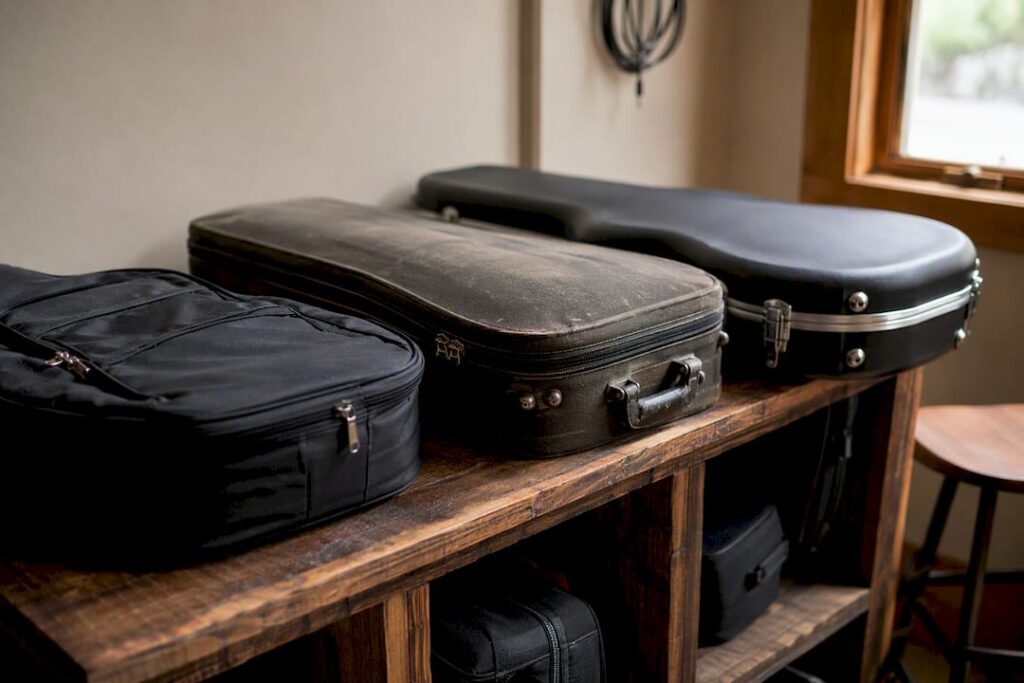
A soft gig bag is light and easy to sling over a shoulder, and it’s often accepted for cabin travel simply because it’s compact. But it offers minimal shock protection, so it’s a poor choice the moment your guitar has to touch a conveyor belt.
A soft-appearing padded case, the style favored by touring pros like those featured in Guitar World’s coverage, threads the needle nicely. It looks compact enough to pass as carry-on while packing serious internal padding, giving you protection closer to a hard case without the bulk.
A hard case or true flight case is mandatory for anything going into the hold. These offer the best shock resistance, though some airlines will refuse them as carry-on purely due to size.
- Gig bag: cabin friendly, weak protection
- Soft-appearing padded case: cabin friendly, strong protection
- Hard case: checked-baggage necessity, best shock resistance
- Flight case: heaviest option, reserved for high-value or touring instruments
Inside any case, support the headstock from below, eliminate loose rattling items, and drop in a humidipak or desiccant packet to buffer against sudden humidity swings in the cargo hold. Our guide to classic guitar cases walks through specific case models worth considering.
Pro Tip: A case that looks unassuming from the outside but is stuffed with foam on the inside gets less scrutiny at the gate than an obvious flight case, and it protects just as well.
Preflight Packing Checklist Before You Leave Home
Getting your guitar flight-ready takes about twenty minutes if you follow this order:
- Measure the case in centimeters and photograph it next to a tape measure, so you have proof if a gate agent disputes the size.
- Remove all detachable accessories, straps, and batteries from onboard electronics.
- Pad the headstock from below and add a thin layer across the face to prevent impact damage, a technique Acoustic Guitar’s repair experts specifically recommend.
- Decide on string tension. Most touring pros advise leaving strings at normal tension, since they add structural stability to the neck rather than the reverse.
- Slip your ID and contact info inside the case, plus valuation documents or receipts if the guitar is expensive.
- Hide a tracker like an AirTag in a padded pocket, not the obvious accessory compartment.
- Pack a small separate bag with essentials in case security asks you to open the case and remove items.
How to Work the Check-In Counter and the Gate
Arrive early enough that you’re not rushing your case through security. At check-in, show your measurements before anyone asks, and mention gate-check as your backup plan if cabin space isn’t guaranteed.
When you reach the gate, ask cabin crew directly whether closet space is available for a musical instrument. Being calm and cooperative works better than citing rulebooks, a pattern Guitar World’s touring-musician sources mention again and again.
If gate-check becomes necessary, ask specifically for a “fragile” tag rather than a standard hold tag. This flags the instrument for separate handling and typically means less time on a conveyor belt, a tactic Acoustic Guitar’s experts endorse.
- Show up early, present measurements unprompted, and offer gate-check as your fallback
- Ask crew politely for overhead or closet space rather than assuming it
- Request a “fragile” gate-check tag instead of standard hold tags
- If a supervisor promises an exception, get it in writing before boarding
Pro Tip: If an agent grants an exception verbally, ask them to note it in your booking record right there at the desk. That note travels with your reservation to the next agent you meet.
If you’re navigating unfamiliar airports on tour, general baggage handling guidance for travelers can help you anticipate how ground staff typically process oversized or fragile items.
Do You Need CITES Paperwork for International Flights?
Certain tonewoods, particularly rosewood species and some historic ebony, fall under CITES protection, and crossing international borders with an instrument built from these materials can require documentation. Provenance paperwork and original receipts matter here, since customs officials may ask for proof of legal sourcing.
Check with the airline and the destination country’s customs authority before you travel, since requirements vary. Guitar World’s touring-musician coverage recommends preparing this paperwork well ahead of departure rather than at the airport.
- Identify whether your guitar’s woods (especially rosewood) are CITES-listed
- Request any needed export or import certificates from the relevant national authority before departure
- Keep documents accessible and declare the instrument proactively at customs
- Consult a specialist for high-value or uncertain-provenance instruments rather than guessing
Insurance and What to Do If Your Guitar Is Damaged
Standard home contents insurance often caps musical instrument coverage far below what a vintage or handcrafted guitar is worth, and it may exclude damage that happens in transit entirely. Dedicated musician’s instrument insurance is usually worth the premium for anything irreplaceable.
Concealed trackers, current photos, and a recent valuation all strengthen your position if something goes wrong. If damage happens, photograph it immediately at the airport, keep every baggage tag and boarding pass, and file an airline property claim before you leave the terminal. Contact your insurer the same day.
- Compare instrument-specific policies against your home insurer’s fine print for transit exclusions
- Photograph the guitar before and after every flight, especially on international routes
- File the airline claim on-site, not days later, since most carriers impose strict reporting windows
- Retain gate-check tags as physical proof of custody chain
Vintage-guitar-world’s appraisal and testing services can help establish a documented valuation before you fly, which becomes essential evidence if you ever need to file a claim.
How Vintage Guitar World Supports Traveling Guitar Owners
Vintage-guitar-world offers guitar appraisal, testing appointments, and guidance on secure transit for valuable instruments, services built specifically for owners who can’t treat their guitar like ordinary luggage.
A documented appraisal gives you a paper trail before departure, which matters enormously if an airline damages or loses an instrument. Our team evaluates condition, provenance, and market value, then issues certification that insurers and customs officials both recognize as credible. If you’re weighing whether an instrument should fly at all versus being professionally shipped, our vintage guitar shipping workflow guide walks through the safer alternative for irreplaceable pieces. Book a testing appointment before a big trip, and you’ll travel with documentation, not just hope.
Recommendations for Choosing Airlines With Musician-Friendly Policies
Not every airline treats guitars the same way, and this is worth researching before you book rather than after you’ve already committed to a route. Look for carriers with published, specific musical-instrument policies rather than vague baggage pages that lump instruments in with “sporting goods” or “fragile items.”
Delta’s instrument guidance is a useful benchmark because it spells out carry-on, checked, and purchased-seat options clearly, and it references ATA 300, an industry standard for flight-case durability. An airline that references a recognized case standard signals it has actually thought through instrument handling, rather than treating your guitar as an afterthought.
Legacy carriers with long-haul international routes tend to have more developed musical-instrument policies than budget carriers, largely because they carry more touring musicians. Before booking, search the airline’s own site for a dedicated “musical instruments” page rather than relying on general baggage rules. If you can’t find one, that absence itself tells you something: call customer service directly and get any promised accommodation in writing before you pay for the ticket.
Frequent flyer status can also tip decisions at the gate in your favor, since staff have more discretion to accommodate loyal customers. If you tour often, concentrating your bookings with one or two carriers that have proven track records with instruments beats chasing the cheapest fare every time.
Best Practices for Transporting Electric Guitars With Electronics Onboard
Electric guitars bring a few extra wrinkles that acoustic players don’t deal with. Pickups, active electronics, and onboard preamps are generally fine for air travel, but batteries need attention before you pack.
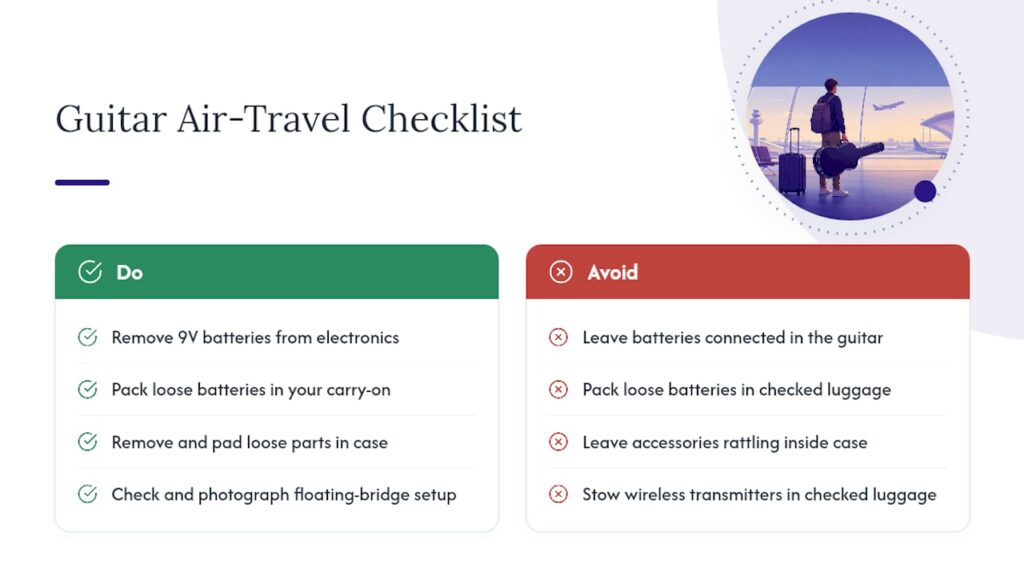
Remove 9-volt batteries from any active pickup system before your flight. A battery left connected can drain during transit, and in rare cases, a shorted connection inside a sealed case creates a genuine fire risk that security screening takes seriously. Loose batteries should travel in your carry-on bag, not inside checked luggage, per most airline hazardous-materials policies.
Detach removable knobs, whammy bars, and any accessory that rattles loose inside the case cavity. A tremolo arm bouncing around during turbulence or rough handling can scratch the finish or crack the body over a long flight. If your case has a dedicated accessory compartment, use it; if not, wrap the parts separately in a soft cloth.
Locking tuners and floating bridges deserve a quick check before departure too. A floating bridge especially can shift out of position under pressure changes and rough handling, so photograph the setup beforehand so you know exactly how to restore it if it moves. Cable inputs should be left unplugged, and any wireless transmitter units should travel separately in your carry-on, both to protect delicate connectors and to keep small electronics away from checked baggage handling.
Tips for Preparing and Carrying Additional Guitar Accessories
Guitarists rarely travel with just the instrument. Pedals, stands, straps, and cables all need their own packing strategy, and cramming them into the guitar case is usually a mistake.
Pack pedals in a small padded pedal case or wrap each one individually in a cloth pouch before placing them in checked luggage. Analog pedals with tube components are more fragile than digital ones and deserve extra padding. If you’re checking a pedalboard, disconnect all patch cables first, since a hard landing can bend input jacks when cables are still attached under tension.
Guitar stands rarely survive a flight intact if checked loose. Fold-up tripod stands pack down small enough for a suitcase, but rigid A-frame stands are better shipped separately or left at home for a short trip. If a stand must fly, wrap the folding joints in bubble wrap since those hinges take the brunt of impact damage.
Keep cables coiled and secured with velcro ties rather than loose in a bag, where they tangle and put strain on connector ends. A small hard-shell accessory case, the kind used for camera gear, works well for tuners, capos, and slides, and it’s compact enough to slide into a carry-on backpack alongside your guitar case. Anything battery-powered, including wireless pedal units, should stay in carry-on for the same reasons as your guitar’s onboard electronics.
What the Research Actually Tells Us About Flying With a Guitar
The conventional wisdom around flying with instruments tends to focus on the wrong thing: rules. Readers want to know the exact regulation that guarantees cabin space, and the honest answer is that no such guarantee exists. What actually protects your guitar is preparation and behavior at the gate, not a citation from an airline’s terms and conditions.
The touring-musician tactics scattered through this guide, like requesting a fragile tag, keeping strings at tension, padding the headstock from below, matter more than memorizing dimension charts. Airlines publish policies, but staff on the ground make the calls that count.
For a high-value vintage or handcrafted instrument, insurance and documentation aren’t optional extras. They’re the difference between a stressful travel story and a five-figure loss with no recourse. Get an appraisal before you fly, not after something goes wrong. That single step does more for your instrument’s safety than any packing trick in this article.
— Vintage
Sources
- Musical instruments — British Airways
- Flying with your guitar: everything you need to know | Guitar World
- Ask the Expert: Flying with Your Guitar | Acoustic Guitar
- Musikinstrumente — Air Europa
- How much does it cost if I travel with my instrument? — Finnair