














TL;DR:
- Authenticity significantly boosts vintage guitar value, especially with verified serial numbers and original finishes.
- Scientific testing methods confirm authenticity beyond visual inspection, critical for high-value instruments.
- Rarity, original condition, and accurate documentation greatly influence a vintage guitar’s market worth.
That battered guitar in the corner of an estate sale could be a six-figure Gibson Les Paul or a convincing copy that costs you thousands. The stakes in vintage electric guitar collecting are genuinely high, and the difference between a life-changing find and an expensive mistake often comes down to knowing exactly what to look for. Authenticity increases value by up to 50 percent, which means skipping even one step in your evaluation process can leave serious money on the table. This checklist walks you through every critical identification point, from serial numbers to scientific finish analysis, so you can evaluate any vintage electric with confidence.
Table of Contents
- Core criteria for electric guitar identification
- Authenticity checks: Science-driven and visual inspection
- Condition, originality, and modifications: Understanding value impact
- Comparison summary: Identifying rare and high-value guitars
- What most collectors miss about vintage guitar authentication
- Take the next step: Expand your vintage guitar expertise
- Frequently asked questions
Key Takeaways
| Point | Details |
|---|---|
| Check originality | A guitar’s original finish and parts boost value and authenticity. |
| Use scientific tools | Spectrometry and documentation confirm authenticity beyond visual checks. |
| Assess condition accurately | Condition grading and verified repairs directly impact investment value. |
| Know rare models | Some models command far higher value thanks to rarity and production history. |
| Document everything | Keep detailed records and provenance for maximum resale confidence. |
Core criteria for electric guitar identification
Every solid identification starts with the same foundation: the serial number, brand logo, and manufacturing date. These three elements tell you where a guitar was made, when, and whether the numbers line up with known production records. On Fender guitars, the serial number moved locations several times across decades, appearing on the neck plate, headstock decal, or neckplate depending on the era. Gibson used ink stamps inside the body cavity through much of the 1950s and 1960s. Cross-reference any number you find against published factory records and model-specific databases before drawing conclusions.
Finish originality is one of the most misunderstood factors in guitar valuation. A guitar with its original lacquer intact, even if worn and checked, is far more valuable than one that looks pristine because it was refinished. Collectors and dealers call this “checking” or “crazing,” and it is actually a sign of age-appropriate authenticity. A refinished guitar, no matter how beautiful, signals that something was done to hide the original surface, and buyers will discount accordingly.
Hardware and electronics deserve the same scrutiny. Look for manufacturer markings on tuning machines, pickups, and potentiometers. Pots are especially useful because they carry date codes stamped directly on the casing, usually in a format that reveals the manufacturer and the week of production. If a 1959 Les Paul has pots dated to 1974, you know replacements were made at some point.
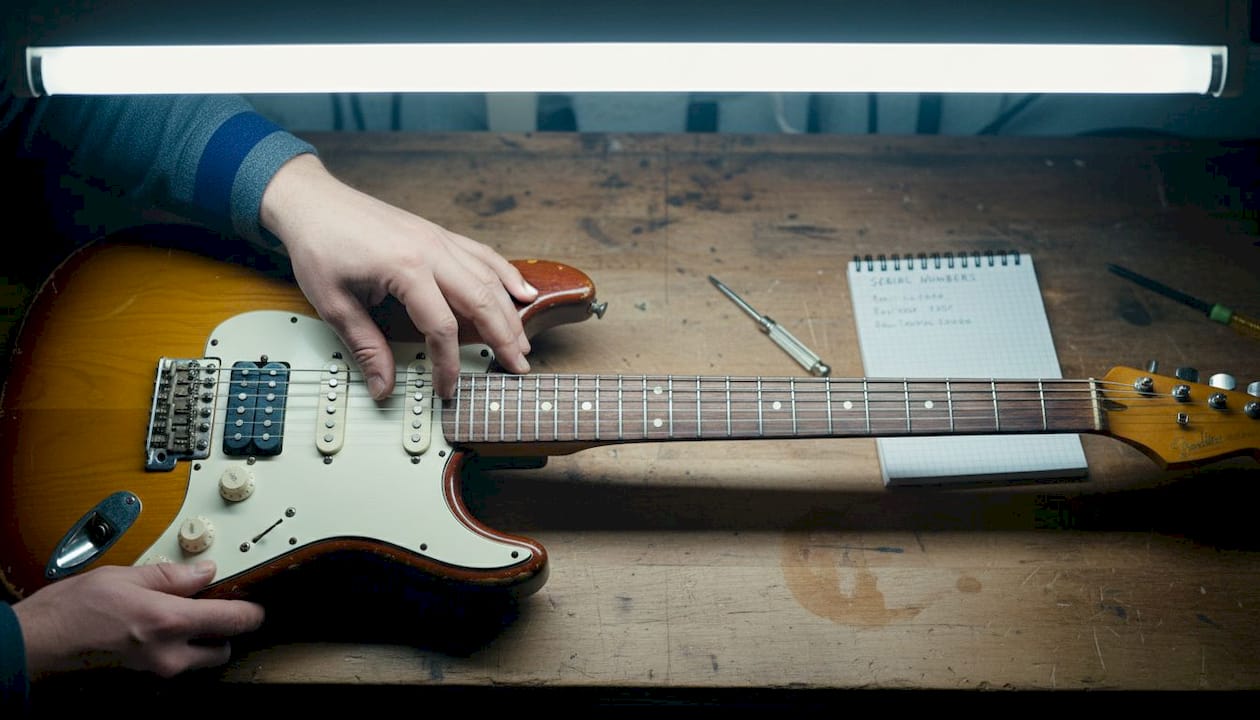
Rarity factors matter too. Certain model years and production runs are sought after far above others. A 1954 Fender Stratocaster or a 1958 Flying V carries a premium that a 1978 version of the same model simply does not. Production numbers, color options, and factory variations all feed into collectibility.
Finally, learn to distinguish genuine wear from artificially aged “relic” guitars. Real wear concentrates in logical places: the back of the neck, the forearm contour, the area around the input jack. Relic jobs often spread wear too evenly or place it in spots a player would never actually contact.
Pro Tip: Always bring a flashlight, a clip-on tuner, and a small portable amp to any field evaluation. Plug the guitar in and play every note on every fret. Use the flashlight to inspect the neck pocket, body cavities, and headstock back. Negotiate based on what you actually observe, not what the seller claims. Our vintage guitar buying checklist gives you a printable version of these steps to take with you.
- Verify serial number against known production records for that brand and year.
- Check finish originality for crazing, checking, and period-correct color.
- Inspect hardware markings and pot date codes for era consistency.
- Research production numbers to understand rarity and demand.
- Distinguish authentic wear patterns from artificial aging.
Authenticity checks: Science-driven and visual inspection
Having established the core criteria, the next step is to assess authenticity with both tried-and-true and cutting-edge methods. Traditional visual inspection is still the starting point. You are looking for color consistency under different lighting conditions, the texture of original lacquer versus modern polyester, and whether the grain pattern of the wood is consistent under the finish. These are skills that take years to develop, and even experienced collectors get fooled.
That is exactly why science is changing the game. Spectrometers now analyze vintage finishes and fret wire to fight counterfeits, identifying the specific chemical composition of nitrocellulose lacquer, pigments, and even the metal alloys used in hardware. This kind of analysis can confirm whether a finish is period-correct or whether a refinish was applied decades later.
The value impact of a refinish is dramatic. Refinishes can reduce a vintage guitar’s value by 50 to 90 percent depending on the model and the severity of the work. A 1960 Les Paul Standard in original finish might sell for hundreds of thousands of dollars. The same guitar refinished might fetch a fraction of that price. This is not a small detail.
Provenance documentation adds another layer of confidence. Original purchase receipts, photographs showing the guitar in earlier decades, and repair logs from known luthiers all build a paper trail that supports authenticity claims. Our provenance guide explains what to look for and how to verify documents you receive from a seller. You can also review our checking authenticity guide for a step-by-step breakdown of the visual inspection process.
Key benefits of combining both approaches:
- Visual inspection is fast, free, and catches obvious issues immediately.
- Scientific testing is definitive for high-value instruments where the stakes justify the cost.
- Provenance documents provide context that neither method alone can supply.
- Combining all three methods gives you the strongest possible case for or against authenticity.
“For high-value instruments, scientific authentication is definitive.”
The limitation of visual inspection alone is that it depends entirely on the evaluator’s experience. A skilled faker can fool even seasoned eyes. Science does not have that vulnerability.
Condition, originality, and modifications: Understanding value impact
Once the guitar’s authenticity is clear, collectors need to assess condition and originality, which are key to value. The vintage guitar market uses a standardized grading scale that most dealers and auction houses recognize. Understanding these grades helps you compare prices across listings and negotiate from an informed position.
| Grade | Description | Value impact |
|---|---|---|
| Mint | Unplayed, all original, no wear | Maximum value |
| Excellent | Light play wear, all original parts | 80-95% of mint |
| Very Good (VG) | Moderate wear, original parts intact | 60-80% of mint |
| Good | Heavy wear, some replaced parts | 40-60% of mint |
| Fair | Significant damage or modifications | 20-40% of mint |
| Poor | Major damage, heavy modifications | Below 20% of mint |
Mint originals are 30 to 50 percent more valuable than modified or refinished specimens, which makes the grading conversation essential before any purchase.
Not all replaced parts are equal. A replaced nut or a period-correct replacement tuner set is far less damaging to value than a replaced pickup or a routed body cavity. Some replacements are expected and accepted by the collector community. Others are deal-breakers.
Professional repairs, when done correctly, can preserve or even slightly improve playability without destroying value. A quality refret by a respected luthier typically costs between $200 and $400 and is generally accepted. What you want to avoid is irreversible work: new routing for different electronics, headstock breaks repaired with visible glue lines, or neck resets that leave evidence of structural compromise.
Key modifications that most damage value:
- New body routing for non-original pickup configurations.
- Headstock repairs with visible cracks or color mismatches.
- Replaced original pickups with non-period-correct units.
- Refinishing the body or neck.
Pro Tip: Keep a written record of every modification and repair, including who did the work, when, and what parts were used. This documentation becomes a selling asset when you move the guitar later. Our guides on evaluating used guitars and testing vintage quality walk you through how to document and assess these factors systematically.
Comparison summary: Identifying rare and high-value guitars
To tie these practical points together, a comparison helps clarify what makes certain electric guitars truly stand out. Not all vintage electrics are created equal, and understanding the specific markers that separate a common player from a collector-grade instrument is what separates informed buyers from everyone else.
| Model | Key years | Rarity factor | Value potential |
|---|---|---|---|
| Gibson Les Paul Standard | 1958-1960 | Very limited production | Six figures and above |
| Fender Stratocaster | 1954-1956 | Early production, pre-CBS | High to very high |
| Gibson Flying V | 1958-1959 | Extremely limited run | Very high |
| Fender Telecaster | 1950-1952 | First production models | High |
| Gibson ES-335 | 1958-1964 | Dot-neck variants | High |
1958 to 1960 Gibson Les Pauls and Flying Vs are especially prized due to limited production, and their values reflect that scarcity consistently at auction.
The three most collectible models and what makes them so desirable:
- 1958-1960 Gibson Les Paul Standard: The combination of a carved maple top, PAF humbuckers, and a short production window before the model was discontinued makes these guitars legendary. Original sunburst examples in excellent condition regularly exceed $300,000.
- 1958-1959 Gibson Flying V: Gibson produced fewer than 100 Flying Vs in 1958. That extreme rarity, combined with the futuristic design, makes surviving examples extraordinarily valuable regardless of condition.
- 1954-1956 Fender Stratocaster: The earliest Stratocasters feature a single-ply pickguard, soft V-shaped neck profile, and two-tone sunburst finish that later models dropped. These details are the markers collectors pay premiums to own.
Rarity premiums can push value up to 50 percent above comparable standard production models. When you find a potential example of any of these guitars, photograph everything before touching it, note every detail in writing, and consult our expert vintage guitar buying guide before making any offer.
What most collectors miss about vintage guitar authentication
Here is an uncomfortable truth: most collectors still rely primarily on their eyes and their gut, and the market for convincing fakes has never been more sophisticated. We have seen beautifully aged guitars that fooled experienced dealers for years before scientific testing revealed a modern refinish or non-original hardware.
The collector community has a deep culture of expertise and lore, and that knowledge is genuinely valuable. But it has a ceiling. Human eyes cannot detect chemical composition. They cannot confirm whether a finish was applied in 1959 or 1989. Traditional assessment and scientific methods contrast sharply, and only modern science delivers full certainty for valuable models.
The shift we encourage is treating scientific authentication not as an optional extra but as a standard step for any guitar above a certain price threshold. Think of it the way you would a building inspection before buying a house. You would not skip that step on a major purchase. The same logic applies here.
Gut feel still matters for the initial screen. It gets you to the right instruments faster. But before committing serious money, use the tools available. Our guide on testing guitar quality covers how to integrate these approaches into a single workflow that protects your investment.
Take the next step: Expand your vintage guitar expertise
You now have the framework to evaluate vintage electrics with the same rigor that professional appraisers use. The next move is putting it into practice with the right resources behind you.

At Vintage Guitar World, we have built a full ecosystem for serious collectors. Explore our guitar appraisal guide to understand how professional valuations work and what documentation you need. Browse our guide to vintage guitar types to deepen your knowledge of what makes each category special. When you are ready to buy or sell, the Vintage Guitar World marketplace connects you with curated, expert-evaluated instruments you can trust. Every listing comes with detailed provenance notes and condition assessments so you can shop with confidence.
Frequently asked questions
How do I tell if a vintage electric guitar is refinished?
Look for color inconsistencies under different lighting, masking lines near the binding, and overspray on hardware. Finish spectrometry can confirm originality definitively, and a refinish can reduce value by 50 to 90 percent.
What do provenance documents include for electric guitars?
Provenance documents typically include original purchase receipts, dated photographs, and repair logs from known luthiers. Strong provenance can add up to 50 percent to a vintage guitar’s market value.
Which electric guitar models are the most collectible?
The 1958 to 1960 Gibson Les Paul Standard and Flying V are among the most valuable due to extremely limited production runs and sustained collector demand worldwide.
Are modifications always bad for vintage electric guitars?
Reversible modifications like period-correct part swaps are generally more acceptable, but irreversible changes such as new routing or headstock repairs can significantly reduce value. Always document every modification for future buyers.