














TL;DR:
- Fan bracing is essential for classical guitars because it shapes tone and touch sensitivity while providing structural support. The traditional fan pattern distributes vibrations evenly, producing warm, responsive sounds tailored to nuanced playing techniques. Variations in bracing details allow luthiers to customize tonal character and responsiveness, influencing overall instrument performance.
Most guitarists think of bracing as the skeleton inside a guitar, something that keeps the top from collapsing under string tension. That structural role is real, but it only tells half the story. Why classical guitar bracing matters has everything to do with tone, touch sensitivity, and the voice a luthier coaxes out of a thin piece of spruce or cedar. The internal architecture of the soundboard is, in many ways, the instrument’s musical fingerprint. This guide breaks down exactly how bracing works, what the traditional fan pattern does that nothing else replicates, and how this knowledge makes you a sharper player, buyer, and listener.
Table of Contents
- The fundamentals of classical guitar bracing
- How fan bracing shapes classical guitar sound and responsiveness
- Crafting the fan braced soundboard: the luthier’s art and science
- Variations and modifications: nuanced bracing designs for tonal character
- Choosing a classical guitar with the right bracing for your playing style
- A skilled luthier’s perspective: why bracing goes beyond tradition
- Explore vintage guitars crafted with expert bracing techniques
- Frequently asked questions
Key Takeaways
| Point | Details |
|---|---|
| Bracing shapes sound | Bracing not only supports the guitar but controls how it vibrates, defining its tonal qualities. |
| Fan bracing benefits | Fan bracing offers warmth and responsiveness that suits classical fingerstyle playing perfectly. |
| Craftsmanship matters | The sequential gluing and carving of braces on a domed soundboard requires precise artisan skill. |
| Subtle tweaks enhance tone | Minor asymmetries and added struts allow luthiers to fine-tune sound without losing traditional character. |
| Informed guitar selection | Understanding bracing helps players choose guitars that best fit their tonal preferences and technique. |
The fundamentals of classical guitar bracing
Bracing is wooden struts glued to the underside of the soundboard to control how it vibrates and to support the tension loads imposed by the strings. That dual role is worth sitting with, because most people collapse it into just one function. A guitar top that is only structurally reinforced without any thought for vibrational control will ring like a plank. The bracing pattern is what turns a flat piece of wood into a tuned acoustic membrane.
Classical guitars use fan bracing, a system where thin wooden struts radiate outward from the lower bout like the spines of a fan. This design was standardized in the 19th century by Antonio de Torres, the Spanish luthier whose instruments became the template every classical maker since has referenced. Torres discovered that a lightly braced, responsively tuned top produced far more resonance under low-tension gut (and later nylon) strings than any heavier construction could.
Understanding how this differs from acoustic guitar bracing on steel-string instruments sharpens the picture immediately:
- Fan bracing distributes vibration laterally across a thin top, favoring warmth and tonal nuance
- X-bracing, used on most steel-string acoustics, crosses two primary struts beneath the soundhole to handle the higher tension of steel strings, which adds volume and attack but sacrifices some dynamic subtlety
- Classical tops are typically 2 to 2.5 mm thick versus 2.5 to 3 mm on steel-string guitars, because nylon strings exert far less pull
- The differences in guitar bracing between these two systems explain almost entirely why the two instrument families sound so unlike each other, even when played identically
Fan bracing is not just a design choice. It is the engine of classical guitar sound quality.
How fan bracing shapes classical guitar sound and responsiveness
Fan bracing produces warmer, bass-rich tones with roughly 10 to 20% less volume projection compared to X-bracing, but delivers noticeably greater responsiveness to light finger touch. That tradeoff is the entire point. Classical technique relies on gradations of pressure, angle, and nail contact that produce enormous tonal variation. A guitar bracing design that rewards subtlety is not a limitation. It is a prerequisite.
“The guitar’s bracing is not just structural engineering. It is the luthier’s voice written into wood, deciding how much energy the top gives back to each note you play.”
Consider what happens during a rest stroke (apoyando) versus a free stroke (tirando). Both techniques produce different attack profiles, and a fan-braced top with the correct stiffness-to-mass ratio makes that difference audible even in the back of a concert hall. A heavier-braced top would blur those distinctions.
The tonal character fan bracing creates comes from several interacting factors:
- Balanced bass response from struts angled toward the lower bass bout
- Clarity in the treble register because the upper bout area sees less bracing mass, allowing faster decay on higher strings
- Sustain without muddiness because the struts are individually shaped (scalloped) to reduce mass while keeping stiffness where the top needs it most
- Touch sensitivity that responds to fingernail angle and flesh contact in ways steel-string guitars simply cannot match
This is also why Spanish guitars made in the traditional Andalusian tradition carry such a distinctive warmth. The fan bracing used by makers in Almería and Granada was refined over generations for exactly this tonal profile.
Crafting the fan braced soundboard: the luthier’s art and science

Knowing that bracing patterns feature 5 to 9 fan struts glued sequentially onto a domed soundboard mounted on a solera, with each brace carved individually after gluing, gives you a working picture of the process. But the nuance is in what that sequence demands from the maker.
Here is how the process unfolds in a traditional Spanish workshop:
- Preparing the solera: The solera is a flat or slightly domed workboard into which the soundboard is recessed. The dome it imparts (typically around 15 feet radius) gives the finished top a gentle arch that helps resist string pull and adds structural rigidity without adding mass.
- Thicknessing the top: The maker thins the soundboard to the target thickness by tapping it repeatedly, listening for the resonant frequency. This is not guesswork. Experienced luthiers describe recognizing the exact pitch change that signals the wood has reached its sweet spot.
- Laying out the fan struts: Positions are marked based on the maker’s template, which reflects the bracing philosophy of the tradition they follow. Torres-influenced layouts differ subtly from later Granada school variants.
- Sequential gluing and carving: Each brace is glued, clamped, and then carved before the next one goes down. This lets the maker feel how the top responds at each stage and adjust the height and profile of upcoming braces accordingly.
- Final tap tuning: Once all struts are placed, the maker flexes the top gently, listens to tap tones across multiple points, and decides whether any brace needs additional reduction.
The grain orientation of the brace wood (almost always quarter-sawn spruce or cedar) matters enormously. Quarter-sawn grain runs perpendicular to the top surface, maximizing stiffness-to-weight ratio. A brace with even slightly off-angle grain can behave unpredictably under string load.
Pro Tip: When examining any classical guitar, press lightly on the soundboard near the lower bout. A top that has too much give may have undersized braces, while one that feels rigid might be overbuilt and tonally unresponsive.
Variations and modifications: nuanced bracing designs for tonal character
Fan bracing is not a single fixed design. The number of struts, their angles, their asymmetry, and the addition of extra diagonal struts create nuanced tonal colors without sacrificing sustain. This flexibility is part of what makes classical guitar construction such a living craft rather than a static formula.
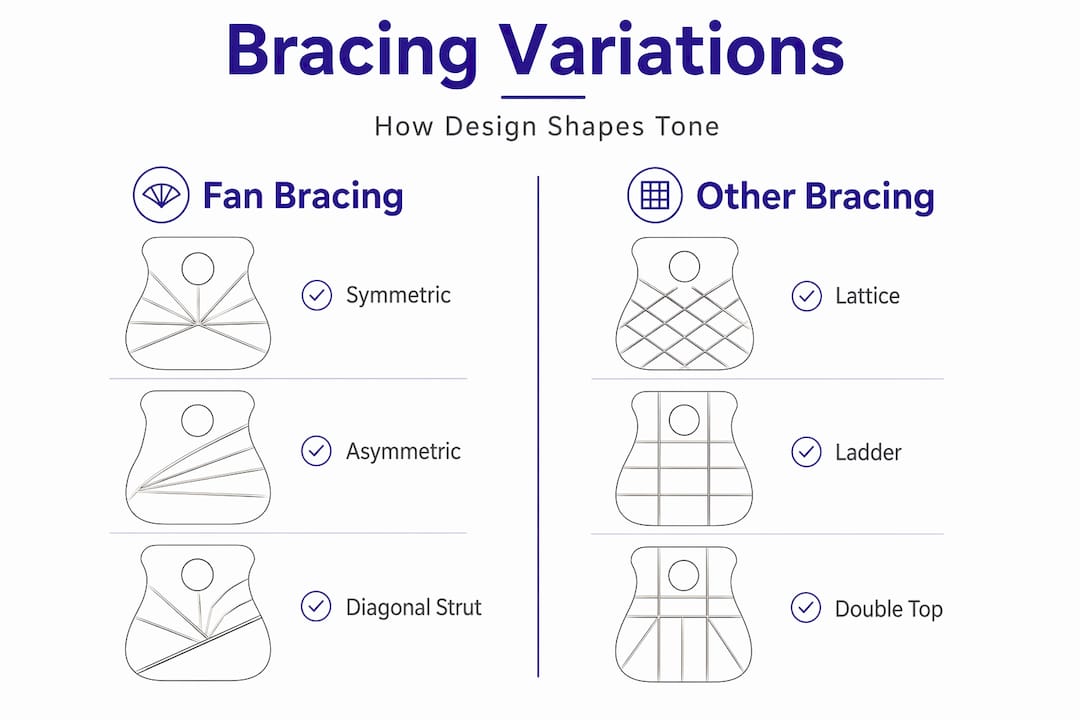
| Bracing variation | Typical strut count | Tonal character | Common usage |
|---|---|---|---|
| Symmetrical fan | 5 to 7 struts | Balanced warmth, even response | Entry to mid-range classical |
| Asymmetrical fan | 5 to 9 struts | Enhanced bass on treble side | Concert and luthier-grade instruments |
| Fan with diagonal struts | 7 to 9 plus diagonals | Increased sustain, richer midrange | Granada and Torres-style guitars |
| Lattice bracing (modern) | Carbon fiber lattice | High projection, bright attack | Contemporary concert guitars |
Asymmetrical designs place the bass-side fan struts at a slightly different angle than the treble side, compensating for the natural acoustic imbalance between wound and plain strings. This is a refinement that Spanish guitar makers in the 19th century developed by ear, long before any acoustic theory explained why it worked.
Diagonal struts, sometimes called harmonic bars or cross struts, are placed across the fan at strategic points to redirect vibration and add sustain without adding significant mass. Their placement above or below the main fan cluster changes how quickly the top reaches full resonance after each note.
Pro Tip: If you are comparing two classical guitars from the same maker at different price points, ask about the number and asymmetry of the fan struts. A hand-carved asymmetrical fan on a concert model is not a marketing detail. It is an audible difference that you will feel in the first arpeggio.
Choosing a classical guitar with the right bracing for your playing style
Fan bracing is responsive to light touch and produces warmer tones preferred in classical playing, but the specific bracing configuration should match what you actually do at the instrument. This is where the importance of guitar bracing becomes practical rather than theoretical.
| Playing style | Bracing to look for | Why it suits you |
|---|---|---|
| Fingerstyle, intimate repertoire | 5 to 7 fan struts, symmetrical | Maximum touch sensitivity and warmth |
| Concert performance, large halls | Asymmetrical fan or lattice | Better projection, tonal balance at volume |
| Flamenco-influenced playing | Lighter fan, often cedar top | Faster attack, pronounced percussion response |
| Early music and Baroque repertoire | Torres-style fan, spruce top | Historical authenticity, clear treble articulation |
When you are selecting a classical guitar, bracing is rarely visible without a mirror and a flashlight. But its effects are completely audible. Play single-note lines on the treble strings and listen for how quickly each note blooms and decays. Then play open bass strings and listen for definition versus boom. A well-braced guitar separates those two registers cleanly.
- Look for even tap tone response across the soundboard, especially in the lower bout
- Listen for sustain without unwanted overtones, which signals properly carved brace ends
- Check for bracing symmetry using a small mirror through the soundhole
- Ask about the wood species used for the braces, spruce and cedar being the most tonally proven choices
A skilled luthier’s perspective: why bracing goes beyond tradition
There is a belief, common among players new to classical guitar construction, that fan bracing is simply the way it has always been done, a tradition preserved more by inertia than by ongoing merit. That view underestimates the sophistication of what traditional fan bracing actually accomplishes.
Traditional fan bracing is carefully balanced to allow thinner tops for better resonance under low-tension nylon strings, using precise grain orientation to optimize both strength and tone. That last part deserves emphasis. A maker who skews the grain of a brace even slightly off the quarter-sawn ideal changes how energy moves through the top at the cellular level. This is not auditory mythology. It is why two guitars with identical plans built by makers of different skill levels can sound dramatically different.
The asymmetry point matters here too. Many buyers focus on the number of fan struts when they should be asking how each strut was shaped and where it was placed relative to the bridge. A seven-strut asymmetrical fan carved by a maker with 20 years of experience will outperform a nine-strut symmetrical fan from a factory production line because the carving shape of each brace controls how the top flexes, and that carving is where hand skill shows.
Torres’ bracing philosophy was grounded in the idea that the soundboard is the primary voice of the guitar, and every other component is in service to it. Modern luthiers who push tonal boundaries, whether through lattice systems or hybrid fan designs, are not departing from that philosophy. They are extending it. The tradition is not the pattern. It is the priority placed on top resonance above all else.
Where we see the most interesting work in classical guitar bracing today is in makers who treat asymmetry as a deliberate tonal tool rather than a historical quirk. Minor tweaks to the angle of a single strut can shift the guitar’s character from evenly balanced to slightly treble-forward or bass-warm. That is a level of tonal customization unavailable to any other construction variable.
Explore vintage guitars crafted with expert bracing techniques
If the mechanics of fan bracing have shifted how you hear a classical guitar, the next step is getting your hands on instruments where that craftsmanship is tangible.

At Vintage Guitar World, we specialize in curated instruments where the internal architecture is as important as the finish on the top. Whether you are drawn to vintage guitar types with historically significant bracing or to handcrafted guitars built by contemporary luthiers who carry the Torres tradition forward, our collection is evaluated with exactly this level of structural and tonal scrutiny. Every instrument we offer has been assessed for bracing quality, top responsiveness, and long-term playability. Explore our classical guitars for collectors and discover what a properly braced soundboard sounds like in your hands.
Frequently asked questions
Why is fan bracing preferred for classical guitars?
Fan bracing creates a warm, resonant tone with high responsiveness to light touch, which suits the dynamic nuance required in classical playing techniques. No other acoustic guitar bracing system delivers the same combination of warmth and touch sensitivity for nylon strings.
How does bracing affect the guitar’s sound projection?
Fan bracing results in 10 to 20% less volume than X-bracing but compensates with greater tonal richness and dynamic range at lower volumes. For intimate and ensemble settings, this tradeoff favors the classical player.
What is the role of the solera in classical guitar bracing?
The solera is a domed workboard that shapes the soundboard and provides the support surface for sequentially gluing and carving each fan brace. Its dome profile transfers directly to the finished top, giving it the structural curvature that resists string tension over decades.
Can minor bracing modifications change the guitar’s tone?
Yes. Asymmetry and diagonal struts can produce subtle but clearly audible shifts in tonal color, sustain, and attack character without departing from the core fan bracing system that defines classical guitar sound.