













TL;DR:
- The hardware in vintage guitars significantly influences sound, sustain, and value, with original parts being highly prized.
- Proper coupling, contact area, and hardware condition matter more for tone than the neck joint type alone, regardless of common beliefs.
Most collectors spend hours debating tonewood choices and neck joint types, yet the role of hardware in vintage guitars often gets treated as an afterthought. That’s a costly mistake. The bridges, tuners, nuts, saddles, and even the screws on a vintage instrument are not cosmetic details. They directly shape how vibrations travel through the body, how long notes sustain, and whether a guitar is worth $3,000 or $30,000. This guide breaks down every layer of that equation, from the physics of coupling stiffness to the practical reality of what a replaced bridge saddle does to resale value.
Table of Contents
- Key Takeaways
- The role of hardware in vintage guitars: what it actually covers
- How hardware physically affects vibration and sustain
- Hardware originality and its impact on vintage guitar value
- Neck joint types and hardware design compared
- Maintaining and restoring vintage guitar hardware responsibly
- My take on what most enthusiasts get wrong about hardware
- Explore vintage guitars and restoration at Vintage-guitar-world
- FAQ
Key Takeaways
| Point | Details |
|---|---|
| Hardware shapes sound physically | Coupling quality between hardware and wood determines vibration transfer and sustain more than joint type alone. |
| Originality drives collector value | Replaced tuners or bridges can reduce a vintage guitar’s value by 10% to 25% depending on the part. |
| Small parts matter as much as large ones | Mismatched screws, saddles, or nuts compromise authenticity and lower resale price for serious collectors. |
| Neck joint labels are misleading | A tight bolt-on neck with proper clamping can outperform a sloppy set-neck in both sustain and tone transfer. |
| Maintenance over replacement | Cleaning, lubricating, and preserving original hardware protects playability and long-term investment value. |
The role of hardware in vintage guitars: what it actually covers
When most people picture guitar hardware, they think of the bridge and maybe the tuning machines. The actual scope is much broader, and each component has a specific mechanical function that affects both sound and playability.
The major hardware components in a vintage guitar include:
- Tuning machines (tuners): Hold string tension and affect how vibration dissipates at the headstock. Vintage Kluson-style tuners behave differently than modern sealed-gear units.
- Bridge and saddles: The primary point of contact between the strings and the guitar body. Bridge mass, material, and contact surface area all influence sustain and tone character.
- Nut: Transfers vibration from the strings to the neck at the headstock end. Bone and ivory nuts found on pre-1970s guitars behave differently than synthetic replacements.
- Neck plate and screws (bolt-on models): Determines clamping force and coupling stiffness at the neck joint.
- Pickguard hardware, strap buttons, and control cavity plates: Less tonally significant but critical for dating and authenticating instruments.
The materials used in vintage hardware tell their own story. Pre-1970s builders used zinc alloy castings, nickel plating, and real bone for nuts and saddles. These materials age in ways that modern chrome-plated zinc or synthetic tusq simply do not replicate. Original nitro finishes, for example, develop a brittle shell over decades that affects resonance in ways a thick polyester finish never will. The same principle applies to metal hardware. Aged nickel develops a density and patina that is sonically and visually distinct from new production parts.
Unique guitar hardware examples that collectors prize include the original ABR-1 Tune-o-matic bridge on 1950s and early 1960s Les Pauls, the Kluson Deluxe tuners on vintage Stratocasters, and the adjustable saddle bridge designs found on archtop jazz guitars from the 1940s and 1950s. These are not just historical curiosities. They represent specific engineering choices that define how those guitars sound.

How hardware physically affects vibration and sustain
Here is where conventional wisdom breaks down. For decades, the guitar world operated on a simple assumption: glued necks sustain longer than bolt-on necks, and neck-through designs are the best of all. Mottola’s 2007 research challenged all of that directly. His experimental findings showed no measurable correlation between neck joint type and sustain duration once coupling stiffness was properly controlled for.
What actually matters is the physical quality of the connection between parts. Surface contact area and clamping force matter far more than whether a neck is glued or bolted. A well-routed bolt-on pocket with tight tolerances and maximum surface contact will transfer vibrations more efficiently than a loosely fitted set-neck with gaps in the joint.
The same logic applies to bridges. Fixed bridges transfer vibration to the guitar body more directly than floating tremolo units because there is no mechanical interruption in the vibration path. Blocking a tremolo restores a measurable amount of sustain without touching the neck joint at all. That single fact tells you everything about where to focus your attention when evaluating a vintage guitar’s hardware setup.
The hardware components most responsible for vibration transfer are:
- Bridge coupling to the guitar top or body: Contact area, screw tension, and material density all factor in.
- Nut seating and string slot depth: Shallow or poorly cut slots create false notes and kill sustain at the nut.
- Neck pocket flatness and screw tension: Even a 0.5mm gap in a bolt-on pocket is enough to scatter vibration energy.
- Tuner post mass and housing tightness: Heavy, loose tuners at the headstock absorb vibration instead of reflecting it back through the string.
Pro Tip: If you want to test hardware coupling on a bolt-on vintage guitar, gently tighten the neck screws a quarter turn and play a few notes before and after. A noticeable improvement in sustain and note bloom usually confirms that coupling, not the joint type, was the limiting factor.
Hardware originality and its impact on vintage guitar value
For collectors, the importance of guitar hardware is ultimately a financial question as much as a sonic one. Original hardware is one of the primary criteria used to authenticate and appraise a vintage instrument, and the numbers bear this out clearly.
According to collector valuation data, hardware replacement has quantifiable consequences:
- Replaced tuners reduce value by 10% to 20% depending on model, year, and whether original parts are included with the sale.
- Replaced bridge or saddles carry a 10% to 25% value reduction because the bridge is one of the most visible and sonically significant hardware elements.
- Replaced nut results in a modest but real value drop, especially on pre-CBS Fenders or pre-1970 Gibsons where bone nuts are period-correct.
- Mismatched screws or pickguard hardware may seem trivial, but these small components affect authenticity in the eyes of serious buyers who know what correct specs look like.
- Refinished or replaced knobs and control hardware signal that the guitar may have been modified more extensively, which raises red flags even if the core hardware is original.
The key to authentication is consistency. A collector evaluating a 1959 Les Paul is looking at whether the patina on the ABR-1 bridge matches the patina on the tailpiece, whether the screw heads show uniform aging, and whether the finish runs under the hardware or stops at the edges (which would indicate the hardware was removed at some point for a refin).
“Collectors prioritize original hardware not only for condition but as a tangible connection to a guitar’s provenance and vintage character that no replacement part can reproduce.” The Vintage Advantage
A reliable way to evaluate hardware authenticity is to look for consistent wear across all metal components. Fresh, bright saddles on a guitar with a heavily aged bridge plate suggest someone replaced the saddles. Paint in the neck pocket indicates the neck was removed after finishing, which is normal on some production models but suspicious on others. These details separate a correctly priced vintage guitar from an overpriced parts guitar.
Neck joint types and hardware design compared
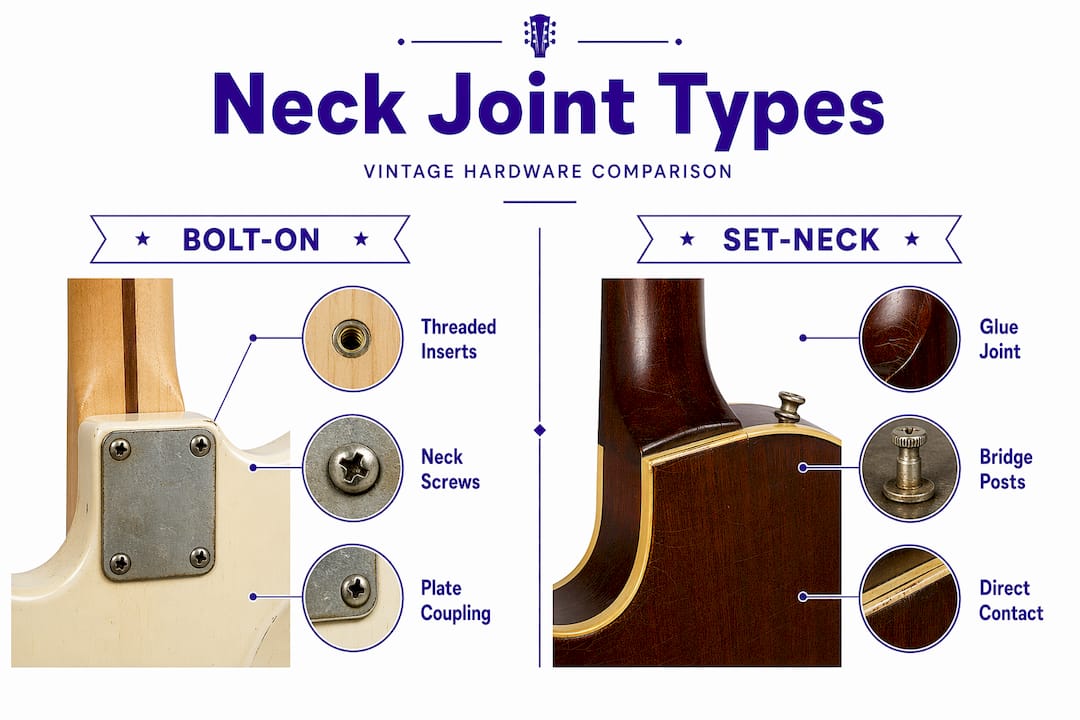
The neck joint debate is worth addressing head-on because it shapes how many collectors think about hardware, often in misleading ways. The three main types each involve different hardware approaches, and the real-world performance differences come down to execution, not category.
| Neck joint type | Hardware involved | Coupling quality factor | Tonal and playability implications |
|---|---|---|---|
| Bolt-on | Neck plate, 4 screws (or threaded inserts) | Pocket tolerance and screw clamping force | Bright, snappy attack; sustain equals set-neck when coupling is tight |
| Set-neck (glued) | Hide glue or epoxy, no external hardware | Surface area of glued joint, wood-to-wood contact | Warm midrange character; sustain depends on glue joint quality and fit |
| Neck-through | Continuous wood piece with wing body sections | Hardware only at bridge and string anchor points | Potentially highest sustain, but depends entirely on bridge coupling |
Threaded inserts in bolt-on necks significantly improve long-term clamping force and repeatability over traditional wood screws, which strip and lose tension over decades. This is a nuance that often gets lost in vintage discussions because purists resist modifications. But a vintage bolt-on with worn-out screw threads and a loose pocket is genuinely underperforming relative to its original spec, not just compared to a set-neck.
The practical takeaway is that surface flatness and proper mating between hardware and wood can create vibration pathways that rival glued joints in sustain and tone propagation. A well-maintained bolt-on vintage guitar with tight hardware often plays and resonates better than a set-neck instrument that has suffered from years of humidity damage and a loose tenon.
You can read more about how these neck joint designs evolved throughout the history of electric guitar manufacturing, which adds useful context when evaluating specific models.
Maintaining and restoring vintage guitar hardware responsibly
Knowing the role of guitar hardware is one thing. Knowing how to care for it without destroying value is another. These are the areas to check and the practices worth adopting.
Key inspection points for any vintage guitar:
- Tuner bushings and shaft tightness: Loose bushings rattle and degrade headstock coupling. Tighten with a proper bushing tool, not pliers.
- Bridge saddle slots and intonation screws: Check for rust, stripped threads, and saddle height consistency.
- Nut slot depth and material: Look for cracks in bone nuts. A cracked nut kills sustain and causes tuning instability at the first fret.
- Neck screws and plate condition: Check for stripped holes, missing screws, or a loose plate. These are direct coupling killers.
- Finish condition around hardware: Overspray or missing finish under a tuner plate tells a detailed story about the guitar’s repair history.
For cleaning vintage hardware, the safest approach is dry or very lightly damp cloths for aged nickel and chrome. Abrasive metal polishes remove the patina that collectors and appraisers factor into value. Rust on non-structural parts like tuner buttons can be addressed with a light application of a penetrating oil, but always test on an inconspicuous area first.
For lubrication, graphite or a purpose-made nut lubricant at the nut slots and bridge saddle contact points prevents binding and reduces tuning instability without affecting tone or finish. Avoid petroleum-based lubricants near plastic components.
If a guitar requires hardware restoration, the guiding principle should be reversibility. Any modification that cannot be undone without altering the original instrument is a threat to long-term value.
Pro Tip: Always retain original hardware even when replacing it for playability reasons. Store original tuners, bridges, and saddles in a labeled bag with the guitar. Buyers and appraisers will pay a premium for instruments sold with original parts included, even if those parts are not currently installed.
My take on what most enthusiasts get wrong about hardware
I’ve spent years evaluating, restoring, and advising on vintage instruments, and the single most persistent misconception I encounter is the idea that the neck joint label tells you most of what you need to know about a guitar’s sustain and tone. It simply does not. What I’ve found is that the condition and coupling quality of the hardware matter far more than whether a neck is bolted or glued.
A 1960s bolt-on guitar with pristine hardware, a tight neck pocket, and its original bridge will outplay a set-neck instrument from the same era that has suffered through decades of neglect, replaced parts, and a loose tenon. The label on the joint is almost irrelevant once you start looking at actual coupling quality.
What I’ve also learned is that collectors who focus obsessively on specific hardware brands, like treating a particular tuner brand as a magic tonal ingredient, are often missing the more productive question: how well does all the hardware on this specific guitar work together and mate with the wood? That interaction, not a brand name on a tuner plate, is what creates the character that makes a great vintage guitar different from an ordinary one.
My advice is to learn why old guitars sound better by studying the physical mechanics, not just the mythology. The hardware is your best diagnostic tool and your clearest window into what a vintage guitar has been through.
— Vintage
Explore vintage guitars and restoration at Vintage-guitar-world

At Vintage-guitar-world, every instrument in our catalog has been evaluated with exactly the kind of hardware scrutiny this guide describes. We check coupling quality, assess patina consistency, verify correct specs for the year and model, and document everything so you know precisely what you are buying. Whether you are looking to explore vintage guitar types and investment value or considering a professional restoration to bring a neglected instrument back to proper playing condition, our team has the expertise to guide your decision. If you are weighing a purchase and want to understand how hardware condition affects your options, our vintage vs. reissue buying guide walks through exactly that question with the specificity it deserves. Hardware is where the real story of a vintage guitar lives, and we help you read it correctly.
FAQ
Does hardware type affect vintage guitar sustain?
Yes, but the joint label matters less than coupling quality. Research confirms that bolt-on necks can match or exceed set-necks in sustain when coupling stiffness, surface contact, and clamping force are optimized.
How much does replaced hardware reduce a vintage guitar’s value?
Replaced bridges reduce value by 10% to 25%, and replaced tuners by 10% to 20%, according to collector valuation standards. Even small components like mismatched saddles and screws affect authenticity and price.
What are the most important hardware parts to inspect on a vintage guitar?
Focus on the bridge, tuners, nut, neck plate, and all screws. Check for consistent patina, correct period specs, absence of overspray under hardware, and tight mechanical fit across all contact points.
Can you upgrade vintage guitar hardware without losing value?
You can, provided you retain all original parts and ensure any modification is fully reversible. Storing original hardware with the guitar protects resale value even when upgraded components are installed for playability.
What makes vintage guitar hardware different from modern hardware?
Vintage hardware was made from different alloys, used different plating processes, and aged in ways modern production parts cannot replicate. Original materials like bone nuts and aged nickel plating contribute to the tonal character and provenance that collectors specifically seek.